




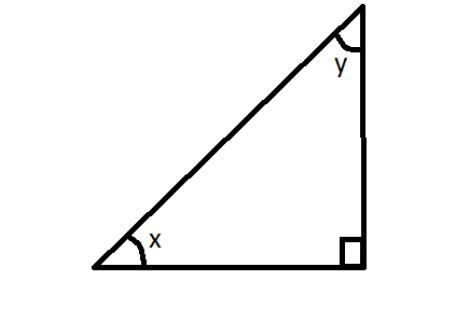
In the triangle above, the sine of $ x^\circ $ is 0.6. What is the cosine of $ y^\circ $ ?
Answer
 Verified
526.2k+ views
Hint: We know, sine and cosine are the ratios of side to the hypotenuse of a right angled triangle. So, to solve this problem, we have to find the sine of $ x^\circ $ that resembles the ratio of which side to the hypotenuse of the triangle. Then we will find the cosine of $ y^\circ $ resembles the ratio of which side to the hypotenuse. Then by using the value for sine of $ x^\circ $ as given, we can find the required value, that is cosine of $ y^\circ $ .
Complete step by step solution:
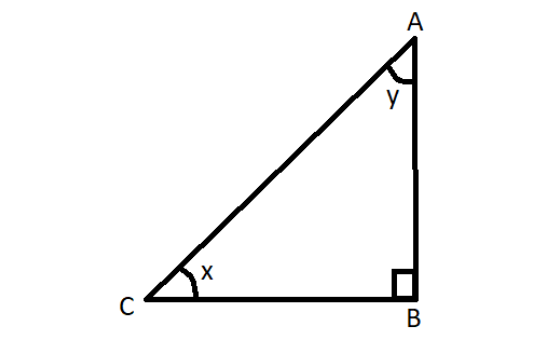
So, let us name the sides of the triangle as $ A,B,C $ , such that the right angle is at $ B $ .
The angle $ x^\circ $ is at $ C $ and the angle $ y^\circ $ is at $ A $ .
Now, we know, the sine of an angle is the ratio of the perpendicular to the hypotenuse in a right angled triangle.
Therefore, sine of $ x^\circ $ can be written as, $ \sin x = \dfrac{{AB}}{{AC}} = 0.6 $
Also, we know, cosine of an angle is the ratio of the base to the hypotenuse in a right angled triangle.
Therefore, we can write, cosine of $ y^\circ $ as, $ \cos y = \dfrac{{AB}}{{AC}} $
Therefore, it is clearly visible to us that, $ \sin x = \cos y = \dfrac{{AB}}{{AC}} $ .
So, we get a cosine of $ y^\circ $ as, $ \cos y = \dfrac{{AB}}{{AC}} = 0.6 $ .
So, the correct answer is “0.6”.
Note: We can also solve this problem in another way that is, if the sine of an angle is $ 0.6 = \dfrac{3}{5} $ , then the angle is $ 37^\circ $ , therefore, the other angle of the triangle other than right angle is clearly $ 53^\circ $ . Therefore, the cosine of $ 53^\circ $ is also $ 0.6 = \dfrac{3}{5} $ . The formulae of the trigonometric functions must be clearly understood before attempting such questions.
Complete step by step solution:
So, let us name the sides of the triangle as $ A,B,C $ , such that the right angle is at $ B $ .
The angle $ x^\circ $ is at $ C $ and the angle $ y^\circ $ is at $ A $ .
Now, we know, the sine of an angle is the ratio of the perpendicular to the hypotenuse in a right angled triangle.
Therefore, sine of $ x^\circ $ can be written as, $ \sin x = \dfrac{{AB}}{{AC}} = 0.6 $
Also, we know, cosine of an angle is the ratio of the base to the hypotenuse in a right angled triangle.
Therefore, we can write, cosine of $ y^\circ $ as, $ \cos y = \dfrac{{AB}}{{AC}} $
Therefore, it is clearly visible to us that, $ \sin x = \cos y = \dfrac{{AB}}{{AC}} $ .
So, we get a cosine of $ y^\circ $ as, $ \cos y = \dfrac{{AB}}{{AC}} = 0.6 $ .
So, the correct answer is “0.6”.
Note: We can also solve this problem in another way that is, if the sine of an angle is $ 0.6 = \dfrac{3}{5} $ , then the angle is $ 37^\circ $ , therefore, the other angle of the triangle other than right angle is clearly $ 53^\circ $ . Therefore, the cosine of $ 53^\circ $ is also $ 0.6 = \dfrac{3}{5} $ . The formulae of the trigonometric functions must be clearly understood before attempting such questions.
Recently Updated Pages
Master Class 11 English: Engaging Questions & Answers for Success

Master Class 11 Maths: Engaging Questions & Answers for Success
Class 11 Question and Answer - Your Ultimate Solutions Guide
Master Class 11 Biology: Engaging Questions & Answers for Success
Master Class 11 Physics: Engaging Questions & Answers for Success
Master Class 11 Accountancy: Engaging Questions & Answers for Success
Trending doubts
Differentiate between an exothermic and an endothermic class 11 chemistry CBSE
One Metric ton is equal to kg A 10000 B 1000 C 100 class 11 physics CBSE
Difference Between Prokaryotic Cells and Eukaryotic Cells
There are 720 permutations of the digits 1 2 3 4 5 class 11 maths CBSE
Draw a diagram of a plant cell and label at least eight class 11 biology CBSE
1 Quintal is equal to a 110 kg b 10 kg c 100kg d 1000 class 11 physics CBSE