




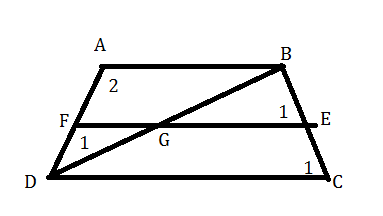
In the trapezium ABC, $\text{AB}\parallel \text{DA}$ and $\text{DC=2AB}$ .EF drawn parallel to AB cuts AD in F and BC in E such that $\dfrac{\text{BE}}{\text{EC}}=\dfrac{\text{3}}{4}$ . Diagonal DB intersects EF at G. Prove that, $7\text{FE=10AB}$ .
Answer
 Verified
618.9k+ views
Hint: In the given question we can solve the question by proving triangle DFG and triangle DAB are similar to each other and in the similar triangles ratio of corresponding sides are equal.
Complete step by step answer:
In triangle DFG and triangle DAB
$\angle DFG=\angle DAB$ $\left\{ \begin{align}
& \because FG||AB\, \\
& \therefore \angle DFG=\angle DAB\,\text{due}\,\text{to}\,\text{corresponding}\,\text{angle} \\
\end{align} \right\}$
$\angle ADB=\angle FDG$ $\left\{ \because \,Common\,Angle \right\}$
$\therefore \angle DGF=\angle DBA$
So By AA similarity we can say \[\Delta DFG\approx \Delta DAB\]
So we can say the ratio of corresponding sides is equal.
$\dfrac{DF}{DA}=\dfrac{FG}{AB}$ .......................................................(i)
As in trapezium $EF||AB||DC$
$\dfrac{AF}{DF}=\dfrac{BE}{EC}$
As given in question $\dfrac{BE}{EC}=\dfrac{3}{4}$
So we can write
$\dfrac{AF}{DF}=\dfrac{3}{4}$
On adding 1 in both side of equation
$\dfrac{AF}{DF}+1=\dfrac{3}{4}+1$
$\dfrac{AF+DF}{DF}=\dfrac{3+4}{4}$
$\dfrac{AD}{DF}=\dfrac{7}{4}$ $\left\{ \because AF+FD=AD \right\}$
$\dfrac{DF}{AD}=\dfrac{4}{7}$
We can use this value in equation (i)
Hence we have
$\dfrac{FG}{AB}=\dfrac{4}{7}$
$FG=\dfrac{4}{7}AB$......................................(ii)
Now in triangle compare $\Delta \text{BEG}$ and $\Delta \text{BCD}$ $\angle \text{BEG=}\angle \text{BCD}$ [corresponding angles ]
$\angle \text{B}=\angle \text{B}$ [ Common in both triangle ]
Now by AA criterion both and are similar.
$\therefore $$\Delta \text{BEG}$$\sim $ $\Delta \text{BCD}$ .
That will give us $\dfrac{\text{BE}}{\text{BC}}=\dfrac{\text{EG}}{\text{CD}}$ [similarity triangle]
Now we have given $\dfrac{\text{BE}}{\text{EC}}=\dfrac{\text{3}}{4}$
$\therefore $ $\dfrac{\text{EC}}{\text{BE}}$ $=\dfrac{4}{3}$
Add one both side $\dfrac{\text{EC}}{\text{BE}}+1=\dfrac{4}{3}+1$
$\dfrac{\text{EC+BE}}{\text{BE}}=\dfrac{4+3}{3}$
$\dfrac{\text{BC}}{\text{BE}}=\dfrac{7}{3}\text{ }\!\![\!\!\text{ BE+EC=BC }\!\!]\!\!\text{ }$
So, $\dfrac{\text{BE}}{\text{BC}}=\dfrac{3}{7}$
Got, $\dfrac{\text{BE}}{\text{BC}}=\dfrac{\text{EG}}{\text{CD}}$
from above calculation
$\dfrac{\text{EG}}{\text{CD}}=\dfrac{3}{7}$
$\text{EG=}\dfrac{3}{7}\times \text{CD}$
We have,$\text{CD=2AB}$ (Given)
$\text{EG=}\dfrac{3}{7}\times \text{2AB}$ ...... (iii)
Now add (ii) and (iii) equations
$\text{FG+EG=}\dfrac{4}{7}\text{AB+}\dfrac{6}{7}\text{AB}$
$\Rightarrow \text{EF=}\dfrac{10}{7}\text{AB}$
$7\text{EF=10AB}$
Note: We can say two triangles are similar if all three sides or all three angles are equal. So if in two triangles two angles are equal then the third angle will also be equal. So from this rule we say triangles are similar to each other by AA similarity.
Complete step by step answer:
In triangle DFG and triangle DAB
$\angle DFG=\angle DAB$ $\left\{ \begin{align}
& \because FG||AB\, \\
& \therefore \angle DFG=\angle DAB\,\text{due}\,\text{to}\,\text{corresponding}\,\text{angle} \\
\end{align} \right\}$
$\angle ADB=\angle FDG$ $\left\{ \because \,Common\,Angle \right\}$
$\therefore \angle DGF=\angle DBA$
So By AA similarity we can say \[\Delta DFG\approx \Delta DAB\]
So we can say the ratio of corresponding sides is equal.
$\dfrac{DF}{DA}=\dfrac{FG}{AB}$ .......................................................(i)
As in trapezium $EF||AB||DC$
$\dfrac{AF}{DF}=\dfrac{BE}{EC}$
As given in question $\dfrac{BE}{EC}=\dfrac{3}{4}$
So we can write
$\dfrac{AF}{DF}=\dfrac{3}{4}$
On adding 1 in both side of equation
$\dfrac{AF}{DF}+1=\dfrac{3}{4}+1$
$\dfrac{AF+DF}{DF}=\dfrac{3+4}{4}$
$\dfrac{AD}{DF}=\dfrac{7}{4}$ $\left\{ \because AF+FD=AD \right\}$
$\dfrac{DF}{AD}=\dfrac{4}{7}$
We can use this value in equation (i)
Hence we have
$\dfrac{FG}{AB}=\dfrac{4}{7}$
$FG=\dfrac{4}{7}AB$......................................(ii)
Now in triangle compare $\Delta \text{BEG}$ and $\Delta \text{BCD}$ $\angle \text{BEG=}\angle \text{BCD}$ [corresponding angles ]
$\angle \text{B}=\angle \text{B}$ [ Common in both triangle ]
Now by AA criterion both and are similar.
$\therefore $$\Delta \text{BEG}$$\sim $ $\Delta \text{BCD}$ .
That will give us $\dfrac{\text{BE}}{\text{BC}}=\dfrac{\text{EG}}{\text{CD}}$ [similarity triangle]
Now we have given $\dfrac{\text{BE}}{\text{EC}}=\dfrac{\text{3}}{4}$
$\therefore $ $\dfrac{\text{EC}}{\text{BE}}$ $=\dfrac{4}{3}$
Add one both side $\dfrac{\text{EC}}{\text{BE}}+1=\dfrac{4}{3}+1$
$\dfrac{\text{EC+BE}}{\text{BE}}=\dfrac{4+3}{3}$
$\dfrac{\text{BC}}{\text{BE}}=\dfrac{7}{3}\text{ }\!\![\!\!\text{ BE+EC=BC }\!\!]\!\!\text{ }$
So, $\dfrac{\text{BE}}{\text{BC}}=\dfrac{3}{7}$
Got, $\dfrac{\text{BE}}{\text{BC}}=\dfrac{\text{EG}}{\text{CD}}$
from above calculation
$\dfrac{\text{EG}}{\text{CD}}=\dfrac{3}{7}$
$\text{EG=}\dfrac{3}{7}\times \text{CD}$
We have,$\text{CD=2AB}$ (Given)
$\text{EG=}\dfrac{3}{7}\times \text{2AB}$ ...... (iii)
Now add (ii) and (iii) equations
$\text{FG+EG=}\dfrac{4}{7}\text{AB+}\dfrac{6}{7}\text{AB}$
$\Rightarrow \text{EF=}\dfrac{10}{7}\text{AB}$
$7\text{EF=10AB}$
Note: We can say two triangles are similar if all three sides or all three angles are equal. So if in two triangles two angles are equal then the third angle will also be equal. So from this rule we say triangles are similar to each other by AA similarity.
Recently Updated Pages
Master Class 11 English: Engaging Questions & Answers for Success

Master Class 11 Maths: Engaging Questions & Answers for Success
Class 11 Question and Answer - Your Ultimate Solutions Guide
Master Class 11 Biology: Engaging Questions & Answers for Success
Master Class 11 Physics: Engaging Questions & Answers for Success
Master Class 11 Accountancy: Engaging Questions & Answers for Success
Trending doubts
Explain the Treaty of Vienna of 1815 class 10 social science CBSE
Who Won 36 Oscar Awards? Record Holder Revealed
What is the median of the first 10 natural numbers class 10 maths CBSE
Why is it 530 pm in india when it is 1200 afternoon class 10 social science CBSE
Why is there a time difference of about 5 hours between class 10 social science CBSE
What is the full form of POSCO class 10 social science CBSE