




In the spiral of Theodorus, what is the significance of the hypotenuse of the triangles?
(A) It represents rational and irrational numbers alternatively.
(B) It gives squares of corresponding natural numbers.
(C) It gives the square root of the corresponding natural number.
(D) None of these
Answer
 Verified
648.9k+ views
Hint: First of all, we should understand about the spiral of Theodorus. Then we should find the lengths of triangles in the spiral. Now we should find the general relation between the side of \[{{n}^{th}}\] triangle and n. Now we should find the hypotenuse of each and every triangle. Now we should find the general relation between the hypotenuse of \[{{n}^{th}}\]triangle and n. Now by using this relation, we have to find the correct statement among the options.
Complete step by step solution:
Before solving the problem, we should know about the spiral of Theodorus.
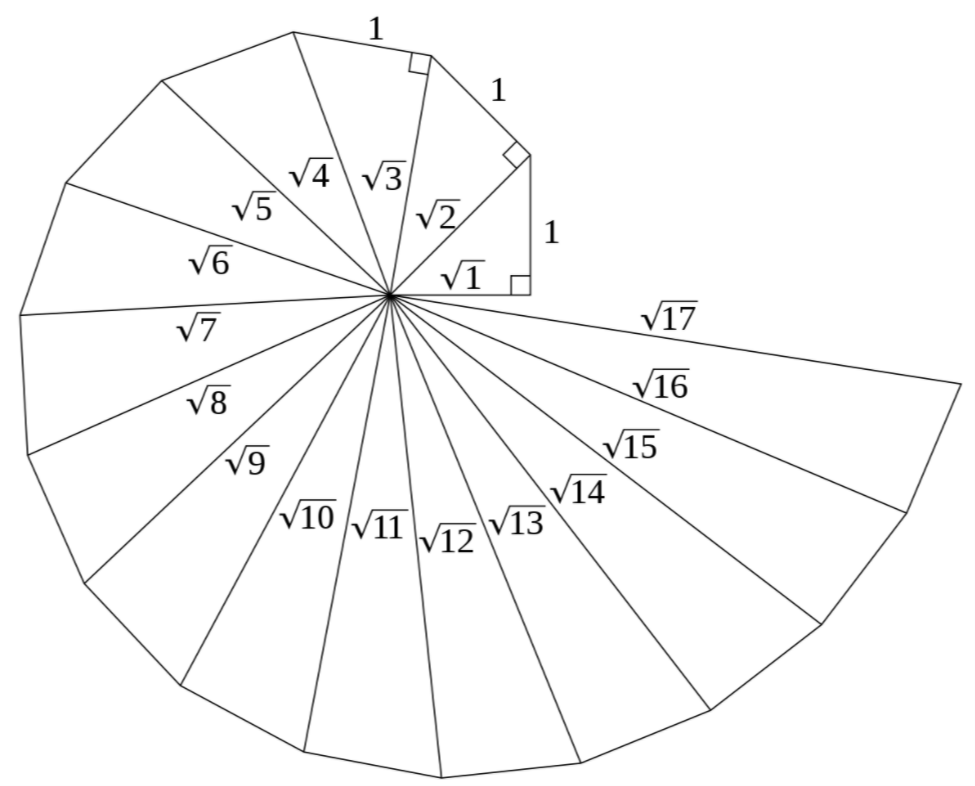
The above diagram represents the spiral of Theodorus.
In the spiral of Theodorus, the first side of every triangle is equal 1.
In the first triangle, the length of the second side is equal to \[\sqrt{1}\].
In the second triangle, the length of the second side is equal to \[\sqrt{2}\].
In the third triangle, the length of the second side is equal to \[\sqrt{3}\].
In the fourth triangle, the length of the side is equal to \[\sqrt{4}\].
In the fifth triangle, the length of the second side is equal to \[\sqrt{5}\].
In the sixth triangle, the length of the second side is equal to \[\sqrt{6}\].
In the similar way,
In the \[{{n}^{th}}\] triangle, the length of the second side is equal to \[\sqrt{n}\].
Now we have to find the hypotenuse of each triangle.
We know that the Pythagoras theorem states that “The sum of squares of two sides of a right -angle triangle is equal to the square of the hypotenuse of a triangle”.
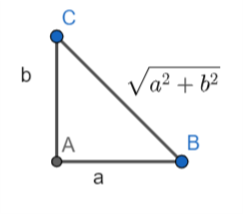
If the length of side AB is equal to a and length of side AC is equal to b, then the length of hypotenuse BC is equal to \[\sqrt{{{a}^{2}}+{{b}^{2}}}\].
In first triangle,
\[Hypotenuse=\sqrt{{{1}^{2}}+{{\left( \sqrt{1} \right)}^{2}}}=\sqrt{2}\]
In second triangle,
\[Hypotenuse=\sqrt{{{1}^{2}}+{{\left( \sqrt{2} \right)}^{2}}}=\sqrt{3}\]
In third triangle,
\[Hypotenuse=\sqrt{{{1}^{2}}+{{\left( \sqrt{3} \right)}^{2}}}=\sqrt{4}\]
In the similar manner,
The hypotenuse of the \[{{n}^{th}}\] triangle is equal to \[\sqrt{{{n}^{2}}+1}\].
So, from this analysis we can observe that the hypotenuse of the first triangle is the side of the second triangle, the hypotenuse of the second triangle is the side of the third triangle. In the similar manner the hypotenuse of \[{{(n-1)}^{th}}\] is the side of \[{{n}^{th}}\] side of the triangle.
Here \[{{n}^{2}}\] is a natural number and n is the square root of that natural number.
So, the significance of hypotenuse of the triangles gives the square root of corresponding natural number.
Hence, option (C) is correct.
Note: Students may confuse between option (B) and option (C). From option (B), it is clear that hypotenuse gives squares of corresponding natural numbers. From option (C), it is clear that hypotenuse gives the square root of corresponding natural number. We know that the hypotenuse of \[{{n}^{th}}\] triangle is equal to \[\sqrt{{{n}^{2}}+1}\] where n represents the square root of a natural number and \[{{n}^{2}}\]represents a natural number. So, it is clear that hypotenuse represents the square root of the corresponding natural number but not square of a natural number.
Complete step by step solution:
Before solving the problem, we should know about the spiral of Theodorus.
The above diagram represents the spiral of Theodorus.
In the spiral of Theodorus, the first side of every triangle is equal 1.
In the first triangle, the length of the second side is equal to \[\sqrt{1}\].
In the second triangle, the length of the second side is equal to \[\sqrt{2}\].
In the third triangle, the length of the second side is equal to \[\sqrt{3}\].
In the fourth triangle, the length of the side is equal to \[\sqrt{4}\].
In the fifth triangle, the length of the second side is equal to \[\sqrt{5}\].
In the sixth triangle, the length of the second side is equal to \[\sqrt{6}\].
In the similar way,
In the \[{{n}^{th}}\] triangle, the length of the second side is equal to \[\sqrt{n}\].
Now we have to find the hypotenuse of each triangle.
We know that the Pythagoras theorem states that “The sum of squares of two sides of a right -angle triangle is equal to the square of the hypotenuse of a triangle”.
If the length of side AB is equal to a and length of side AC is equal to b, then the length of hypotenuse BC is equal to \[\sqrt{{{a}^{2}}+{{b}^{2}}}\].
In first triangle,
\[Hypotenuse=\sqrt{{{1}^{2}}+{{\left( \sqrt{1} \right)}^{2}}}=\sqrt{2}\]
In second triangle,
\[Hypotenuse=\sqrt{{{1}^{2}}+{{\left( \sqrt{2} \right)}^{2}}}=\sqrt{3}\]
In third triangle,
\[Hypotenuse=\sqrt{{{1}^{2}}+{{\left( \sqrt{3} \right)}^{2}}}=\sqrt{4}\]
In the similar manner,
The hypotenuse of the \[{{n}^{th}}\] triangle is equal to \[\sqrt{{{n}^{2}}+1}\].
So, from this analysis we can observe that the hypotenuse of the first triangle is the side of the second triangle, the hypotenuse of the second triangle is the side of the third triangle. In the similar manner the hypotenuse of \[{{(n-1)}^{th}}\] is the side of \[{{n}^{th}}\] side of the triangle.
Here \[{{n}^{2}}\] is a natural number and n is the square root of that natural number.
So, the significance of hypotenuse of the triangles gives the square root of corresponding natural number.
Hence, option (C) is correct.
Note: Students may confuse between option (B) and option (C). From option (B), it is clear that hypotenuse gives squares of corresponding natural numbers. From option (C), it is clear that hypotenuse gives the square root of corresponding natural number. We know that the hypotenuse of \[{{n}^{th}}\] triangle is equal to \[\sqrt{{{n}^{2}}+1}\] where n represents the square root of a natural number and \[{{n}^{2}}\]represents a natural number. So, it is clear that hypotenuse represents the square root of the corresponding natural number but not square of a natural number.
Recently Updated Pages
Basicity of sulphurous acid and sulphuric acid are

Master Class 10 Computer Science: Engaging Questions & Answers for Success
Master Class 10 Social Science: Engaging Questions & Answers for Success
Master Class 10 Science: Engaging Questions & Answers for Success
Class 10 Question and Answer - Your Ultimate Solutions Guide
Master Class 10 Maths: Engaging Questions & Answers for Success
Trending doubts
What is the Total Duration of Football Match?
Explain the Treaty of Vienna of 1815 class 10 social science CBSE
In football, which nation is called "La Roja"?
Why is there a time difference of about 5 hours between class 10 social science CBSE
10 examples of evaporation in daily life with explanations
What is the full form of POSCO class 10 social science CBSE