




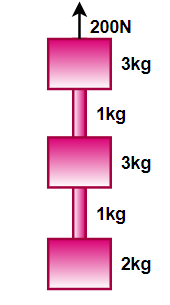
In the situation shown blocks are connected with the help of ropes. Find $\left( a \right)$ the acceleration of blocks and $\left( b \right)$ Tension at the middle of each rope. Masses of blocks and ropes are indicated in the figure. $\left( {Take\,\,g = 10m/{s^2}} \right)$
Answer
 Verified
556.5k+ views
Hint: Here, in this question, we have to find the acceleration so as we know that the acceleration is equal to the force upon the mass. So by calculating the force we will be able to get the acceleration from there. For calculating the tension, we will equate the tension with the force and solve it to get the tension for each rope.
Formula used:
Acceleration,
$Acceleration = \dfrac{{Force}}{{Area}}$
Complete step by step answer:
$\left( a \right)$ So as we know that force is equal to the product of mass and acceleration. Therefore, according to the question, the formula will become
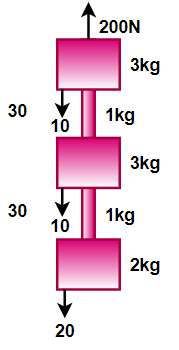
$F - {\left( {mg} \right)_{total}} = {m_{total}} \times a$
Now by substituting the values, we will get the above equation as
$ \Rightarrow 200 - \left( {40 + 40 + 20} \right) = \left( {5 + 3 + 2} \right) \times a$
And on solving the above equation, we get
\[ \Rightarrow 200 - \left( {100} \right) = 10 \times a\]
Solving for the constant value, that is acceleration, we get the equation as
\[ \Rightarrow a = \dfrac{{200 - 100}}{{10}}m/{s^2}\]
And on solving it,
\[ \Rightarrow a = 10m/{s^2}\]
Therefore, the acceleration of the block is equal to \[10m/{s^2}\] .
$\left( b \right)$ Tension at the middle of each rope is named as ${T_1}\,\,and\,\,{T_2}$
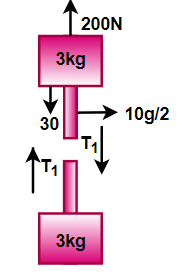
So, from the figure by equating the tension in the block, the equation will become
$ \Rightarrow 200 - 30 - 5 - {T_1} = \left( {3.5} \right) \times a$
Since we already have calculated the values for the acceleration, so we get
$ \Rightarrow 200 - 30 - 5 - {T_1} = \left( {3.5} \right) \times 10$
Now on solving the LHS and RHS of the equation, we get
$ \Rightarrow 175 - {T_1} = 35$
And on solving for the constant term that is the tension, we get the values as
$ \Rightarrow {T_1} = 130N$
Similarly, for the second tension in the rope, we will follow the same procedure, but for this, we have to find $T$ first, so we get the equation as
$ \Rightarrow T - 30 - 10 - 20 = \left( {3 + 2 + 1} \right)a$
On substituting the values for the acceleration, we get the equation as
$ \Rightarrow T - 30 - 10 - 20 = \left( {3 + 2 + 1} \right)10$
And on solving the LHS and RHS, we get
$ \Rightarrow T - 60 = 60$
Therefore, the value will become
$ \Rightarrow T = 120N$
Now we will find the second tension which is ${T_2}$ , so the equation will become
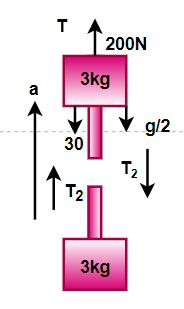
$ \Rightarrow T - 30 - \dfrac{g}{2} - {T_2} = \left( {3 + 0.5} \right)a$
Now on substituting the known values, we get
$ \Rightarrow 120 - 30 - \dfrac{{10}}{2} - {T_2} = \left( {3 + 0.5} \right)10$
And on solving the LHS and RHS, we get
$ \Rightarrow 120 - 30 - 5 - {T_2} = 35$
And on solving for the constant value, we get
$ \Rightarrow {T_2} = 120 - 35 - 35$
And on solving it,
$ \Rightarrow {T_2} = 50N$
Therefore, Tension in the middle of each rope is named as ${T_1}\,\,and\,\,{T_2}$ is equal to $130N\,and\,\,50N$ respectively.
Note: The tension force is that type of force in which the transmission of force is done through a string, rope, cable, or wire when it is pulled tight by forces acting from opposite ends. And it will be focused along the length of the wire that gets pulled equally on the objects on the opposite ends of the wire.
Formula used:
Acceleration,
$Acceleration = \dfrac{{Force}}{{Area}}$
Complete step by step answer:
$\left( a \right)$ So as we know that force is equal to the product of mass and acceleration. Therefore, according to the question, the formula will become
$F - {\left( {mg} \right)_{total}} = {m_{total}} \times a$
Now by substituting the values, we will get the above equation as
$ \Rightarrow 200 - \left( {40 + 40 + 20} \right) = \left( {5 + 3 + 2} \right) \times a$
And on solving the above equation, we get
\[ \Rightarrow 200 - \left( {100} \right) = 10 \times a\]
Solving for the constant value, that is acceleration, we get the equation as
\[ \Rightarrow a = \dfrac{{200 - 100}}{{10}}m/{s^2}\]
And on solving it,
\[ \Rightarrow a = 10m/{s^2}\]
Therefore, the acceleration of the block is equal to \[10m/{s^2}\] .
$\left( b \right)$ Tension at the middle of each rope is named as ${T_1}\,\,and\,\,{T_2}$
So, from the figure by equating the tension in the block, the equation will become
$ \Rightarrow 200 - 30 - 5 - {T_1} = \left( {3.5} \right) \times a$
Since we already have calculated the values for the acceleration, so we get
$ \Rightarrow 200 - 30 - 5 - {T_1} = \left( {3.5} \right) \times 10$
Now on solving the LHS and RHS of the equation, we get
$ \Rightarrow 175 - {T_1} = 35$
And on solving for the constant term that is the tension, we get the values as
$ \Rightarrow {T_1} = 130N$
Similarly, for the second tension in the rope, we will follow the same procedure, but for this, we have to find $T$ first, so we get the equation as
$ \Rightarrow T - 30 - 10 - 20 = \left( {3 + 2 + 1} \right)a$
On substituting the values for the acceleration, we get the equation as
$ \Rightarrow T - 30 - 10 - 20 = \left( {3 + 2 + 1} \right)10$
And on solving the LHS and RHS, we get
$ \Rightarrow T - 60 = 60$
Therefore, the value will become
$ \Rightarrow T = 120N$
Now we will find the second tension which is ${T_2}$ , so the equation will become
$ \Rightarrow T - 30 - \dfrac{g}{2} - {T_2} = \left( {3 + 0.5} \right)a$
Now on substituting the known values, we get
$ \Rightarrow 120 - 30 - \dfrac{{10}}{2} - {T_2} = \left( {3 + 0.5} \right)10$
And on solving the LHS and RHS, we get
$ \Rightarrow 120 - 30 - 5 - {T_2} = 35$
And on solving for the constant value, we get
$ \Rightarrow {T_2} = 120 - 35 - 35$
And on solving it,
$ \Rightarrow {T_2} = 50N$
Therefore, Tension in the middle of each rope is named as ${T_1}\,\,and\,\,{T_2}$ is equal to $130N\,and\,\,50N$ respectively.
Note: The tension force is that type of force in which the transmission of force is done through a string, rope, cable, or wire when it is pulled tight by forces acting from opposite ends. And it will be focused along the length of the wire that gets pulled equally on the objects on the opposite ends of the wire.
Recently Updated Pages
Basicity of sulphurous acid and sulphuric acid are

Master Class 11 Business Studies: Engaging Questions & Answers for Success
Master Class 11 Computer Science: Engaging Questions & Answers for Success
Master Class 11 Economics: Engaging Questions & Answers for Success
Master Class 11 Social Science: Engaging Questions & Answers for Success
Master Class 11 English: Engaging Questions & Answers for Success
Trending doubts
Draw a diagram of nephron and explain its structur class 11 biology CBSE
Explain zero factorial class 11 maths CBSE
Chemical formula of Bleaching powder is A Ca2OCl2 B class 11 chemistry CBSE
Name the part of the brain responsible for the precision class 11 biology CBSE
The growth of tendril in pea plants is due to AEffect class 11 biology CBSE
One Metric ton is equal to kg A 10000 B 1000 C 100 class 11 physics CBSE