




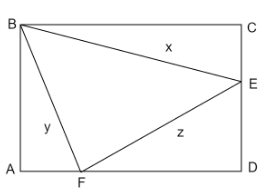
In the rectangle $ABCD$, what is the area of $\Delta BEF$ in terms of $x,y,z$ ?
Answer
 Verified
552.3k+ views
Hint: First, we will find the length of all the sides and then compute the area of all triangles and the rectangle $ABCD$ , by solving all these equations and areas we will get the area of $\Delta BEF$ in terms of $x,y,z$ .
Complete answer:
Let us assume the length of sides $AB = a,BC = b,AF = c,CE = d$ respectively.
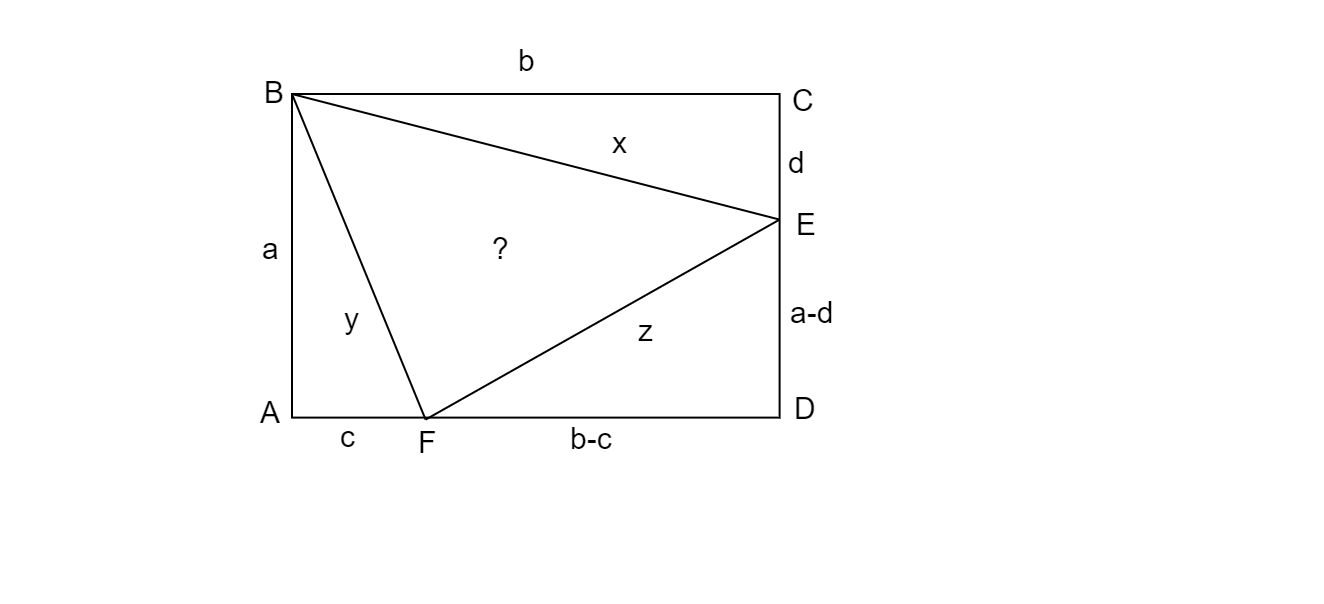
Area of triangle = $\dfrac{1}{2} \times base \times height$
Consider $\Delta ABF$,
$\Rightarrow$ Area of $\Delta ABF$ = \[y\] …. (Given)
$\dfrac{1}{2} \times a \times c = y$
$c = \dfrac{{2y}}{a}$
Consider $\Delta BCE$,
Area of $\Delta BCE$ = $x$ …. (Given)
$\dfrac{1}{2} \times b \times d = x$
$d = \dfrac{{2x}}{b}$
$side{\text{ }}BC = side{\text{ }}AD = b$ …. (Opposite side of rectangle are congruent)
$side{\text{ }}AB = side{\text{ }}CD = a$ …. (Opposite side of rectangle are congruent)
$\Rightarrow$ $sideAD = sideAF + sideFD$ …. ($A - F - D$)
$b = c + sideFD$
$\therefore sideFD = b - c = b - \dfrac{{2y}}{a}$
$\Rightarrow$ $side\;CD = side\;CE + side\;ED$ …. ($C - E - D$)
$a = d + sideED$
$\therefore sideED = a - d = a - \dfrac{{2x}}{b}$
Consider $\Delta DEF$,
Area of $\Delta DEF$ = $z$ …. (Given)
$\Rightarrow$ $\dfrac{1}{2} \times \left( {b - \dfrac{{2y}}{a}} \right) \times \left( {a - \dfrac{{2x}}{b}} \right) = z$
$\Rightarrow$ $ab - 2x - 2y + \dfrac{{4xy}}{{ab}} = 2z$
$\Rightarrow$ $ab - 2x - 2y - 2z + \dfrac{{4xy}}{{ab}} = 0$
Multiplying both sides by $ab$ we get,
$\Rightarrow$ ${(ab)^2} - 2(ab)(x + y + z) + 4xy = 0$
This equation is a quadratic equation of form $a{x^2} + bx + c = 0$ and the roots of the equation are given by $x = \dfrac{{ - b \pm \sqrt {{b^2} - 4ac} }}{{2a}}$
Here, $x = ab,a = 1,b = - 2(x + y + z),c = 4xy$
$\therefore ab = \dfrac{{ - ( - 2(x + y + z)) \pm \sqrt {{{( - 2(x + y + z))}^2} - 4(1)(4xy)} }}{{2(1)}}$
$\therefore ab = \dfrac{{2(x + y + z) \pm \sqrt {4{{(x + y + z)}^2} - 16xy} }}{2}$
$\therefore ab = \dfrac{{2(x + y + z) \pm \sqrt {4[{{(x + y + z)}^2} - 4xy]} }}{2}$
Taking 4 common and inside the radical symbol and taking it out the radical sign we have,
$\therefore ab = \dfrac{{2(x + y + z) \pm 2\sqrt {{{(x + y + z)}^2} - 4xy} }}{2}$
Taking 2 common in the numerator, we have:
$\therefore ab = \dfrac{{2[(x + y + z) \pm \sqrt {{{(x + y + z)}^2} - 4xy} ]}}{2}$
cancelling 2, then we have,
$\therefore ab = (x + y + z) \pm \sqrt {{{(x + y + z)}^2} - 4xy} $
The area of rectangle $ABCD$ = $base \times height = a \times b = ab$
Substituting the value of $ab$ which we got by solving the quadratic equation, we get,
Area of rectangle $ABCD$ = $base \times height = a \times b = ab = (x + y + z) \pm \sqrt {{{(x + y + z)}^2} - 4xy} $
Consider the area of $\Delta BEF = \omega $,
Therefore, we can say
Area of rectangle $ABCD$ = area of $\Delta ABF$+ area of $\Delta BCE$ + area of $\Delta DEF$+ area of $\Delta BEF$
Substituting all the values we got into this equation we get,
$\Rightarrow$ $ab = x + y + z + \omega $
$\therefore (x + y + z) \pm \sqrt {{{(x + y + z)}^2} - 4xy} = (x + y + z) + w$
Since, $ab$ is the area of entire rectangle, it is larger than $(x + y + z)$ and hence we can reject the negative radical and consider only positive radical,
$\Rightarrow$ $w = \sqrt {{{(x + y + z)}^2} - 4xy} $
$\Rightarrow$ $\Delta BEF = \omega = \sqrt {{{(x + y + z)}^2} - 4xy} $
Therefore, the area of $\Delta BEF$ in terms of $x,y,z$ is $\sqrt {{{(x + y + z)}^2} - 4xy} $ .
Note:
Consider the sides of the rectangle and triangle as some constants and then form equations and find the solution of those equations. The area of a triangle inside a rectangle always has an area less than that of the rectangle.
Complete answer:
Let us assume the length of sides $AB = a,BC = b,AF = c,CE = d$ respectively.
Area of triangle = $\dfrac{1}{2} \times base \times height$
Consider $\Delta ABF$,
$\Rightarrow$ Area of $\Delta ABF$ = \[y\] …. (Given)
$\dfrac{1}{2} \times a \times c = y$
$c = \dfrac{{2y}}{a}$
Consider $\Delta BCE$,
Area of $\Delta BCE$ = $x$ …. (Given)
$\dfrac{1}{2} \times b \times d = x$
$d = \dfrac{{2x}}{b}$
$side{\text{ }}BC = side{\text{ }}AD = b$ …. (Opposite side of rectangle are congruent)
$side{\text{ }}AB = side{\text{ }}CD = a$ …. (Opposite side of rectangle are congruent)
$\Rightarrow$ $sideAD = sideAF + sideFD$ …. ($A - F - D$)
$b = c + sideFD$
$\therefore sideFD = b - c = b - \dfrac{{2y}}{a}$
$\Rightarrow$ $side\;CD = side\;CE + side\;ED$ …. ($C - E - D$)
$a = d + sideED$
$\therefore sideED = a - d = a - \dfrac{{2x}}{b}$
Consider $\Delta DEF$,
Area of $\Delta DEF$ = $z$ …. (Given)
$\Rightarrow$ $\dfrac{1}{2} \times \left( {b - \dfrac{{2y}}{a}} \right) \times \left( {a - \dfrac{{2x}}{b}} \right) = z$
$\Rightarrow$ $ab - 2x - 2y + \dfrac{{4xy}}{{ab}} = 2z$
$\Rightarrow$ $ab - 2x - 2y - 2z + \dfrac{{4xy}}{{ab}} = 0$
Multiplying both sides by $ab$ we get,
$\Rightarrow$ ${(ab)^2} - 2(ab)(x + y + z) + 4xy = 0$
This equation is a quadratic equation of form $a{x^2} + bx + c = 0$ and the roots of the equation are given by $x = \dfrac{{ - b \pm \sqrt {{b^2} - 4ac} }}{{2a}}$
Here, $x = ab,a = 1,b = - 2(x + y + z),c = 4xy$
$\therefore ab = \dfrac{{ - ( - 2(x + y + z)) \pm \sqrt {{{( - 2(x + y + z))}^2} - 4(1)(4xy)} }}{{2(1)}}$
$\therefore ab = \dfrac{{2(x + y + z) \pm \sqrt {4{{(x + y + z)}^2} - 16xy} }}{2}$
$\therefore ab = \dfrac{{2(x + y + z) \pm \sqrt {4[{{(x + y + z)}^2} - 4xy]} }}{2}$
Taking 4 common and inside the radical symbol and taking it out the radical sign we have,
$\therefore ab = \dfrac{{2(x + y + z) \pm 2\sqrt {{{(x + y + z)}^2} - 4xy} }}{2}$
Taking 2 common in the numerator, we have:
$\therefore ab = \dfrac{{2[(x + y + z) \pm \sqrt {{{(x + y + z)}^2} - 4xy} ]}}{2}$
cancelling 2, then we have,
$\therefore ab = (x + y + z) \pm \sqrt {{{(x + y + z)}^2} - 4xy} $
The area of rectangle $ABCD$ = $base \times height = a \times b = ab$
Substituting the value of $ab$ which we got by solving the quadratic equation, we get,
Area of rectangle $ABCD$ = $base \times height = a \times b = ab = (x + y + z) \pm \sqrt {{{(x + y + z)}^2} - 4xy} $
Consider the area of $\Delta BEF = \omega $,
Therefore, we can say
Area of rectangle $ABCD$ = area of $\Delta ABF$+ area of $\Delta BCE$ + area of $\Delta DEF$+ area of $\Delta BEF$
Substituting all the values we got into this equation we get,
$\Rightarrow$ $ab = x + y + z + \omega $
$\therefore (x + y + z) \pm \sqrt {{{(x + y + z)}^2} - 4xy} = (x + y + z) + w$
Since, $ab$ is the area of entire rectangle, it is larger than $(x + y + z)$ and hence we can reject the negative radical and consider only positive radical,
$\Rightarrow$ $w = \sqrt {{{(x + y + z)}^2} - 4xy} $
$\Rightarrow$ $\Delta BEF = \omega = \sqrt {{{(x + y + z)}^2} - 4xy} $
Therefore, the area of $\Delta BEF$ in terms of $x,y,z$ is $\sqrt {{{(x + y + z)}^2} - 4xy} $ .
Note:
Consider the sides of the rectangle and triangle as some constants and then form equations and find the solution of those equations. The area of a triangle inside a rectangle always has an area less than that of the rectangle.
Recently Updated Pages
Master Class 11 English: Engaging Questions & Answers for Success

Master Class 11 Physics: Engaging Questions & Answers for Success
Master Class 11 Computer Science: Engaging Questions & Answers for Success
Master Class 11 Chemistry: Engaging Questions & Answers for Success
Master Class 11 Social Science: Engaging Questions & Answers for Success
Master Class 11 Accountancy: Engaging Questions & Answers for Success
Trending doubts
Difference Between Prokaryotic Cells and Eukaryotic Cells
Two of the body parts which do not appear in MRI are class 11 biology CBSE
One Metric ton is equal to kg A 10000 B 1000 C 100 class 11 physics CBSE
10 examples of friction in our daily life
Draw a diagram of nephron and explain its structur class 11 biology CBSE
Draw a diagram of a plant cell and label at least eight class 11 biology CBSE