



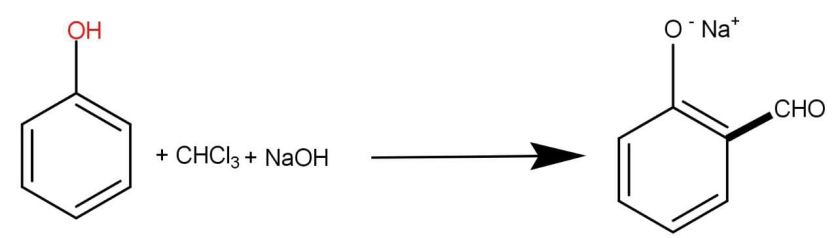
In the reaction the electrophile involved is:
A.Dichloromethyl anion \[(\mathop {\text{C}}\limits^ - {\text{HC}}{{\text{l}}_2})\]
B.Dichloromethyl anion \[(\mathop {\text{C}}\limits^ + {\text{HC}}{{\text{l}}_2})\]
C.Dichlorocarbene \[(:{\text{CC}}{{\text{l}}_2})\]
D.Formyl cation \[(\mathop {\text{C}}\limits^ + {\text{HO}})\]
Answer
 Verified
597.9k+ views
Hint: The above reaction is a famous name reaction Reiman Tiemann reaction. A carbene as an intermediate is formed from deprotonation of chloroform.
Complete step by step answer:
The Reimann Tiemann reaction is an electrophilic substitution reaction. A substitution reaction is that in which one molecule substitutes the other. Phenol is reacted with chloroform that is \[{\text{CHC}}{{\text{l}}_3}\]in the presence of an alkali that is sodium hydroxide to form aldehyde. The aldehyde group is attached to the ortho position of phenol, o-hydroxybenzaldehyde or salicylaldehyde forms.
A nucleophile is an electron rich species, which possesses either lone pair of electrons or has negative charge. Electrophile is an electron deficient species and it accepts electrons due to presence of vacant orbital. In the reaction mechanism first of all a carbanion forms but a carbanion is a nucleophile not an electrophile. The carbanion readily deprotonates the carbene as an electrophile that is electron deficient in nature.
Carbene\[(:{\text{CC}}{{\text{l}}_2})\] is electron deficient in nature because carbon is tetravalent and need to form four bonds in order to complete the octet. Carbene forms only two bonds and hence in an electrophile for the above reaction.
The correct option is C.
Note:
\[{\text{CHC}}{{\text{l}}_3}\] belongs to a class of compounds that are known as hydrofluorocarbon. It is a colorless liquid having a strong odor. It is a very powerful anesthetic. It is widely used as solvents for a wide range of products. The presence of two chlorine groups in carbene makes it very much electron deficient as high electronegativity of chlorine withdraws electrons from carbon.
Complete step by step answer:
The Reimann Tiemann reaction is an electrophilic substitution reaction. A substitution reaction is that in which one molecule substitutes the other. Phenol is reacted with chloroform that is \[{\text{CHC}}{{\text{l}}_3}\]in the presence of an alkali that is sodium hydroxide to form aldehyde. The aldehyde group is attached to the ortho position of phenol, o-hydroxybenzaldehyde or salicylaldehyde forms.
A nucleophile is an electron rich species, which possesses either lone pair of electrons or has negative charge. Electrophile is an electron deficient species and it accepts electrons due to presence of vacant orbital. In the reaction mechanism first of all a carbanion forms but a carbanion is a nucleophile not an electrophile. The carbanion readily deprotonates the carbene as an electrophile that is electron deficient in nature.
Carbene\[(:{\text{CC}}{{\text{l}}_2})\] is electron deficient in nature because carbon is tetravalent and need to form four bonds in order to complete the octet. Carbene forms only two bonds and hence in an electrophile for the above reaction.
The correct option is C.
Note:
\[{\text{CHC}}{{\text{l}}_3}\] belongs to a class of compounds that are known as hydrofluorocarbon. It is a colorless liquid having a strong odor. It is a very powerful anesthetic. It is widely used as solvents for a wide range of products. The presence of two chlorine groups in carbene makes it very much electron deficient as high electronegativity of chlorine withdraws electrons from carbon.
Recently Updated Pages
Master Class 12 Social Science: Engaging Questions & Answers for Success

Master Class 12 Physics: Engaging Questions & Answers for Success
Master Class 12 Maths: Engaging Questions & Answers for Success
Master Class 12 Economics: Engaging Questions & Answers for Success
Master Class 12 Chemistry: Engaging Questions & Answers for Success
Master Class 12 Business Studies: Engaging Questions & Answers for Success
Trending doubts
Which are the Top 10 Largest Countries of the World?
Draw a labelled sketch of the human eye class 12 physics CBSE
Explain the structure of megasporangium class 12 biology CBSE
What are the major means of transport Explain each class 12 social science CBSE
How many chromosomes are found in human ovum a 46 b class 12 biology CBSE
The diagram of the section of a maize grain is given class 12 biology CBSE