




In the reaction \[{C_2}{H_5}O{C_2}{H_5} + CO\xrightarrow[{{{150}^O}C}]{{B{F_3},500atm}}X\]. What is X?
1.Diethyl carbonate
2.Ethyl carbonate
3.Diethyl peroxide
4.Ethyl propionate
Answer
 Verified
502.8k+ views
Hint: Ethers behave as Lewis bases and form coordination complexes with Lewis acids such as \[B{F_3}\]. They are known as etherates. Because of the ability of ethereal oxygen to coordinate with the electron deficient species they are used as solvents in preparations of many organometallic compounds such as Grignard reagent.
Complete answer:
The reaction given above is a reaction involving carbon monoxide. Ethers react with carbon monoxide at very high pressure and high temperature to form esters.
Here the \[B{F_3}\] first attacks the lone pair of the oxygen and thus makes it easy for the carbon monoxide molecule to attack the hydrocarbon part. They will react and form the carbonyl part of the ester. Now the alkoxy ion will attack the carbonyl carbon and thus there will be ester formation.
This will give us an ester.
From the above options we know that the ester will be Ethyl propionate.
The structure of the product is given as below-
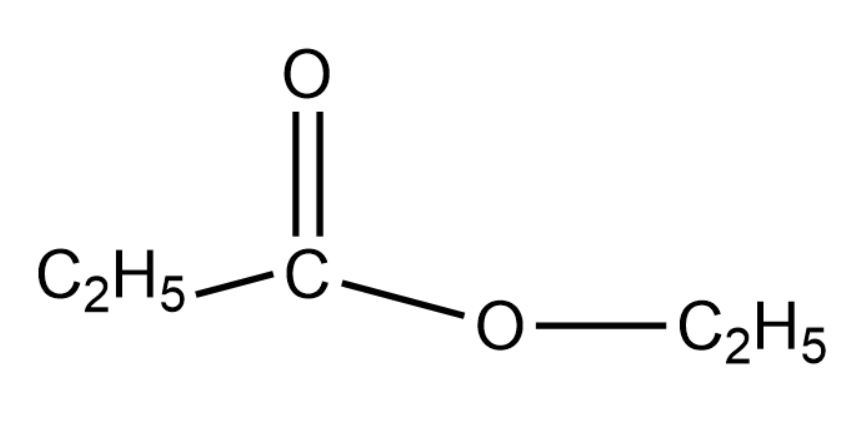
Thus we can say the correct option for this question will be option (4).
Note:
Ethers are widely used as solvents for various organic compounds and reactions, suggesting that they are relatively unreactive. With the exception of the alkanes, cycloalkanes and fluorocarbons, ethers are the least reactive, class of organic compounds. Ethers are less reactive because of the absence of polarity in the molecule. There is no partial positive charge as we observe in carbonyl carbon. So nucleophiles interact with ethers without any reactions taking place.
Complete answer:
The reaction given above is a reaction involving carbon monoxide. Ethers react with carbon monoxide at very high pressure and high temperature to form esters.
Here the \[B{F_3}\] first attacks the lone pair of the oxygen and thus makes it easy for the carbon monoxide molecule to attack the hydrocarbon part. They will react and form the carbonyl part of the ester. Now the alkoxy ion will attack the carbonyl carbon and thus there will be ester formation.
This will give us an ester.
From the above options we know that the ester will be Ethyl propionate.
The structure of the product is given as below-
Thus we can say the correct option for this question will be option (4).
Note:
Ethers are widely used as solvents for various organic compounds and reactions, suggesting that they are relatively unreactive. With the exception of the alkanes, cycloalkanes and fluorocarbons, ethers are the least reactive, class of organic compounds. Ethers are less reactive because of the absence of polarity in the molecule. There is no partial positive charge as we observe in carbonyl carbon. So nucleophiles interact with ethers without any reactions taking place.
Recently Updated Pages
Master Class 11 Computer Science: Engaging Questions & Answers for Success

Master Class 11 Business Studies: Engaging Questions & Answers for Success
Master Class 11 Economics: Engaging Questions & Answers for Success
Master Class 11 English: Engaging Questions & Answers for Success
Master Class 11 Maths: Engaging Questions & Answers for Success
Master Class 11 Biology: Engaging Questions & Answers for Success
Trending doubts
One Metric ton is equal to kg A 10000 B 1000 C 100 class 11 physics CBSE
There are 720 permutations of the digits 1 2 3 4 5 class 11 maths CBSE
Discuss the various forms of bacteria class 11 biology CBSE
Draw a diagram of a plant cell and label at least eight class 11 biology CBSE
State the laws of reflection of light
Explain zero factorial class 11 maths CBSE