




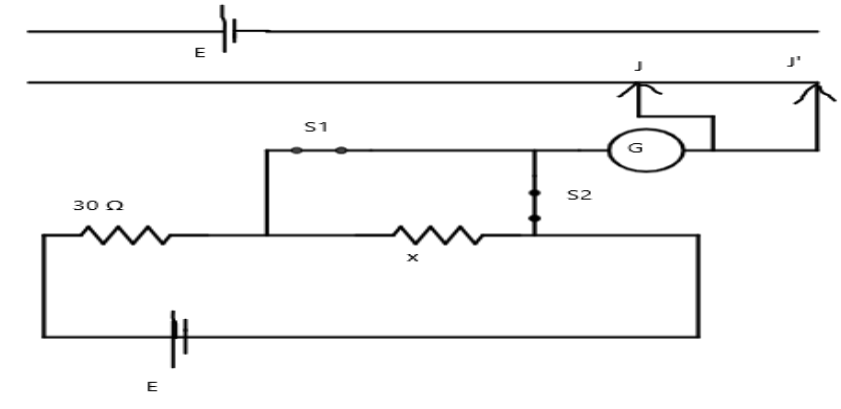
In the potentiometer circuit shown below, balancing length AJ when switch $S_1$ is closed and $S_2$ is open Is found to be 60 cm and that (AJ’) when $S_2$ is closed and $S_1$ is open is 80 cm. The unknown resistance x then is
A) \[\;5\Omega \]
B) \[\;15\Omega \]
C) \[\;10\Omega \]
D) \[20\Omega \]
Answer
 Verified
655.2k+ views
Hint: Consider a constant current that is flowing through a cross-section of area. It has the same composition and the potential drop across any length of the wire is directly proportional to the length. This is known as the principle of the potentiometer. The voltage developed in the circuit is directly proportional to the current and the resistance.
Formula used:
The emf of the cell or the potential drop of the cell, $\varepsilon = k{l_1}$ when \[{S_1}\]is closed and $k$ is the potential gradient ($\dfrac{v}{m}$).
The potential difference at the balance point,$V = k{l_2}$when ${S_2}$is closed and k is the potential gradient ($\dfrac{v}{m}$).
From Ohm’s Law, $V = IR$, where $R$ is the resistance.
Complete step by step solution:
Given details:
The position of the jockey in the first case, \[{l_1} = 80{\text{ }}cm\]
The position of the jockey in the second case,\[\;{l_2} = 60{\text{ }}cm\]
Given resistance, \[R = 30\Omega \]
Now we can use the above formulas to generate a relation between \[\;\varepsilon \] and $V$
Dividing the two equations, $\dfrac{\varepsilon }{V} = \dfrac{{{l_1}}}{{{l_2}}}$
Let $X$ be the unknown resistance of the cell. If the current I flow through cell when it is shunted with resistance $R$, then from Ohm’s Law we get $\varepsilon = I(R + x)$ and $V = IR$
Therefore, diving the equations we get,
$\dfrac{\varepsilon }{V} = \dfrac{{R + x}}{R}$=$\dfrac{{{{\text{l}}_1}}}{{{{\text{l}}_2}}}$
$ \Rightarrow \dfrac{{{\text{R + x}}}}{{\text{R}}} = \dfrac{{{{\text{l}}_1}}}{{{{\text{l}}_2}}}$
$ \Rightarrow 1 + \dfrac{{\text{x}}}{{\text{R}}} = \dfrac{{{{\text{l}}_1}}}{{{{\text{l}}_2}}}$
Taking the 1 to the right-hand side we get,
$ \Rightarrow \dfrac{{\text{x}}}{{\text{R}}} = \dfrac{{{{\text{l}}_1}}}{{{{\text{l}}_2}}} - 1$
$
\Rightarrow {\text{x = R(}}\dfrac{{{{\text{l}}_1}}}{{{{\text{l}}_2}}} - 1) \\
\\
$
Now using the values, we get the value of$X$,
$ \Rightarrow {\text{x = 30(}}\dfrac{{80}}{{60}} - 1)$
$ \Rightarrow x = 30(\dfrac{8}{6} - 1)$
Dividing the terms, we get,
$ \Rightarrow x = 30(\dfrac{4}{3} - 1)$
$ \Rightarrow x = 30(\dfrac{1}{3})$
\[\therefore x = \;10\Omega \]
The correct option is (C).
Note:
Emf of a cell: The electromotive force of a cell is the maximum potential difference between two electrodes of a cell.
2. A potentiometer is used to measure the potential difference in a circuit.
3. Potentiometer is used to measure very small potential differences.
4. It shows a significant balancing length for a small change in the potential difference is measured.
Formula used:
The emf of the cell or the potential drop of the cell, $\varepsilon = k{l_1}$ when \[{S_1}\]is closed and $k$ is the potential gradient ($\dfrac{v}{m}$).
The potential difference at the balance point,$V = k{l_2}$when ${S_2}$is closed and k is the potential gradient ($\dfrac{v}{m}$).
From Ohm’s Law, $V = IR$, where $R$ is the resistance.
Complete step by step solution:
Given details:
The position of the jockey in the first case, \[{l_1} = 80{\text{ }}cm\]
The position of the jockey in the second case,\[\;{l_2} = 60{\text{ }}cm\]
Given resistance, \[R = 30\Omega \]
Now we can use the above formulas to generate a relation between \[\;\varepsilon \] and $V$
Dividing the two equations, $\dfrac{\varepsilon }{V} = \dfrac{{{l_1}}}{{{l_2}}}$
Let $X$ be the unknown resistance of the cell. If the current I flow through cell when it is shunted with resistance $R$, then from Ohm’s Law we get $\varepsilon = I(R + x)$ and $V = IR$
Therefore, diving the equations we get,
$\dfrac{\varepsilon }{V} = \dfrac{{R + x}}{R}$=$\dfrac{{{{\text{l}}_1}}}{{{{\text{l}}_2}}}$
$ \Rightarrow \dfrac{{{\text{R + x}}}}{{\text{R}}} = \dfrac{{{{\text{l}}_1}}}{{{{\text{l}}_2}}}$
$ \Rightarrow 1 + \dfrac{{\text{x}}}{{\text{R}}} = \dfrac{{{{\text{l}}_1}}}{{{{\text{l}}_2}}}$
Taking the 1 to the right-hand side we get,
$ \Rightarrow \dfrac{{\text{x}}}{{\text{R}}} = \dfrac{{{{\text{l}}_1}}}{{{{\text{l}}_2}}} - 1$
$
\Rightarrow {\text{x = R(}}\dfrac{{{{\text{l}}_1}}}{{{{\text{l}}_2}}} - 1) \\
\\
$
Now using the values, we get the value of$X$,
$ \Rightarrow {\text{x = 30(}}\dfrac{{80}}{{60}} - 1)$
$ \Rightarrow x = 30(\dfrac{8}{6} - 1)$
Dividing the terms, we get,
$ \Rightarrow x = 30(\dfrac{4}{3} - 1)$
$ \Rightarrow x = 30(\dfrac{1}{3})$
\[\therefore x = \;10\Omega \]
The correct option is (C).
Note:
Emf of a cell: The electromotive force of a cell is the maximum potential difference between two electrodes of a cell.
2. A potentiometer is used to measure the potential difference in a circuit.
3. Potentiometer is used to measure very small potential differences.
4. It shows a significant balancing length for a small change in the potential difference is measured.
Recently Updated Pages
Which of the following graphs shows the variation of class 12 physics CBSE

Draw a labelled diagram of the human male reproductive class 12 biology CBSE
Describe the experiment to compare the emf of two cells class 12 physics CBSE
What is standard hydrogen electrode
What is conventional current and electric current class 12 physics CBSE
2Bromopentane is treated with an alcoholic KOH solution class 12 chemistry CBSE
Trending doubts
Draw a labelled sketch of the human eye class 12 physics CBSE
Which are the Top 10 Largest Countries of the World?
Differentiate between homogeneous and heterogeneous class 12 chemistry CBSE
Draw ray diagrams each showing i myopic eye and ii class 12 physics CBSE
Which is the correct genotypic ratio of mendel dihybrid class 12 biology CBSE
What is the Full Form of PVC, PET, HDPE, LDPE, PP and PS ?