




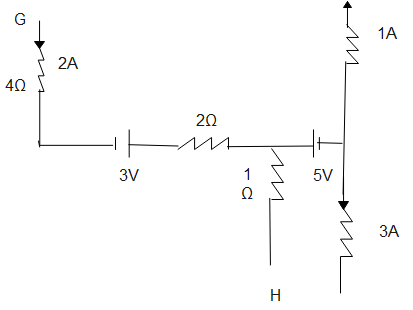
In the part of a circuit shown in fig, the potential difference $\left( {{V_H} - {V_G}} \right)$ between points G and H will be
1)1V
2)-1V
3)7V
4)-7V
Answer
 Verified
611.4k+ views
Hint: First we have to observe the given circuit diagram. To solve this question apply the first law of kirchhoff's junction which states that the current going into a junction must equal the current coming out. Here we have to find the potential difference between given points G and H.
Complete answer:
Kirchhoff's first law is also known as kirchhoff's current law. It states that the current going into a junction must equal the current coming out. So, in the given circuit diagram there is 4A current coming out of the junction (3A+1A). According to Kirchhoff's first law, the current is 4A.
From the point G there is a flowing 2A current and other remaining 2A current came from the point H. So, total incoming current is 2A+2A= 4A. Finally we get the total current of the select branch of the junction from points G to H.
Focus on the branch of junction from points G to H. Here we have to remember Kirchhoff's voltage law; it states that the algebraic sum of all voltages within the loop must be equal to zero. Starting from point G we consider potential is ${V_G}$ there is a drop of potential as we see in the circuit diagram.
In the question mentioned to find potential difference between points G and H. So, we select the branch of the junction from G to H.
$ {V_G} - 2A \times 4\Omega + 3V - 2A \times 2\Omega + 2A \times 1\Omega = {V_H} \\
\Rightarrow {V_G} - 8 + 3 - 4 + 2 = {V_H} \\
\Rightarrow - 8 + 3 - 4 + 2 = {V_H} - {V_G} \\
\therefore - 7 = {V_H} - {V_G} \\ $
Hence the correct answer is -7 that is in the option 4.
Note:
In these types of questions we need to observe circuit diagrams where the current is added and where the current is dropped. We know that ohm's law which states that electric current is directly proportional to voltage and inversely proportional to resistance in other words we can write V=IR.
Complete answer:
Kirchhoff's first law is also known as kirchhoff's current law. It states that the current going into a junction must equal the current coming out. So, in the given circuit diagram there is 4A current coming out of the junction (3A+1A). According to Kirchhoff's first law, the current is 4A.
From the point G there is a flowing 2A current and other remaining 2A current came from the point H. So, total incoming current is 2A+2A= 4A. Finally we get the total current of the select branch of the junction from points G to H.
Focus on the branch of junction from points G to H. Here we have to remember Kirchhoff's voltage law; it states that the algebraic sum of all voltages within the loop must be equal to zero. Starting from point G we consider potential is ${V_G}$ there is a drop of potential as we see in the circuit diagram.
In the question mentioned to find potential difference between points G and H. So, we select the branch of the junction from G to H.
$ {V_G} - 2A \times 4\Omega + 3V - 2A \times 2\Omega + 2A \times 1\Omega = {V_H} \\
\Rightarrow {V_G} - 8 + 3 - 4 + 2 = {V_H} \\
\Rightarrow - 8 + 3 - 4 + 2 = {V_H} - {V_G} \\
\therefore - 7 = {V_H} - {V_G} \\ $
Hence the correct answer is -7 that is in the option 4.
Note:
In these types of questions we need to observe circuit diagrams where the current is added and where the current is dropped. We know that ohm's law which states that electric current is directly proportional to voltage and inversely proportional to resistance in other words we can write V=IR.
Recently Updated Pages
Master Class 5 English: Engaging Questions & Answers for Success

Master Class 5 Maths: Engaging Questions & Answers for Success
Master Class 5 Social Science: Engaging Questions & Answers for Success
Master Class 5 Science: Engaging Questions & Answers for Success
Class 5 Question and Answer - Your Ultimate Solutions Guide
Master Class 9 General Knowledge: Engaging Questions & Answers for Success
Trending doubts
One Metric ton is equal to kg A 10000 B 1000 C 100 class 11 physics CBSE
What is cell theory Who formulated it class 11 biology CBSE
Phyllotaxy is the arrangement of ALeaflets BLeaves class 11 biology CBSE
Difference Between Prokaryotic Cells and Eukaryotic Cells
The symbiotic association of fungi and algae is called class 11 biology CBSE
Cell theory was formulated by A Schleiden and Schwann class 11 biology CBSE