



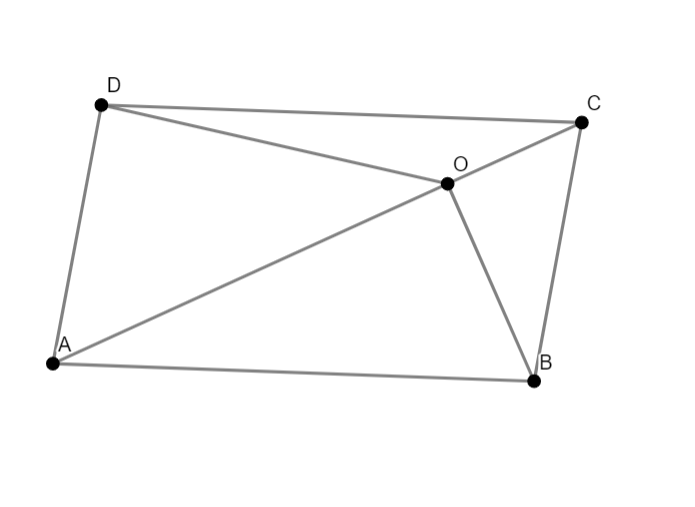
In the parallelogram $ABCD$ , $O$ is any point on diagonal $AC$ . Prove that $ar(\vartriangle OBC)=ar(\vartriangle OCD)$ .
Answer
 Verified
562.8k+ views
Hint: To show that area of $\vartriangle OBC$ is equal to the area of $\vartriangle OCD$ we need to consider the fact that the diagonals of parallelogram divide it into two triangles with equal areas and sides are parallel and equal. From the given diagram the diagonal of parallelogram $ABCD$ is given as $AC$.
Complete step-by-step solution:
Given parallelogram is $ABCD$
One of the diagonals is given and is represented by $AC$ .
From the hint the diagonal $AC$ divides the parallelogram into two triangles with equal area.
These triangles are $\vartriangle ABC$ and $\vartriangle ACD$ .
Let ${{h}_{1}}$ and ${{h}_{2}}$ be the perpendicular distances of points $B$ and $D$ from the diagonal $AC$ respectively.
Now the areas are given by
$ar\left( \vartriangle ABC \right)=ar\left( \vartriangle ACD \right)$
Area of $\vartriangle ABC$ is given by $ar\left( \vartriangle ABC \right)=\dfrac{1}{2}\times AC\times {{h}_{1}}$
And area of $\vartriangle ACD$ is given by $ar\left( \vartriangle ACD \right)=\dfrac{1}{2}\times AC\times {{h}_{2}}$
Equate these two areas
$ ar\left( \vartriangle ABC \right)=ar\left( \vartriangle ACD \right) $
$ \Rightarrow \dfrac{1}{2}\times AC\times {{h}_{1}}=\dfrac{1}{2}\times AC\times {{h}_{2}} $
$ \Rightarrow {{h}_{1}}={{h}_{2}} $
Hence the perpendicular distances of points $B$ and $D$ from the diagonal $AC$ are equal.
Now
Given $O$ is any point on the diagonal.
Consider the areas of $\vartriangle OBC$ and $\vartriangle OCD$ .
The area of $\vartriangle OBC$ is given by half of the product of diagonal and perpendicular distance from diagonal to point $B$ .
But the perpendicular distance is obtained as ${{h}_{1}}$
Hence $ar(\vartriangle OBC)=\dfrac{1}{2}\times OC\times {{h}_{1}}................(1)$
In the similar way we also have $ar(\vartriangle OCD)=\dfrac{1}{2}\times OC\times {{h}_{2}}..................(2)$
But we also have the condition that ${{h}_{1}}={{h}_{2}}$
Substitute the value of ${{h}_{2}}$ with ${{h}_{1}}$ so that area of $\vartriangle OCD$ will become
$ ar(\vartriangle OCD)=\dfrac{1}{2}\times OC\times {{h}_{2}} $
$ \Rightarrow ar(\vartriangle OCD)=\dfrac{1}{2}\times OC\times {{h}_{1}} $
But from equation $(1)$ we get
$ \Rightarrow ar(\vartriangle OCD)=\dfrac{1}{2}\times OC\times {{h}_{1}}=ar(\vartriangle OBC) $
$ \Rightarrow ar(\vartriangle OBC)=ar(\vartriangle OCD) $
Hence the statement given in question is proved.
Note: The quadrilateral whose diagonal divides its area into two equal halves is parallelogram. It is also stated that the diagonal of parallelogram divides into two equal triangles, whose sides are same and also angles. If we consider two diagonals at a time, the two diagonals divide the parallelogram into four equal parts
Complete step-by-step solution:
Given parallelogram is $ABCD$
One of the diagonals is given and is represented by $AC$ .
From the hint the diagonal $AC$ divides the parallelogram into two triangles with equal area.
These triangles are $\vartriangle ABC$ and $\vartriangle ACD$ .
Let ${{h}_{1}}$ and ${{h}_{2}}$ be the perpendicular distances of points $B$ and $D$ from the diagonal $AC$ respectively.
Now the areas are given by
$ar\left( \vartriangle ABC \right)=ar\left( \vartriangle ACD \right)$
Area of $\vartriangle ABC$ is given by $ar\left( \vartriangle ABC \right)=\dfrac{1}{2}\times AC\times {{h}_{1}}$
And area of $\vartriangle ACD$ is given by $ar\left( \vartriangle ACD \right)=\dfrac{1}{2}\times AC\times {{h}_{2}}$
Equate these two areas
$ ar\left( \vartriangle ABC \right)=ar\left( \vartriangle ACD \right) $
$ \Rightarrow \dfrac{1}{2}\times AC\times {{h}_{1}}=\dfrac{1}{2}\times AC\times {{h}_{2}} $
$ \Rightarrow {{h}_{1}}={{h}_{2}} $
Hence the perpendicular distances of points $B$ and $D$ from the diagonal $AC$ are equal.
Now
Given $O$ is any point on the diagonal.
Consider the areas of $\vartriangle OBC$ and $\vartriangle OCD$ .
The area of $\vartriangle OBC$ is given by half of the product of diagonal and perpendicular distance from diagonal to point $B$ .
But the perpendicular distance is obtained as ${{h}_{1}}$
Hence $ar(\vartriangle OBC)=\dfrac{1}{2}\times OC\times {{h}_{1}}................(1)$
In the similar way we also have $ar(\vartriangle OCD)=\dfrac{1}{2}\times OC\times {{h}_{2}}..................(2)$
But we also have the condition that ${{h}_{1}}={{h}_{2}}$
Substitute the value of ${{h}_{2}}$ with ${{h}_{1}}$ so that area of $\vartriangle OCD$ will become
$ ar(\vartriangle OCD)=\dfrac{1}{2}\times OC\times {{h}_{2}} $
$ \Rightarrow ar(\vartriangle OCD)=\dfrac{1}{2}\times OC\times {{h}_{1}} $
But from equation $(1)$ we get
$ \Rightarrow ar(\vartriangle OCD)=\dfrac{1}{2}\times OC\times {{h}_{1}}=ar(\vartriangle OBC) $
$ \Rightarrow ar(\vartriangle OBC)=ar(\vartriangle OCD) $
Hence the statement given in question is proved.
Note: The quadrilateral whose diagonal divides its area into two equal halves is parallelogram. It is also stated that the diagonal of parallelogram divides into two equal triangles, whose sides are same and also angles. If we consider two diagonals at a time, the two diagonals divide the parallelogram into four equal parts
Recently Updated Pages
Master Class 11 English: Engaging Questions & Answers for Success

Master Class 11 Social Science: Engaging Questions & Answers for Success
Master Class 11 Maths: Engaging Questions & Answers for Success
Master Class 11 Biology: Engaging Questions & Answers for Success
Master Class 11 Physics: Engaging Questions & Answers for Success
Master Class 11 Chemistry: Engaging Questions & Answers for Success
Trending doubts