




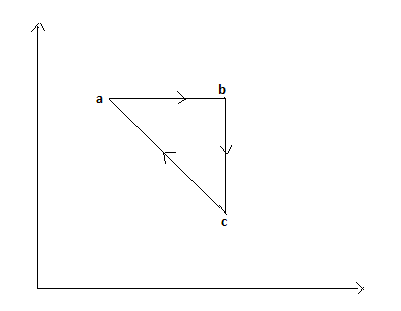
In the \[\;P - V\] diagram shown, the gas does \[5J\] of work in isothermal process \[\;a - b\] and \[4J\] in adiabatic process \[b - c\]. What will be the change in internal energy of the gas in the straight path \[c\] to\[a\]?
A) \[\left( {\text{A}} \right)9J\]
B) \[\left( {\text{B}} \right)1J\]
C) \[\left( {\text{C}} \right)4J\]
D) \[\left( {\text{D}} \right)5J\]
Answer
 Verified
616.2k+ views
Hint:The isothermal process is the process in which the temperature of the system remains constant when converting one form of energy into another form. It can also be said that the work is done in the isothermal process by keeping the temperature constant. Contrastingly, in the adiabatic process, the temperature is varying to keep the heat in a constant value.
Complete step by step answer:
From the diagram, we can understand that the process is cyclic. Therefore the net change in internal energy between the processes \[a\] to \[b\], \[b\] to \[c\] and \[c\]equals to zero.
\[\therefore \Delta U = \Delta {U_a} + \Delta {U_b} + \Delta {U_c} = 0......\left( 1 \right)\]
Since the process \[\;a - b\] is isothermal, the temperature is constant. Therefore the change in internal energy will be zero.
\[\therefore \Delta {U_a} = 0\]
And the process \[\;b - c\] is adiabatic, therefore the heat is constant.
\[\therefore \Delta Q = 0\]
Hence from the equation \[\left( 1 \right)\],
\[\Delta {U_a} + \Delta {U_b} + \Delta {U_c} = 0\]
\[ \rightarrow \Delta {U_b} = - \Delta {U_c}.....\left( 2 \right)\] (As we know \[\Delta {U_a} = 0\])
The internal energy decreases when the work is done using that energy \[\Delta {U_b} = - \Delta W\].
As we know that the work is done in the process \[\;b - c\] is \[4J\]
\[ \rightarrow \Delta {U_b} = - 4J\]
Applying this value in the equation \[\left( 2 \right)\], we get
\[\Delta {U_c} = 4J\]
Thus the change in internal energy of the gas in the straight path \[c\] to \[a\] is \[4J\].
Hence the correct option is C.
Note:The difference between the adiabatic and the isothermal process is that the heat is constant in the adiabatic process and the temperature is constant in the isothermal process.
The isothermal process occurs slowly to keep the equilibrium temperature.
Boyle’s law gives the relation between the pressure and volume \[\left( {\;P - V} \right)\] for the ideal gas of an object. It states that the pressure exerted by the object of an ideal gas is inversely proportional to its volume when the temperature and the amount of gas remain unchanged in the system. That is we write it as, \[PV = k\]
Complete step by step answer:
From the diagram, we can understand that the process is cyclic. Therefore the net change in internal energy between the processes \[a\] to \[b\], \[b\] to \[c\] and \[c\]equals to zero.
\[\therefore \Delta U = \Delta {U_a} + \Delta {U_b} + \Delta {U_c} = 0......\left( 1 \right)\]
Since the process \[\;a - b\] is isothermal, the temperature is constant. Therefore the change in internal energy will be zero.
\[\therefore \Delta {U_a} = 0\]
And the process \[\;b - c\] is adiabatic, therefore the heat is constant.
\[\therefore \Delta Q = 0\]
Hence from the equation \[\left( 1 \right)\],
\[\Delta {U_a} + \Delta {U_b} + \Delta {U_c} = 0\]
\[ \rightarrow \Delta {U_b} = - \Delta {U_c}.....\left( 2 \right)\] (As we know \[\Delta {U_a} = 0\])
The internal energy decreases when the work is done using that energy \[\Delta {U_b} = - \Delta W\].
As we know that the work is done in the process \[\;b - c\] is \[4J\]
\[ \rightarrow \Delta {U_b} = - 4J\]
Applying this value in the equation \[\left( 2 \right)\], we get
\[\Delta {U_c} = 4J\]
Thus the change in internal energy of the gas in the straight path \[c\] to \[a\] is \[4J\].
Hence the correct option is C.
Note:The difference between the adiabatic and the isothermal process is that the heat is constant in the adiabatic process and the temperature is constant in the isothermal process.
The isothermal process occurs slowly to keep the equilibrium temperature.
Boyle’s law gives the relation between the pressure and volume \[\left( {\;P - V} \right)\] for the ideal gas of an object. It states that the pressure exerted by the object of an ideal gas is inversely proportional to its volume when the temperature and the amount of gas remain unchanged in the system. That is we write it as, \[PV = k\]
Recently Updated Pages
Master Class 12 Economics: Engaging Questions & Answers for Success

Master Class 12 English: Engaging Questions & Answers for Success
Master Class 12 Social Science: Engaging Questions & Answers for Success
Master Class 12 Maths: Engaging Questions & Answers for Success
Master Class 12 Physics: Engaging Questions & Answers for Success
Master Class 9 General Knowledge: Engaging Questions & Answers for Success
Trending doubts
One Metric ton is equal to kg A 10000 B 1000 C 100 class 11 physics CBSE
Difference Between Prokaryotic Cells and Eukaryotic Cells
Two of the body parts which do not appear in MRI are class 11 biology CBSE
1 ton equals to A 100 kg B 1000 kg C 10 kg D 10000 class 11 physics CBSE
Draw a diagram of nephron and explain its structur class 11 biology CBSE
10 examples of friction in our daily life