




In the life cycle of Agaricus, secondary mycelium develops when
(a)Hyphae of two mating types showing plasmogamy
(b)Primary mycelium shows plasmogamy with the spermatia
(c)Basidiospore germinates
(d)Gametangial contact occurs
Answer
 Verified
633.9k+ views
Hint: Agaricus is a genus of fungi and is characterized by having a pileus that grows several radiating plates known as gills. These girls produced naked spores. It includes the widely consumed mushroom and some other edibles as well. The yellow staining mushroom is the inedible species in Agaricus. Dried Agaricus or Agaricus extract are found to be a fake cure to cancer by food and drug administration in the US.
Complete answer:
In the life cycle of Agaricus, secondary mycelium develops when hyphae of two mating types showing plasmogamy. It develops from the primary mycelium and after the fusion of hyphae. It forms two opposite strains that are the nucleus of one hypha that migrates to the other. It gives rise to the secondary mycelium which is binucleate or dikaryotic. It has abundant qualities and is long-lived. Hyphae septate and branch and the mycelium is subterranean. Cells communicate by each other with a central portion in the septum which is a typical dolipore septum.
Additional Information: Primary mycelium shows plasmogamy with the spermatia: It gets developed with the germination of uninucleate basidiospores that carry either positive or negative strain. These cells are uninucleate or monokaryotic that are short-lived and become binucleate with the fusion of two hyphae. The secondary mycelium grows under the soil and forms special tissues that form fruiting bodies or basidiocarp. Its structure is umbrella shaped. Tertiary mycelium constitutes dikaryotic hyphae.
Basidiospore germinates: Basidiocarp develops from the subterranean mycelial strand which is known as the rhizomorph. It absorbs food material, and mycelium is small in size which remains underground. Gill chamber or a ring-like cavity develops pileus strands at the junction of the stalk and pileus region. The basic video crop is not fully open at this stage and is connected with the stock by a membrane which is known as velum or inner veil. It gets broken with the enlargement of the cab and elongation of the stalk. It becomes exposed at maturity.
So, the correct answer is 'Hyphae of two mating types showing plasmogamy'.
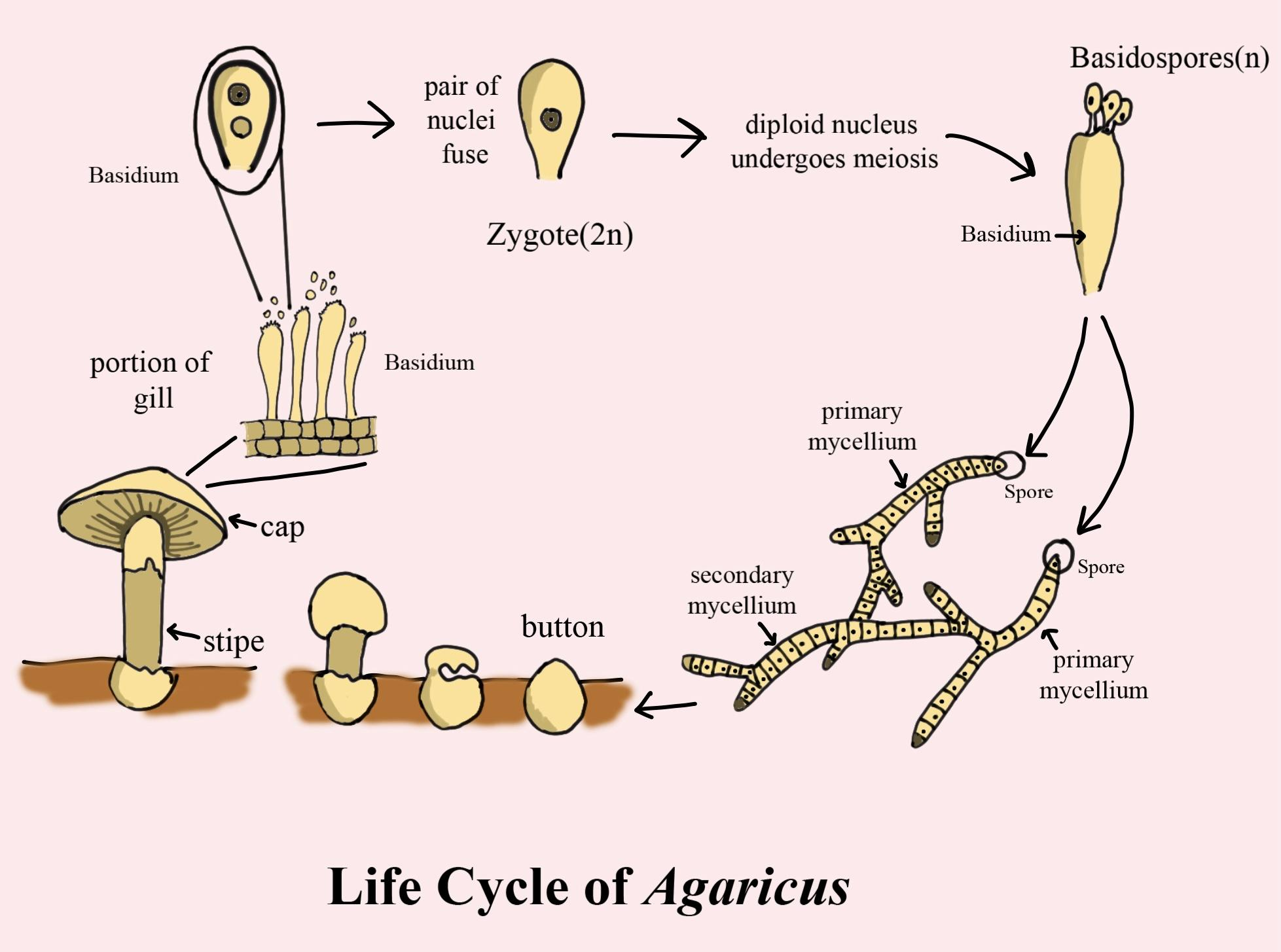
Note: The field mushroom is a creamy white cap and stem and has bright pink and chocolate brown colored gills. It becomes flattened and brownish tinge with its age. It is commonly confused with the species of deadly poisonous fungus that destroys angels in the button stage. Some species of fungus contain a chemical which causes sickness due to their poisonous nature. Some species of fungus are swallowed and can cause death in a few hours.
Complete answer:
In the life cycle of Agaricus, secondary mycelium develops when hyphae of two mating types showing plasmogamy. It develops from the primary mycelium and after the fusion of hyphae. It forms two opposite strains that are the nucleus of one hypha that migrates to the other. It gives rise to the secondary mycelium which is binucleate or dikaryotic. It has abundant qualities and is long-lived. Hyphae septate and branch and the mycelium is subterranean. Cells communicate by each other with a central portion in the septum which is a typical dolipore septum.
Additional Information: Primary mycelium shows plasmogamy with the spermatia: It gets developed with the germination of uninucleate basidiospores that carry either positive or negative strain. These cells are uninucleate or monokaryotic that are short-lived and become binucleate with the fusion of two hyphae. The secondary mycelium grows under the soil and forms special tissues that form fruiting bodies or basidiocarp. Its structure is umbrella shaped. Tertiary mycelium constitutes dikaryotic hyphae.
Basidiospore germinates: Basidiocarp develops from the subterranean mycelial strand which is known as the rhizomorph. It absorbs food material, and mycelium is small in size which remains underground. Gill chamber or a ring-like cavity develops pileus strands at the junction of the stalk and pileus region. The basic video crop is not fully open at this stage and is connected with the stock by a membrane which is known as velum or inner veil. It gets broken with the enlargement of the cab and elongation of the stalk. It becomes exposed at maturity.
So, the correct answer is 'Hyphae of two mating types showing plasmogamy'.
Note: The field mushroom is a creamy white cap and stem and has bright pink and chocolate brown colored gills. It becomes flattened and brownish tinge with its age. It is commonly confused with the species of deadly poisonous fungus that destroys angels in the button stage. Some species of fungus contain a chemical which causes sickness due to their poisonous nature. Some species of fungus are swallowed and can cause death in a few hours.
Recently Updated Pages
Which will be the least stable resonating structure class 11 chemistry CBSE

How many 5 digit telephone numbers can be construc-class-11-maths-CBSE
How do you find the angle of the resultant vector class 11 physics CBSE
Draw labelled diagram of the following i Gram seed class 11 biology CBSE
1 Quintal is equal to a 110 kg b 10 kg c 100kg d 1000 class 11 physics CBSE
What is the need and importance of classification class 11 biology CBSE
Trending doubts
One Metric ton is equal to kg A 10000 B 1000 C 100 class 11 physics CBSE
Find the value of the expression given below sin 30circ class 11 maths CBSE
Draw a diagram of nephron and explain its structur class 11 biology CBSE
10 examples of friction in our daily life
Proton was discovered by A Thomson B Rutherford C Chadwick class 11 chemistry CBSE
The teeth used for biting and cutting food are called class 11 biology CBSE