




In the interval \[\left[ 0,3 \right]\] , the number of points at which the function \[\left[ {{x}^{2}} \right]\sin \pi x\] ( \[\left[ . \right]\] is the usual integral part) is discontinuous are:
(a)\[4\]
(b)\[5\]
(c) \[6\]
(d) \[8\]
Answer
 Verified
639k+ views
Hint: \[\left[ g\left( x \right) \right]\] is continuous only at those points at which \[g\left( x \right)\] does not attain an integer value . If \[g\left( x \right)\] attains an integer value , \[\left[ g\left( x \right) \right]\] becomes discontinuous .
Complete step-by-step solution -
Let the given function be \[f\left( x \right)\] . So, we can say \[f\left( x \right)=\left[ {{x}^{2}} \right]\sin \pi x\] .
Now , we know the greatest integer function is defined as a function which rounds down a real number to the nearest integer . Its graph is as given as
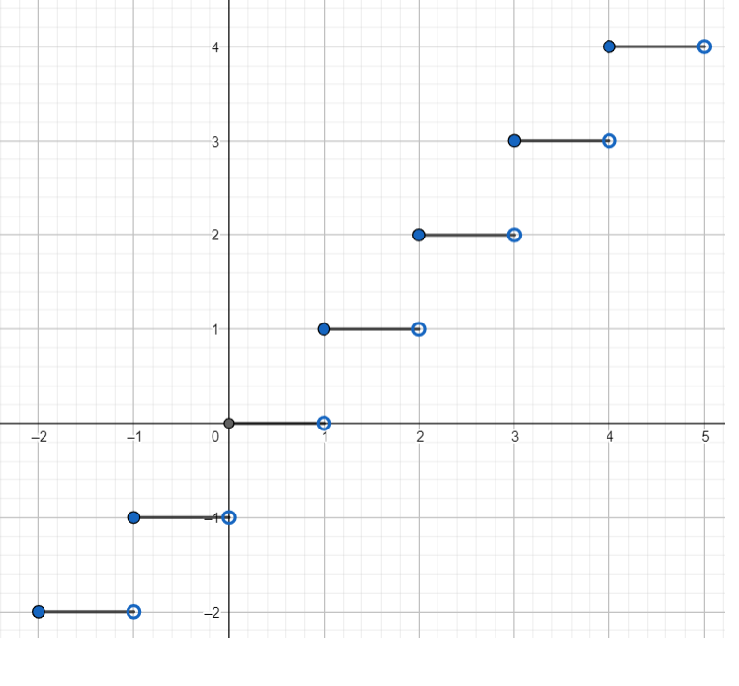
From the graph , we can clearly see that the graph is in the form of steps . So , from the graph we can conclude that the greatest integer function is discontinuous at integer points .
Now , we can define the function \[\left[ {{x}^{2}} \right]\] as:
\[\left[ {{x}^{2}} \right]=\left\{ \begin{align}
& 0,\text{ }0\le x<1 \\
& 1,\text{ }1\le x<\sqrt{2} \\
& 2,\text{ }\sqrt{2}\le x<\sqrt{3} \\
& 3,\text{ }\sqrt{3}\le x<2 \\
& 4,\text{ }2\le x<\sqrt{5} \\
& 5,\text{ }\sqrt{5}\le x<\sqrt{6} \\
& 6,\text{ }\sqrt{6}\le x<\sqrt{7} \\
& 7,\text{ }\sqrt{7}\le x\sqrt{8} \\
& 8,\text{ }\sqrt{8}\le x<3 \\
& 9,\text{ }x=3 \\
\end{align} \right.\]
The graph of the function \[\left[ {{x}^{2}} \right]\] is given as:
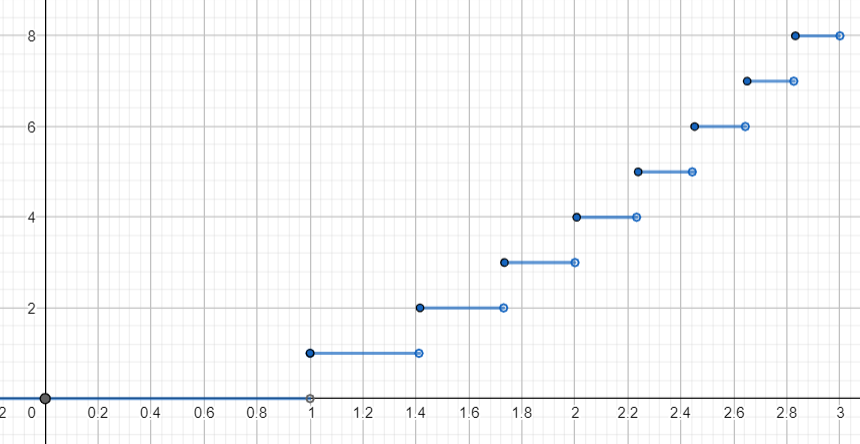
From the graph we can see that \[\left[ g\left( x \right) \right]\] is discontinuous at points where \[g\left( x \right)\] becomes an integer.
So , \[\left[ {{x}^{2}} \right]\] should be discontinuous at \[x=0,x=1,x=\sqrt{2},x=\sqrt{3},x=2,x=\sqrt{5},x=\sqrt{6},x=\sqrt{7},x=\sqrt{8}\] and \[x=3\] .
But , since \[f\left( x \right)\] is defined in the interval \[x\in \left[ 0,3 \right]\] , \[f\left( x \right)\] does not exist to the left of \[x=0\] and to right of \[x=3\] .
So , continuity of function \[f\left( x \right)\] cannot be discussed at \[x=0\] and at \[x=3\] .
Now , in the interval \[\left[ 0,3 \right]\] , we can see there are \[8\] points at which \[\left[ {{x}^{2}} \right]\] is discontinuous i.e. \[{{x}^{2}}\] attains an integer value.
These points are \[x=1,\text{ }x=\sqrt{2},\text{ }x=\sqrt{3},\text{ }x=2,\text{ }x=\sqrt{5},\text{ }x=\sqrt{6},\text{ }x=\sqrt{7}\] and \[x=\sqrt{8}\] .
Hence, the function \[f\left( x \right)=\left[ {{x}^{2}} \right]\sin \pi x\] is discontinuous at these \[8\] points.
Note: The critical points for the function \[\left[ {{x}^{2}} \right]\]are \[x=0,x=1,x=\sqrt{2},x=\sqrt{3},x=2,x=\sqrt{5},x=\sqrt{6},x=\sqrt{7},x=\sqrt{8}\] and \[x=3\] and not \[x=0,x=1,x=2,x=3,x=4,x=5,x=6,x=7,x=8\] and \[x=9\] as in GIF there is square of x so the domain will contains those value whose square is an integer. Students often make this mistake. Due to such mistakes , they end up getting a wrong answer . So , such mistakes should be avoided .
Complete step-by-step solution -
Let the given function be \[f\left( x \right)\] . So, we can say \[f\left( x \right)=\left[ {{x}^{2}} \right]\sin \pi x\] .
Now , we know the greatest integer function is defined as a function which rounds down a real number to the nearest integer . Its graph is as given as
From the graph , we can clearly see that the graph is in the form of steps . So , from the graph we can conclude that the greatest integer function is discontinuous at integer points .
Now , we can define the function \[\left[ {{x}^{2}} \right]\] as:
\[\left[ {{x}^{2}} \right]=\left\{ \begin{align}
& 0,\text{ }0\le x<1 \\
& 1,\text{ }1\le x<\sqrt{2} \\
& 2,\text{ }\sqrt{2}\le x<\sqrt{3} \\
& 3,\text{ }\sqrt{3}\le x<2 \\
& 4,\text{ }2\le x<\sqrt{5} \\
& 5,\text{ }\sqrt{5}\le x<\sqrt{6} \\
& 6,\text{ }\sqrt{6}\le x<\sqrt{7} \\
& 7,\text{ }\sqrt{7}\le x\sqrt{8} \\
& 8,\text{ }\sqrt{8}\le x<3 \\
& 9,\text{ }x=3 \\
\end{align} \right.\]
The graph of the function \[\left[ {{x}^{2}} \right]\] is given as:
From the graph we can see that \[\left[ g\left( x \right) \right]\] is discontinuous at points where \[g\left( x \right)\] becomes an integer.
So , \[\left[ {{x}^{2}} \right]\] should be discontinuous at \[x=0,x=1,x=\sqrt{2},x=\sqrt{3},x=2,x=\sqrt{5},x=\sqrt{6},x=\sqrt{7},x=\sqrt{8}\] and \[x=3\] .
But , since \[f\left( x \right)\] is defined in the interval \[x\in \left[ 0,3 \right]\] , \[f\left( x \right)\] does not exist to the left of \[x=0\] and to right of \[x=3\] .
So , continuity of function \[f\left( x \right)\] cannot be discussed at \[x=0\] and at \[x=3\] .
Now , in the interval \[\left[ 0,3 \right]\] , we can see there are \[8\] points at which \[\left[ {{x}^{2}} \right]\] is discontinuous i.e. \[{{x}^{2}}\] attains an integer value.
These points are \[x=1,\text{ }x=\sqrt{2},\text{ }x=\sqrt{3},\text{ }x=2,\text{ }x=\sqrt{5},\text{ }x=\sqrt{6},\text{ }x=\sqrt{7}\] and \[x=\sqrt{8}\] .
Hence, the function \[f\left( x \right)=\left[ {{x}^{2}} \right]\sin \pi x\] is discontinuous at these \[8\] points.
Note: The critical points for the function \[\left[ {{x}^{2}} \right]\]are \[x=0,x=1,x=\sqrt{2},x=\sqrt{3},x=2,x=\sqrt{5},x=\sqrt{6},x=\sqrt{7},x=\sqrt{8}\] and \[x=3\] and not \[x=0,x=1,x=2,x=3,x=4,x=5,x=6,x=7,x=8\] and \[x=9\] as in GIF there is square of x so the domain will contains those value whose square is an integer. Students often make this mistake. Due to such mistakes , they end up getting a wrong answer . So , such mistakes should be avoided .
Recently Updated Pages
Master Class 12 Business Studies: Engaging Questions & Answers for Success

Master Class 12 Biology: Engaging Questions & Answers for Success
Master Class 12 Chemistry: Engaging Questions & Answers for Success
Class 12 Question and Answer - Your Ultimate Solutions Guide
Master Class 11 Social Science: Engaging Questions & Answers for Success
Master Class 11 English: Engaging Questions & Answers for Success
Trending doubts
Which are the Top 10 Largest Countries of the World?
Draw a labelled sketch of the human eye class 12 physics CBSE
Differentiate between homogeneous and heterogeneous class 12 chemistry CBSE
Sulphuric acid is known as the king of acids State class 12 chemistry CBSE
Why is the cell called the structural and functional class 12 biology CBSE
Which is the correct genotypic ratio of mendel dihybrid class 12 biology CBSE