




In the hysteresis cycle, the value of H needed to make the intensity of magnetism zero is called
A. Retentivity
B. Coercive force
C. Lorentz force
D. None of the above
Answer
 Verified
631.8k+ views
Hint: In this question, we first see the hysteresis loop and see the point of saturation, the point of retentivity, and the point of coercivity. From the hysteresis, we see that the residual magnetism is called retentivity and the point where the magnetism becomes zero is called coercivity.
Step-By-Step answer:
The hysteresis loop is the graph plotted between the intensity of Magnetization M and the magnetizing field intensity H. this loop is made because when a ferromagnetic material is magnetized to some value, it will not return back to the initial zero magnetization after the applied field is removed hence resulting in a loop called as the hysteresis loop.
Now seeing the plot of the hysteresis loop in figure 1 we will see each part one by one that is,
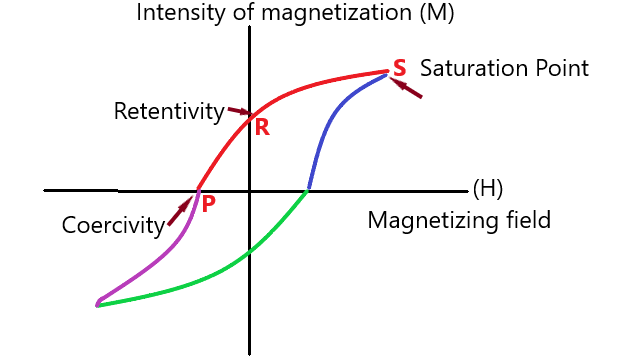
Figure 1
First, we apply a magnetic field intensity (H) and due to this, the intensity of Magnetization (M) starts rising from the initial value that is zero. After that The intensity of Magnetization(M) eventually reaches a point S where it gets saturated hence, known as saturation point.
Then we start reducing the magnetic field intensity (H) due to this the magnetism (M) also starts to reduce but it follows a different path and because of this at point R when (H) becomes zero the (M) does not become zero that is the material still retains some magnetism known as residual magnetism or Retentivity of the material.
So to demagnetize the material completely we need to apply a negative magnetic field intensity and at point P the magnetism becomes zero. This force which is needed to remove the Retentivity is called Coercive force and it is also known as the coercivity of the material.
Therefore from the above explanation, we can see that the value of H needed to make M zero is the coercive force, so the correct option is C.
Note: For these types of questions we need to know about the different types of magnetic material that are paramagnetic, diamagnetic, antiferromagnetic, ferromagnetic, and ferrimagnetic materials. Then we need to know about the mechanism of magnetism, demagnetism, magnetic dipole, magnetic domains, and hysteresis loop.
Step-By-Step answer:
The hysteresis loop is the graph plotted between the intensity of Magnetization M and the magnetizing field intensity H. this loop is made because when a ferromagnetic material is magnetized to some value, it will not return back to the initial zero magnetization after the applied field is removed hence resulting in a loop called as the hysteresis loop.
Now seeing the plot of the hysteresis loop in figure 1 we will see each part one by one that is,
Figure 1
First, we apply a magnetic field intensity (H) and due to this, the intensity of Magnetization (M) starts rising from the initial value that is zero. After that The intensity of Magnetization(M) eventually reaches a point S where it gets saturated hence, known as saturation point.
Then we start reducing the magnetic field intensity (H) due to this the magnetism (M) also starts to reduce but it follows a different path and because of this at point R when (H) becomes zero the (M) does not become zero that is the material still retains some magnetism known as residual magnetism or Retentivity of the material.
So to demagnetize the material completely we need to apply a negative magnetic field intensity and at point P the magnetism becomes zero. This force which is needed to remove the Retentivity is called Coercive force and it is also known as the coercivity of the material.
Therefore from the above explanation, we can see that the value of H needed to make M zero is the coercive force, so the correct option is C.
Note: For these types of questions we need to know about the different types of magnetic material that are paramagnetic, diamagnetic, antiferromagnetic, ferromagnetic, and ferrimagnetic materials. Then we need to know about the mechanism of magnetism, demagnetism, magnetic dipole, magnetic domains, and hysteresis loop.
Recently Updated Pages
Master Class 11 Social Science: Engaging Questions & Answers for Success

Master Class 11 Chemistry: Engaging Questions & Answers for Success
Master Class 12 Business Studies: Engaging Questions & Answers for Success
Master Class 12 Chemistry: Engaging Questions & Answers for Success
Master Class 12 Biology: Engaging Questions & Answers for Success
Class 12 Question and Answer - Your Ultimate Solutions Guide
Trending doubts
One Metric ton is equal to kg A 10000 B 1000 C 100 class 11 physics CBSE
Difference Between Prokaryotic Cells and Eukaryotic Cells
How many of the following diseases can be studied with class 11 biology CBSE
Two of the body parts which do not appear in MRI are class 11 biology CBSE
Which of the following enzymes is used for carboxylation class 11 biology CBSE
Explain zero factorial class 11 maths CBSE