




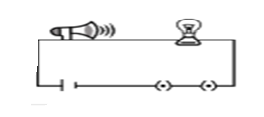
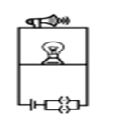
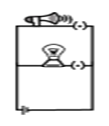
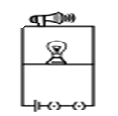
In the house of a person who is weak in hearing, a light bulb is also lit when somebody rings the doorbell. The ring can be operated both from the garden gate and from the door of the house. Select the correct possible circuit(s) required.
A)
B)
C)
D)
Answer
 Verified
628.5k+ views
Hint: When appliances connected in parallel then current flowing through them is different but potential difference or voltage across them is the same. And in the case of series connection, current flowing through them is the same and potential difference is different.
Complete step by step answer:
In a parallel circuit, the voltage across each of the components remains the same, and the total current is the sum of the currents through each component. If one of the components in the parallel connection goes wrong, the other components will function without any hindrance. Therefore, in this case, there are two switches in the circuit, one on the door and one on the gate. Both the switches are connected in parallel and then, the bell and the light bulb are connected in parallel. Each component operates independently of each other and can function if any one of the components goes wrong.
Hence, circuit B is correct
Additional information:
Every electrical appliance will have rated or design values like wattage, voltage printed on it. These values give information about resistance and allowable current etc.., let $P$ and $V$ be the power and voltage rating on a bulb.
As the three bulbs are connected in parallel, the voltage applied across them would be the same, let us consider as $V$ and current through each of them is different.
Now, due to the fact that the power dissipated by the three bulbs is different, also the current flowing through them would be different and thus they will have different brightness.
We know that the brightness of the bulb is directly proportional to the power it uses or the amount of current it draws.
Note:
When appliances are connected in parallel then current flowing through them is different but potential difference or voltage across them is the same. And in the case of series connection, current flowing through them is the same and potential difference is different.
In parallel connection, if one appliance gets fused the other will work.
Complete step by step answer:
In a parallel circuit, the voltage across each of the components remains the same, and the total current is the sum of the currents through each component. If one of the components in the parallel connection goes wrong, the other components will function without any hindrance. Therefore, in this case, there are two switches in the circuit, one on the door and one on the gate. Both the switches are connected in parallel and then, the bell and the light bulb are connected in parallel. Each component operates independently of each other and can function if any one of the components goes wrong.
Hence, circuit B is correct
Additional information:
Every electrical appliance will have rated or design values like wattage, voltage printed on it. These values give information about resistance and allowable current etc.., let $P$ and $V$ be the power and voltage rating on a bulb.
As the three bulbs are connected in parallel, the voltage applied across them would be the same, let us consider as $V$ and current through each of them is different.
Now, due to the fact that the power dissipated by the three bulbs is different, also the current flowing through them would be different and thus they will have different brightness.
We know that the brightness of the bulb is directly proportional to the power it uses or the amount of current it draws.
Note:
When appliances are connected in parallel then current flowing through them is different but potential difference or voltage across them is the same. And in the case of series connection, current flowing through them is the same and potential difference is different.
In parallel connection, if one appliance gets fused the other will work.
Recently Updated Pages
Master Class 5 English: Engaging Questions & Answers for Success

Master Class 5 Maths: Engaging Questions & Answers for Success
Master Class 5 Social Science: Engaging Questions & Answers for Success
Master Class 5 Science: Engaging Questions & Answers for Success
Class 5 Question and Answer - Your Ultimate Solutions Guide
Master Class 9 General Knowledge: Engaging Questions & Answers for Success
Trending doubts
Which are the Top 10 Largest Countries of the World?
The total number of vertebrae in man is a30 b31 c32 class 12 biology CBSE
Draw a labelled sketch of the human eye class 12 physics CBSE
The number of cranial nerves in a frog is A 10 pairs class 12 biology CBSE
Differentiate between homogeneous and heterogeneous class 12 chemistry CBSE
Differentiate between Pyramid of energy and pyramid class 12 biology CBSE