




In the ground state Cl atom, how many electrons have quantum number l=1?
Answer
 Verified
571.2k+ views
Hint:The electronic configuration says about how the electrons are distributed in atomic orbitals. The electronic configuration is filled according to the energy they have. They follow the standard notion in which electrons containing the atomic subshells are placed in a sequence. For example, the Magnesium’s electron configuration; \[Mg = {\text{ }}1{s^2}2{s^2}2{p^6}3{s^2}\]
Complete step-by-step answer:The full electronic configuration of any element is written in a standard format. But when it comes to higher elements will consist of many numbers of orbital, so for simplification condensed electronic configuration is noted.
Thus, there are \[7\] valence electrons in the chlorine atom.
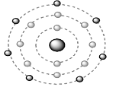
In the case of valence electrons of chlorine, the outermost electrons present in the darker shade is the valence. These valence electrons are crucial to effective chemical bonding and are usually the sole participants in chemical reactions (as opposed to core participation).
In the ground state of chlorine, the electronic configuration is;
\[Cl = {\text{ }}1{s^2}2{s^2}2{p^6}3{s^2}\,3{p^5}\]
The quantum number \[(l)\] is an azimuthal quantum number (orbital angular momentum quantum number). If the \[l = 1\] that means it is \[p\] orbital.
As we know,
The Azimuthal quantum number ranges between \[0\]and \[n - 1\].
If, \[l = 0\,\,{\text{then it is }}s\],
\[l = 1\,\,{\text{then it is }}p\],
\[l = 2\,\,{\text{then it is }}d\], and so on.
So, here we have;
\[l = 1\] which is \[p - \] orbital
So, we have
\[2{p^6}\,and\,3{p^5}\]
Let’s sum the electrons of \[p - \] orbital;
\[6\, + \,5\, = \,11\]
We get,
\[11\] electrons
So, the total number of electrons is \[11\] electrons.
Note:Chlorine \[(Cl)\] whose atomic number is \[17\] , which is having \[17\] electrons. The \[17\] protons are there in atomic nuclei. A neutral atom has the same number of protons as well as the same number of electrons. When it comes to the case of chlorine, it is in the \[{3^{rd}}\] period of the table and the group \[17\] element. The silicon has \[7\] valence electrons.
Complete step-by-step answer:The full electronic configuration of any element is written in a standard format. But when it comes to higher elements will consist of many numbers of orbital, so for simplification condensed electronic configuration is noted.
Thus, there are \[7\] valence electrons in the chlorine atom.
In the case of valence electrons of chlorine, the outermost electrons present in the darker shade is the valence. These valence electrons are crucial to effective chemical bonding and are usually the sole participants in chemical reactions (as opposed to core participation).
In the ground state of chlorine, the electronic configuration is;
\[Cl = {\text{ }}1{s^2}2{s^2}2{p^6}3{s^2}\,3{p^5}\]
The quantum number \[(l)\] is an azimuthal quantum number (orbital angular momentum quantum number). If the \[l = 1\] that means it is \[p\] orbital.
As we know,
The Azimuthal quantum number ranges between \[0\]and \[n - 1\].
If, \[l = 0\,\,{\text{then it is }}s\],
\[l = 1\,\,{\text{then it is }}p\],
\[l = 2\,\,{\text{then it is }}d\], and so on.
So, here we have;
\[l = 1\] which is \[p - \] orbital
So, we have
\[2{p^6}\,and\,3{p^5}\]
Let’s sum the electrons of \[p - \] orbital;
\[6\, + \,5\, = \,11\]
We get,
\[11\] electrons
So, the total number of electrons is \[11\] electrons.
Note:Chlorine \[(Cl)\] whose atomic number is \[17\] , which is having \[17\] electrons. The \[17\] protons are there in atomic nuclei. A neutral atom has the same number of protons as well as the same number of electrons. When it comes to the case of chlorine, it is in the \[{3^{rd}}\] period of the table and the group \[17\] element. The silicon has \[7\] valence electrons.
Recently Updated Pages
Master Class 11 Social Science: Engaging Questions & Answers for Success

Master Class 11 English: Engaging Questions & Answers for Success
Master Class 11 Maths: Engaging Questions & Answers for Success
Master Class 11 Chemistry: Engaging Questions & Answers for Success
Master Class 11 Biology: Engaging Questions & Answers for Success
Master Class 11 Physics: Engaging Questions & Answers for Success
Trending doubts
One Metric ton is equal to kg A 10000 B 1000 C 100 class 11 physics CBSE
Difference Between Prokaryotic Cells and Eukaryotic Cells
Draw a diagram of a plant cell and label at least eight class 11 biology CBSE
Two of the body parts which do not appear in MRI are class 11 biology CBSE
Which gas is abundant in air class 11 chemistry CBSE
10 examples of friction in our daily life