




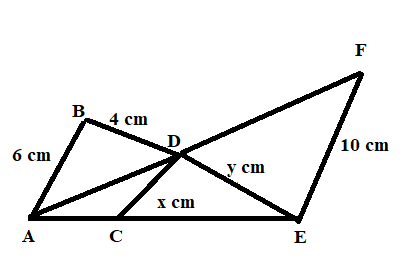
In the given figure, we have AB || CD || EF. If AB = 6 cm, CD = x, BD = 4 cm and DE = y cm, calculate the value of x and y.
Answer
 Verified
651k+ views
Hint: As given in the question, AB is parallel to CD which is again parallel to EF. Now we have to prove triangle ADB and triangle EDF are similar. After proving this, we get the ratio of their corresponding sides and we get the value of y. Now, we take again two Triangles triangle ADE and triangle CDE. Since, both the triangles are similar, the ratio of their corresponding sides is equal. By this we get the value of x.
Complete step by step answer:
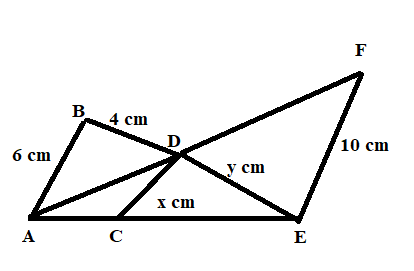
As stated in the problem, AB is parallel to CD which is again parallel to EF. So, by using the diagram we proceed for proving the triangle similar.
First, we take \[\Delta ADB\text{ and }\Delta EDF\], now we have to prove that both the triangles are similar.
In $\Delta ADB\text{ and }\Delta EDF$
$\angle ADB=\angle EDF$(Using vertical opposite angles property)
$\angle ABD=\angle FED$ (Using alternate angles property)
$\angle BAD=\angle EFD$ (Using alternate angles property)
$\therefore \Delta ADB\sim \Delta EDF$ (By using Angle Side Angle criterion)
Now, the ratio of their corresponding sides is:
\[\begin{align}
& \Rightarrow \dfrac{BD}{DE}=\dfrac{AB}{FE} \\
& \Rightarrow \dfrac{4}{y}=\dfrac{6}{10} \\
& \Rightarrow 6y=40 \\
& \Rightarrow y=\dfrac{40}{6}=\dfrac{20}{3} \\
& \Rightarrow y=6.67cm \\
\end{align}\]
Hence, the value of y is 6.67 cm.
Similarly, $\Delta ADE\sim \Delta CDE$ (using Angle-Angle criterion)
$\begin{align}
& \Rightarrow \dfrac{DE}{BE}=\dfrac{DC}{BA} \\
& \Rightarrow \dfrac{6.67}{10.67}=\dfrac{x}{6} \\
& \Rightarrow x=6\times \dfrac{6.67}{10.67} \\
& \Rightarrow x=3.75cm \\
\end{align}$
Hence, the value of x is 3.75 cm.
Therefore, the obtained values of the x and y are 3.75 and 6.67 respectively.
Note: The key concept involved in solving this problem is the knowledge of similar triangles. Students must be careful while proving the triangle is similar using certain observable properties. The property of proportionality of sides in a similar triangle is useful in solving this problem.
Complete step by step answer:
As stated in the problem, AB is parallel to CD which is again parallel to EF. So, by using the diagram we proceed for proving the triangle similar.
First, we take \[\Delta ADB\text{ and }\Delta EDF\], now we have to prove that both the triangles are similar.
In $\Delta ADB\text{ and }\Delta EDF$
$\angle ADB=\angle EDF$(Using vertical opposite angles property)
$\angle ABD=\angle FED$ (Using alternate angles property)
$\angle BAD=\angle EFD$ (Using alternate angles property)
$\therefore \Delta ADB\sim \Delta EDF$ (By using Angle Side Angle criterion)
Now, the ratio of their corresponding sides is:
\[\begin{align}
& \Rightarrow \dfrac{BD}{DE}=\dfrac{AB}{FE} \\
& \Rightarrow \dfrac{4}{y}=\dfrac{6}{10} \\
& \Rightarrow 6y=40 \\
& \Rightarrow y=\dfrac{40}{6}=\dfrac{20}{3} \\
& \Rightarrow y=6.67cm \\
\end{align}\]
Hence, the value of y is 6.67 cm.
Similarly, $\Delta ADE\sim \Delta CDE$ (using Angle-Angle criterion)
$\begin{align}
& \Rightarrow \dfrac{DE}{BE}=\dfrac{DC}{BA} \\
& \Rightarrow \dfrac{6.67}{10.67}=\dfrac{x}{6} \\
& \Rightarrow x=6\times \dfrac{6.67}{10.67} \\
& \Rightarrow x=3.75cm \\
\end{align}$
Hence, the value of x is 3.75 cm.
Therefore, the obtained values of the x and y are 3.75 and 6.67 respectively.
Note: The key concept involved in solving this problem is the knowledge of similar triangles. Students must be careful while proving the triangle is similar using certain observable properties. The property of proportionality of sides in a similar triangle is useful in solving this problem.
Recently Updated Pages
Master Class 11 Social Science: Engaging Questions & Answers for Success

Master Class 11 English: Engaging Questions & Answers for Success
Master Class 11 Maths: Engaging Questions & Answers for Success
Master Class 11 Chemistry: Engaging Questions & Answers for Success
Master Class 11 Biology: Engaging Questions & Answers for Success
Class 11 Question and Answer - Your Ultimate Solutions Guide
Trending doubts
Explain the Treaty of Vienna of 1815 class 10 social science CBSE
Why is it 530 pm in india when it is 1200 afternoon class 10 social science CBSE
What is the full form of POSCO class 10 social science CBSE
Define Potential, Developed, Stock and Reserved resources
Which Country Has the Largest Border with India?
Choose the feminine form of the given noun Fox AFoxess class 10 english CBSE