




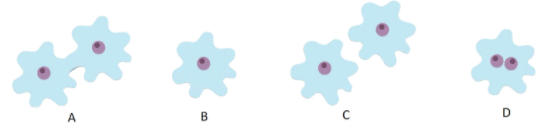
In the given figure, there are stages of binary fission in Amoeba. Which one out of the following would you select as the correct sequence of these stages?
A) A, B, C, D
B) A, C, D, B
C) B, D, A, C
D) C, A, D, B
Answer
 Verified
508.2k+ views
Hint: Binary fission, a form of asexual mode of reproduction, is typically found in prokaryotes and a few single-celled eukaryotes. It involves the division of the parent cell into two new daughter cells. In this process, the genetic material of the parent cell divides and duplicates into two parts. Hence, each daughter cell gets one copy of its parent DNA.
Complete answer:
Binary Fission in Amoeba
Being a unicellular organism, Amoeba also reproduces through binary fission. Now let us look at each of the stages shown in the image to find out the correct sequence of binary fission in Amoeba.
Stage (A): It shows the process of Cytokinesis. In this process, the cell’s cytoplasm divides into two daughter Amoebae cells having a nucleus and its own cell organelles.
Stage (B): It shows the parent Amoeba which duplicates its genetic material through mitotic division.
Stage (C): It shows the 2 new daughter cells formed after the process of cytokinesis.
Stage (D): It shows the process of Karyokinesis. In this process, the nucleus of the Amoeba divides to form 2 daughter nuclei. An Amoeba that is about to undergo division grows to become large, and finally, its nucleus extends and divides into two. The process is followed by cytokinesis. Thus, the correct order of sequence will be B, D, A, C
Thus the correct answer is option ‘C’.
Note: The advantage of binary fission is that it is a simple and fast process that only requires a single organism. But it is considered disadvantageous because the DNA that is passed on by the parent cell is unaltered, meaning there is no genetic variation.
Complete answer:
Binary Fission in Amoeba
Being a unicellular organism, Amoeba also reproduces through binary fission. Now let us look at each of the stages shown in the image to find out the correct sequence of binary fission in Amoeba.
Stage (A): It shows the process of Cytokinesis. In this process, the cell’s cytoplasm divides into two daughter Amoebae cells having a nucleus and its own cell organelles.
Stage (B): It shows the parent Amoeba which duplicates its genetic material through mitotic division.
Stage (C): It shows the 2 new daughter cells formed after the process of cytokinesis.
Stage (D): It shows the process of Karyokinesis. In this process, the nucleus of the Amoeba divides to form 2 daughter nuclei. An Amoeba that is about to undergo division grows to become large, and finally, its nucleus extends and divides into two. The process is followed by cytokinesis. Thus, the correct order of sequence will be B, D, A, C
Thus the correct answer is option ‘C’.
Note: The advantage of binary fission is that it is a simple and fast process that only requires a single organism. But it is considered disadvantageous because the DNA that is passed on by the parent cell is unaltered, meaning there is no genetic variation.
Recently Updated Pages
Master Class 11 Computer Science: Engaging Questions & Answers for Success

Master Class 11 Business Studies: Engaging Questions & Answers for Success
Master Class 11 Economics: Engaging Questions & Answers for Success
Master Class 11 English: Engaging Questions & Answers for Success
Master Class 11 Maths: Engaging Questions & Answers for Success
Master Class 11 Biology: Engaging Questions & Answers for Success
Trending doubts
One Metric ton is equal to kg A 10000 B 1000 C 100 class 11 physics CBSE
There are 720 permutations of the digits 1 2 3 4 5 class 11 maths CBSE
Discuss the various forms of bacteria class 11 biology CBSE
Draw a diagram of a plant cell and label at least eight class 11 biology CBSE
State the laws of reflection of light
Explain zero factorial class 11 maths CBSE