




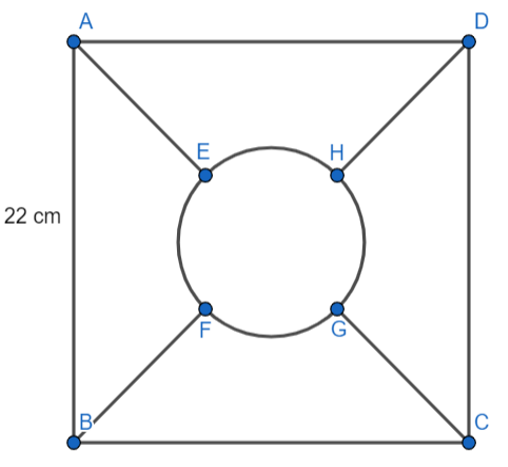
In the given figure, the square ABCD is divided into five equal roots, all having the same area. The central part is circular and the lines AE, GC, BF, and HD lie along diagonals AC and BD of the square. If AB=22cm, find the circumference of the central part.
Answer
 Verified
585.6k+ views
Hint: We should find the area of total square. Now we should divide the obtained area by 5. This gives the central part of the area of the circle. Now by using the formula for the area of the circle, we should find the radius of the central part of the circle. We know that the circumference of the circle is equal to \[2\pi r\] where r is the radius of the circle. By using the radius of the circle, we have to find the circumference of the central part of the circle.
Complete step-by-step solution:
Before solving the question, we should know that if the side of the square is equal to a, then the area of the square is equal to \[{{a}^{2}}\].
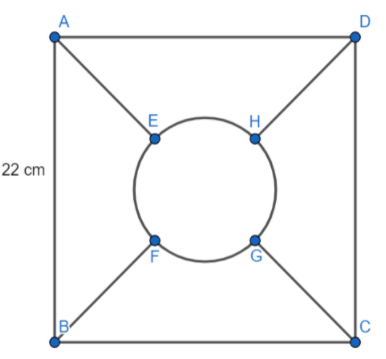
From the question, it was given that the side of the square is equal to 22 cm.
Let us assume \[a=22cm\].
We know that if the side of the square is equal to a, then the area of the square is equal to \[{{a}^{2}}\].
Then we get,
\[{{a}^{2}}={{(22)}^{2}}c{{m}^{2}}=484c{{m}^{2}}\]
So, the area of the square is equal to \[484c{{m}^{2}}\].
In the question, it is given that the area of the square is divided into 5 parts.
So, the area of each part \[=\dfrac{484}{5}c{{m}^{2}}=96.8c{{m}^{2}}\]
As the area of each part is equal to \[96.8c{{m}^{2}}\], the area of the circle is equal to \[96.8c{{m}^{2}}\].
We know that if the radius of the circle is r, then the area of the circle is equal to \[\pi {{r}^{2}}\].
So, we get
\[\Rightarrow \pi {{r}^{2}}=96.8c{{m}^{2}}\]
By using cross multiplication, we get
\[\begin{align}
& \Rightarrow {{r}^{2}}=\dfrac{96.8}{\pi }c{{m}^{2}} \\
& \Rightarrow r=\sqrt{\dfrac{96.8}{\pi }}cm \\
\end{align}\]
We know that if the radius of the circle is r, then the circumference of the circle is equal to \[2\pi r\].
\[\Rightarrow \]Circumference\[=2\pi \sqrt{\dfrac{96.8}{\pi }}cm\]
\[\Rightarrow \]Circumference \[=2\sqrt{(96.8)\pi }cm\]
So, the circumference of the central part of the circle is equal to \[2\sqrt{(96.8)\pi }cm\].
Note: This question can be solved in another method also.
Let us assume the central part of the circle as O. Now join O with all vertices of the square. Let us draw a perpendicular from O to side AB at the point I. So, it is clear that triangle AOI and triangle BOI are right-angled triangles.
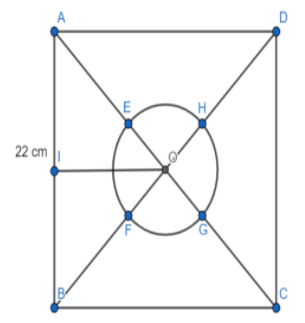
The area of sector OEF is equal to the difference in the area of triangle AOB and area of region AEFB.
Area of triangle AOB = Area of triangle AOI + Area of triangle BOI.
Area of triangle AOI \[=\dfrac{1}{2}(IO)(AI)....(1)\]
We know that if the side of a square is a, then the length of the diagonal of the square is equal to \[a\sqrt{2}\].
As the side of the square is equal to 22 cm, then the length of the diagonal of the square is equal to \[22\sqrt{2}cm\].
From the diagram, it is clear that
AC = AO + OB = 2AO
\[\begin{align}
& \Rightarrow 2AO=22\sqrt{2} \\
& \Rightarrow AO=11\sqrt{2}....(2) \\
\end{align}\]
As ‘I’ is the midpoint of side AB, we get AI is equal to 11 cm.
From the triangle AOI, we get
\[\Rightarrow A{{O}^{2}}=O{{I}^{2}}+A{{I}^{2}}\]
From equation (2), we get
\[\begin{align}
& \Rightarrow {{(11\sqrt{2})}^{2}}=O{{I}^{2}}+{{(11)}^{2}} \\
& \Rightarrow OI=11cm.....(3) \\
\end{align}\]
Now we will substitute equation (2) and equation (3) in equation (1).
Area of triangle AOI \[=\dfrac{1}{2}(IO)(AI)=\dfrac{1}{2}(11)(11)=\dfrac{121}{2}.\]
In a similar manner,
Area of triangle BOI \[=\dfrac{121}{2}\].
Hence,
Area of triangle AOB = Area of triangle AOI + Area of triangle BOI \[=\dfrac{121}{2}+\dfrac{121}{2}=121\]
From the question, it was given that the side of the square is equal to 22 cm.
Let us assume \[a=22cm\].
We know that if the side of the square is equal to a, then the area of the square is equal to \[{{a}^{2}}\].
Then we get,
\[{{a}^{2}}={{(22)}^{2}}c{{m}^{2}}=484c{{m}^{2}}\]
So, the area of the square is equal to \[484c{{m}^{2}}\].
In the question, it is given that the area of the square is divided into 5 parts.
So, the area of each part \[=\dfrac{484}{5}c{{m}^{2}}=96.8c{{m}^{2}}\]
So, the area of region AEFB is equal to \[96.8\].
The area of sector OEF is equal to the difference in the area of triangle AOB and area of region AEFB.
So, the area of sector OEF \[=(121-96.8)c{{m}^{2}}=24.2c{{m}^{2}}\].
In a similar way,
Area of sector OEH \[=24.2c{{m}^{2}}\]
Area of sector OGH \[=24.2c{{m}^{2}}\]
Area of sector OFH \[=24.2c{{m}^{2}}\]
So, the area of central circle = Area of sector OEG + Area of sector OGH +Area of sector OFH + Area of sector OFH.
So,
Area of central circle \[=24.2+24.2+24.2+24.2=96.8\]
We know that if the radius of the circle is r, then the area of the circle is equal to \[\pi {{r}^{2}}\].
So, we get
\[\Rightarrow \pi {{r}^{2}}=96.8c{{m}^{2}}\]
By using cross multiplication, we get
\[\begin{align}
& \Rightarrow {{r}^{2}}=\dfrac{96.8}{\pi }c{{m}^{2}} \\
& \Rightarrow r=\sqrt{\dfrac{96.8}{\pi }}cm \\
\end{align}\]
We know that if the radius of the circle is r, then the circumference of the circle is equal to \[2\pi r\].
\[\Rightarrow \]Circumference\[=2\pi \sqrt{\dfrac{96.8}{\pi }}cm\]
\[\Rightarrow \]Circumference \[=2\sqrt{(96.8)\pi }cm\]
So, the circumference of the central part of the circle is equal to \[2\sqrt{(96.8)\pi }cm\].
Complete step-by-step solution:
Before solving the question, we should know that if the side of the square is equal to a, then the area of the square is equal to \[{{a}^{2}}\].
From the question, it was given that the side of the square is equal to 22 cm.
Let us assume \[a=22cm\].
We know that if the side of the square is equal to a, then the area of the square is equal to \[{{a}^{2}}\].
Then we get,
\[{{a}^{2}}={{(22)}^{2}}c{{m}^{2}}=484c{{m}^{2}}\]
So, the area of the square is equal to \[484c{{m}^{2}}\].
In the question, it is given that the area of the square is divided into 5 parts.
So, the area of each part \[=\dfrac{484}{5}c{{m}^{2}}=96.8c{{m}^{2}}\]
As the area of each part is equal to \[96.8c{{m}^{2}}\], the area of the circle is equal to \[96.8c{{m}^{2}}\].
We know that if the radius of the circle is r, then the area of the circle is equal to \[\pi {{r}^{2}}\].
So, we get
\[\Rightarrow \pi {{r}^{2}}=96.8c{{m}^{2}}\]
By using cross multiplication, we get
\[\begin{align}
& \Rightarrow {{r}^{2}}=\dfrac{96.8}{\pi }c{{m}^{2}} \\
& \Rightarrow r=\sqrt{\dfrac{96.8}{\pi }}cm \\
\end{align}\]
We know that if the radius of the circle is r, then the circumference of the circle is equal to \[2\pi r\].
\[\Rightarrow \]Circumference\[=2\pi \sqrt{\dfrac{96.8}{\pi }}cm\]
\[\Rightarrow \]Circumference \[=2\sqrt{(96.8)\pi }cm\]
So, the circumference of the central part of the circle is equal to \[2\sqrt{(96.8)\pi }cm\].
Note: This question can be solved in another method also.
Let us assume the central part of the circle as O. Now join O with all vertices of the square. Let us draw a perpendicular from O to side AB at the point I. So, it is clear that triangle AOI and triangle BOI are right-angled triangles.
The area of sector OEF is equal to the difference in the area of triangle AOB and area of region AEFB.
Area of triangle AOB = Area of triangle AOI + Area of triangle BOI.
Area of triangle AOI \[=\dfrac{1}{2}(IO)(AI)....(1)\]
We know that if the side of a square is a, then the length of the diagonal of the square is equal to \[a\sqrt{2}\].
As the side of the square is equal to 22 cm, then the length of the diagonal of the square is equal to \[22\sqrt{2}cm\].
From the diagram, it is clear that
AC = AO + OB = 2AO
\[\begin{align}
& \Rightarrow 2AO=22\sqrt{2} \\
& \Rightarrow AO=11\sqrt{2}....(2) \\
\end{align}\]
As ‘I’ is the midpoint of side AB, we get AI is equal to 11 cm.
From the triangle AOI, we get
\[\Rightarrow A{{O}^{2}}=O{{I}^{2}}+A{{I}^{2}}\]
From equation (2), we get
\[\begin{align}
& \Rightarrow {{(11\sqrt{2})}^{2}}=O{{I}^{2}}+{{(11)}^{2}} \\
& \Rightarrow OI=11cm.....(3) \\
\end{align}\]
Now we will substitute equation (2) and equation (3) in equation (1).
Area of triangle AOI \[=\dfrac{1}{2}(IO)(AI)=\dfrac{1}{2}(11)(11)=\dfrac{121}{2}.\]
In a similar manner,
Area of triangle BOI \[=\dfrac{121}{2}\].
Hence,
Area of triangle AOB = Area of triangle AOI + Area of triangle BOI \[=\dfrac{121}{2}+\dfrac{121}{2}=121\]
From the question, it was given that the side of the square is equal to 22 cm.
Let us assume \[a=22cm\].
We know that if the side of the square is equal to a, then the area of the square is equal to \[{{a}^{2}}\].
Then we get,
\[{{a}^{2}}={{(22)}^{2}}c{{m}^{2}}=484c{{m}^{2}}\]
So, the area of the square is equal to \[484c{{m}^{2}}\].
In the question, it is given that the area of the square is divided into 5 parts.
So, the area of each part \[=\dfrac{484}{5}c{{m}^{2}}=96.8c{{m}^{2}}\]
So, the area of region AEFB is equal to \[96.8\].
The area of sector OEF is equal to the difference in the area of triangle AOB and area of region AEFB.
So, the area of sector OEF \[=(121-96.8)c{{m}^{2}}=24.2c{{m}^{2}}\].
In a similar way,
Area of sector OEH \[=24.2c{{m}^{2}}\]
Area of sector OGH \[=24.2c{{m}^{2}}\]
Area of sector OFH \[=24.2c{{m}^{2}}\]
So, the area of central circle = Area of sector OEG + Area of sector OGH +Area of sector OFH + Area of sector OFH.
So,
Area of central circle \[=24.2+24.2+24.2+24.2=96.8\]
We know that if the radius of the circle is r, then the area of the circle is equal to \[\pi {{r}^{2}}\].
So, we get
\[\Rightarrow \pi {{r}^{2}}=96.8c{{m}^{2}}\]
By using cross multiplication, we get
\[\begin{align}
& \Rightarrow {{r}^{2}}=\dfrac{96.8}{\pi }c{{m}^{2}} \\
& \Rightarrow r=\sqrt{\dfrac{96.8}{\pi }}cm \\
\end{align}\]
We know that if the radius of the circle is r, then the circumference of the circle is equal to \[2\pi r\].
\[\Rightarrow \]Circumference\[=2\pi \sqrt{\dfrac{96.8}{\pi }}cm\]
\[\Rightarrow \]Circumference \[=2\sqrt{(96.8)\pi }cm\]
So, the circumference of the central part of the circle is equal to \[2\sqrt{(96.8)\pi }cm\].
Recently Updated Pages
Master Class 10 Computer Science: Engaging Questions & Answers for Success

Master Class 10 General Knowledge: Engaging Questions & Answers for Success
Master Class 10 English: Engaging Questions & Answers for Success
Master Class 10 Social Science: Engaging Questions & Answers for Success
Master Class 10 Maths: Engaging Questions & Answers for Success
Master Class 10 Science: Engaging Questions & Answers for Success
Trending doubts
Which women's tennis player has 24 Grand Slam singles titles?
Who is the Brand Ambassador of Incredible India?
Why is there a time difference of about 5 hours between class 10 social science CBSE
Which Country is Called "The Land of Festivals"?
What type of cell is found in the Seminiferous tub class 10 biology CBSE
What are the public facilities provided by the government? Also explain each facility