




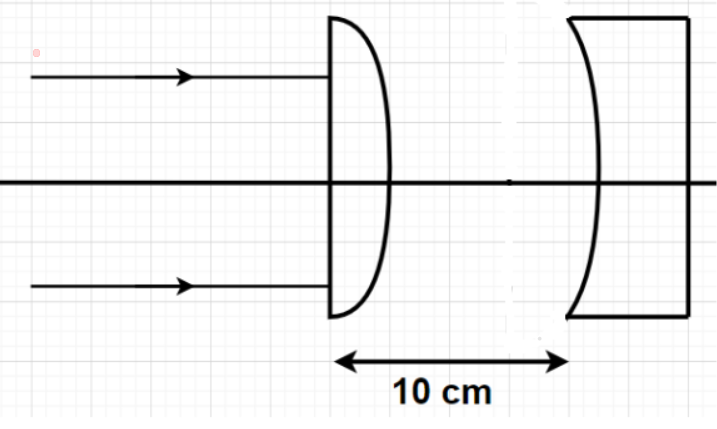
In the given figure, the radius of curvature of a curved surface for both the piano-convex and plano-concave lens is 10 cm and the refractive index for both is 1.5. What is the location of the final image after all the refractions through lenses?
${\text{A}}{\text{.}}$ 15 cm
${\text{B}}{\text{.}}$ 20 cm
${\text{C}}{\text{.}}$ 25 cm
${\text{D}}{\text{.}}$ 40 cm
Answer
 Verified
631.5k+ views
Hint: Here, we will proceed by using the lens maker equation to find the focal lengths of the given lenses. Then, we will find the final image distance after refraction through both the lenses.
Formulas Used- $\dfrac{1}{{\text{f}}} = \left( {{\text{n}} - 1} \right)\left( {\dfrac{1}{{{{\text{R}}_2}}} - \dfrac{1}{{{{\text{R}}_1}}}} \right)$ and $\dfrac{1}{{\text{f}}} = \dfrac{1}{{\text{v}}} - \dfrac{1}{{\text{u}}}$.
Complete Step-by-Step solution:
Let us suppose that all the distances measured in the right direction from the poles are taken as positive whereas all the distances measured in the left direction from the poles are taken as negative.
According to lens maker’s equation if the lens is placed in air as the surrounding medium (i.e., Refractive index of air/surrounding = 1), we can write
$\dfrac{1}{{\text{f}}} = \left( {{\text{n}} - 1} \right)\left( {\dfrac{1}{{{{\text{R}}_2}}} - \dfrac{1}{{{{\text{R}}_1}}}} \right){\text{ }} \to {\text{(1)}}$ where f denotes the focal length of the lens, n denotes the refractive index of the lens material, ${{\text{R}}_1}$ denotes the radius of curvature for the surface on which light is incident upon, ${{\text{R}}_2}$ denotes the radius of curvature for the surface from which light is exiting through.
For the given piano-convex lens,
Refractive index of lens material n = 1.5 (Given)
Radius of curvature for the surface on which light is incident upon ${{\text{R}}_1} = \infty $
Radius of curvature for the surface from which light is exiting through ${{\text{R}}_2}$ = 10 cm (Given)
Using the formula given by equation (1), focal length for the piano-convex lens is given by
$
\dfrac{1}{{\text{f}}} = \left( {{\text{1}}{\text{.5}} - 1} \right)\left( {\dfrac{1}{{10}} - \dfrac{1}{\infty }} \right) = 0.5\left( {\dfrac{1}{{10}} - 0} \right) = \dfrac{{0.5}}{{10}} = \dfrac{5}{{10 \times 10}} = \dfrac{1}{{20}} \\
\Rightarrow {\text{f}} = 20{\text{ cm}} \\
$
So, the focal length for the piano-convex lens is 20 cm
For the given plano-concave lens,
Refractive index of lens material n = 1.5 (Given)
Radius of curvature for the surface on which light is incident upon ${{\text{R}}_1} = 10$ cm (Given)
Radius of curvature for the surface from which light is exiting through ${{\text{R}}_2} = \infty $
Using the formula given by equation (1), focal length for the plano-concave lens is given by
$
\dfrac{1}{{\text{f}}} = \left( {{\text{1}}{\text{.5}} - 1} \right)\left( {\dfrac{1}{\infty } - \dfrac{1}{{10}}} \right) = 0.5\left( {0 - \dfrac{1}{{10}}} \right) = - \dfrac{{0.5}}{{10}} = - \dfrac{5}{{10 \times 10}} = - \dfrac{1}{{20}} \\
\Rightarrow {\text{f}} = - 20{\text{ cm}} \\
$
So, the focal length for the plano-concave lens is -20 cm
According to lens formula, we can write
$\dfrac{1}{{\text{f}}} = \dfrac{1}{{\text{v}}} - \dfrac{1}{{\text{u}}}{\text{ }} \to {\text{(2)}}$ where f denotes the focal length of the lens, v denotes the distance of the image formed from the pole of the lens, u denotes the object distance measured from the pole of lens
By substituting f = 20 cm and u = $\infty $ (since both the incident rays are parallel and hence the object is placed at infinity) for given piano-convex lens in equation (2), we get
..
So, the image for the plano-convex lens which is actually the object for the plano-concave lens will be formed at 20 cm in the right direction from the pole of the plano-convex lens. Since, the distance between the two lenses is 10 cm. So, the object distance for plano-concave lens is +10 cm
By substituting f = -20 cm and u = 10 cm for given plano-concave lens in equation (2), we get
$
\Rightarrow \dfrac{1}{{ - 20}} = \dfrac{1}{{\text{v}}} - \dfrac{1}{{10}} \\
\Rightarrow \dfrac{1}{{\text{v}}} = \dfrac{1}{{{\text{10}}}} - \dfrac{1}{{{\text{20}}}} \\
\Rightarrow \dfrac{1}{{\text{v}}} = \dfrac{{2 - 1}}{{{\text{20}}}} \\
\Rightarrow \dfrac{1}{{\text{v}}} = \dfrac{1}{{{\text{20}}}} \\
\Rightarrow {\text{v}} = 20{\text{ cm}} \\
$
Therefore, the final image after all the refractions through lenses is located at 20 cm
Hence, option B is correct.
Note- As the radius of curvature for any plane surface is always infinite. In this particular problem, ${{\text{R}}_1}$ and ${{\text{R}}_2}$ for piano-convex lens represents the radius of curvature for plane surface and that for curved surface respectively. Also, ${{\text{R}}_1}$ and ${{\text{R}}_2}$ for plano-concave lens represents the radius of curvature for curved surface and that for plane surface respectively.
Formulas Used- $\dfrac{1}{{\text{f}}} = \left( {{\text{n}} - 1} \right)\left( {\dfrac{1}{{{{\text{R}}_2}}} - \dfrac{1}{{{{\text{R}}_1}}}} \right)$ and $\dfrac{1}{{\text{f}}} = \dfrac{1}{{\text{v}}} - \dfrac{1}{{\text{u}}}$.
Complete Step-by-Step solution:
Let us suppose that all the distances measured in the right direction from the poles are taken as positive whereas all the distances measured in the left direction from the poles are taken as negative.
According to lens maker’s equation if the lens is placed in air as the surrounding medium (i.e., Refractive index of air/surrounding = 1), we can write
$\dfrac{1}{{\text{f}}} = \left( {{\text{n}} - 1} \right)\left( {\dfrac{1}{{{{\text{R}}_2}}} - \dfrac{1}{{{{\text{R}}_1}}}} \right){\text{ }} \to {\text{(1)}}$ where f denotes the focal length of the lens, n denotes the refractive index of the lens material, ${{\text{R}}_1}$ denotes the radius of curvature for the surface on which light is incident upon, ${{\text{R}}_2}$ denotes the radius of curvature for the surface from which light is exiting through.
For the given piano-convex lens,
Refractive index of lens material n = 1.5 (Given)
Radius of curvature for the surface on which light is incident upon ${{\text{R}}_1} = \infty $
Radius of curvature for the surface from which light is exiting through ${{\text{R}}_2}$ = 10 cm (Given)
Using the formula given by equation (1), focal length for the piano-convex lens is given by
$
\dfrac{1}{{\text{f}}} = \left( {{\text{1}}{\text{.5}} - 1} \right)\left( {\dfrac{1}{{10}} - \dfrac{1}{\infty }} \right) = 0.5\left( {\dfrac{1}{{10}} - 0} \right) = \dfrac{{0.5}}{{10}} = \dfrac{5}{{10 \times 10}} = \dfrac{1}{{20}} \\
\Rightarrow {\text{f}} = 20{\text{ cm}} \\
$
So, the focal length for the piano-convex lens is 20 cm
For the given plano-concave lens,
Refractive index of lens material n = 1.5 (Given)
Radius of curvature for the surface on which light is incident upon ${{\text{R}}_1} = 10$ cm (Given)
Radius of curvature for the surface from which light is exiting through ${{\text{R}}_2} = \infty $
Using the formula given by equation (1), focal length for the plano-concave lens is given by
$
\dfrac{1}{{\text{f}}} = \left( {{\text{1}}{\text{.5}} - 1} \right)\left( {\dfrac{1}{\infty } - \dfrac{1}{{10}}} \right) = 0.5\left( {0 - \dfrac{1}{{10}}} \right) = - \dfrac{{0.5}}{{10}} = - \dfrac{5}{{10 \times 10}} = - \dfrac{1}{{20}} \\
\Rightarrow {\text{f}} = - 20{\text{ cm}} \\
$
So, the focal length for the plano-concave lens is -20 cm
According to lens formula, we can write
$\dfrac{1}{{\text{f}}} = \dfrac{1}{{\text{v}}} - \dfrac{1}{{\text{u}}}{\text{ }} \to {\text{(2)}}$ where f denotes the focal length of the lens, v denotes the distance of the image formed from the pole of the lens, u denotes the object distance measured from the pole of lens
By substituting f = 20 cm and u = $\infty $ (since both the incident rays are parallel and hence the object is placed at infinity) for given piano-convex lens in equation (2), we get
..
So, the image for the plano-convex lens which is actually the object for the plano-concave lens will be formed at 20 cm in the right direction from the pole of the plano-convex lens. Since, the distance between the two lenses is 10 cm. So, the object distance for plano-concave lens is +10 cm
By substituting f = -20 cm and u = 10 cm for given plano-concave lens in equation (2), we get
$
\Rightarrow \dfrac{1}{{ - 20}} = \dfrac{1}{{\text{v}}} - \dfrac{1}{{10}} \\
\Rightarrow \dfrac{1}{{\text{v}}} = \dfrac{1}{{{\text{10}}}} - \dfrac{1}{{{\text{20}}}} \\
\Rightarrow \dfrac{1}{{\text{v}}} = \dfrac{{2 - 1}}{{{\text{20}}}} \\
\Rightarrow \dfrac{1}{{\text{v}}} = \dfrac{1}{{{\text{20}}}} \\
\Rightarrow {\text{v}} = 20{\text{ cm}} \\
$
Therefore, the final image after all the refractions through lenses is located at 20 cm
Hence, option B is correct.
Note- As the radius of curvature for any plane surface is always infinite. In this particular problem, ${{\text{R}}_1}$ and ${{\text{R}}_2}$ for piano-convex lens represents the radius of curvature for plane surface and that for curved surface respectively. Also, ${{\text{R}}_1}$ and ${{\text{R}}_2}$ for plano-concave lens represents the radius of curvature for curved surface and that for plane surface respectively.
Recently Updated Pages
Master Class 12 Business Studies: Engaging Questions & Answers for Success

Master Class 12 Biology: Engaging Questions & Answers for Success
Master Class 12 Chemistry: Engaging Questions & Answers for Success
Class 12 Question and Answer - Your Ultimate Solutions Guide
Master Class 11 Social Science: Engaging Questions & Answers for Success
Master Class 11 English: Engaging Questions & Answers for Success
Trending doubts
Which Indian city is known as the "City of Victory"?
Which instrument is used to measure the Blood Pressure?
Why is it 530 pm in india when it is 1200 afternoon class 10 social science CBSE
Fill the blanks with proper collective nouns 1 A of class 10 english CBSE
Why is there a time difference of about 5 hours between class 10 social science CBSE
Find the mode of 10 12 11 10 15 20 19 21 11 9 10 class 10 maths CBSE