




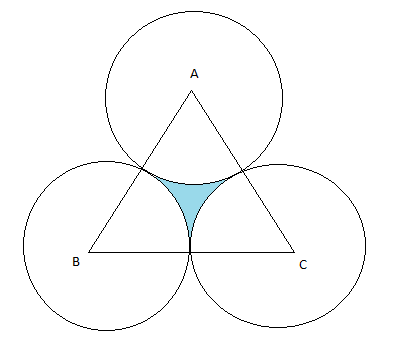
In the given figure the area of an equilateral triangle \[ABC\] is \[17320.5\] sq. cm. With the vertex of the triangle as a centre, a circle is drawn with a radius equal to half of the length of the triangle. Find the area of the shaded region. (Use \[\pi = 3.14\]and \[\sqrt 3 = 1.73205\])
Answer
 Verified
604.2k+ views
Hint: We have to find the area of the shaded part. For that, first we find the sum of all sectors of the circle. By using the given in the question we will find the radius of the circle.
\[
{\text{The area of the shaded region }} \\
{\text{ = the area of the triangle-the sum of the area of all sectors of the circle}} \\
\].
So, to find the required area at first, we will find the area of all the sectors and the area of the equilateral triangle.
From using the formula, we can find our required answer.
Complete step-by-step answer:
It is given that; the area of an equilateral \[\Delta ABC\] is \[17320.5\] sq. cm. The vertices of the triangles are the centre of the circles. The radius of the circle is equal to the half of the length of the side of the triangle.
We have to find the shaded area of the triangle.
\[
{\text{The area of the shaded region }} \\
{\text{ = the area of the triangle-the sum of the area of all sectors of the circle}} \\
\]
At first, we will find the area of each sector.
To find the area of the sector, we need the radius of the circle.
We know that the area of an equilateral triangle with each side $a$ is \[\dfrac{{\sqrt 3 }}{4}{a^2}\] sq. cm.
Let us take, each side of the \[\Delta ABC\] is $a$.
According to the problem,
\[\dfrac{{\sqrt 3 }}{4}{a^2} = 17320.5\]
Solving we get,
\[{a^2} = 17320.5 \times \dfrac{4}{{\sqrt 3 }}\]
Simplifying we get,
\[a = 200\]
We have, the radius of the circle is equal to the half of the length of the side of the triangle.
So, the radius of the circle is \[\dfrac{{200}}{2} = 100\] cm.
\[{\text{The area of all sectors}}\] = \[3 \times \text {the area of each sector}\].
We know that, if \[r\] be the circular arc of radius, the area of the major arc is \[\dfrac{\theta }{{{{360}^ \circ }}} \times \pi {r^2}\]
So, the area of each sector is \[\dfrac{{{{60}^ \circ }}}{{{{360}^ \circ }}} \times 3.14 \times {100^2}\]
So, the area of all sectors \[ = 3 \times \dfrac{{{{60}^ \circ }}}{{{{360}^ \circ }}} \times 3.14 \times {100^2} = 15700\] sq. cm.
Therefore, the area of the shaded region \[ = 17320.5 - 15700\] sq. cm.
Simplifying we get,
The area of the shaded region \[ = 1620.5\] sq. cm.
Hence, the area of the shaded region is \[1620.5\] sq. cm.
Note: For this question we may go wrong in substitution of the values in the area formula. Because they give the area of the triangle from that we find the side value of the triangle. Then we find the radius of the circle from that and by using the radius we found the area of the circles. Finally, subtracting the area of circles from the area of the triangle we got the area of the shaded region. In this long process we will make mistakes on substituting the values. So we have to give concentration on substituting the values.
\[
{\text{The area of the shaded region }} \\
{\text{ = the area of the triangle-the sum of the area of all sectors of the circle}} \\
\].
So, to find the required area at first, we will find the area of all the sectors and the area of the equilateral triangle.
From using the formula, we can find our required answer.
Complete step-by-step answer:
It is given that; the area of an equilateral \[\Delta ABC\] is \[17320.5\] sq. cm. The vertices of the triangles are the centre of the circles. The radius of the circle is equal to the half of the length of the side of the triangle.
We have to find the shaded area of the triangle.
\[
{\text{The area of the shaded region }} \\
{\text{ = the area of the triangle-the sum of the area of all sectors of the circle}} \\
\]
At first, we will find the area of each sector.
To find the area of the sector, we need the radius of the circle.
We know that the area of an equilateral triangle with each side $a$ is \[\dfrac{{\sqrt 3 }}{4}{a^2}\] sq. cm.
Let us take, each side of the \[\Delta ABC\] is $a$.
According to the problem,
\[\dfrac{{\sqrt 3 }}{4}{a^2} = 17320.5\]
Solving we get,
\[{a^2} = 17320.5 \times \dfrac{4}{{\sqrt 3 }}\]
Simplifying we get,
\[a = 200\]
We have, the radius of the circle is equal to the half of the length of the side of the triangle.
So, the radius of the circle is \[\dfrac{{200}}{2} = 100\] cm.
\[{\text{The area of all sectors}}\] = \[3 \times \text {the area of each sector}\].
We know that, if \[r\] be the circular arc of radius, the area of the major arc is \[\dfrac{\theta }{{{{360}^ \circ }}} \times \pi {r^2}\]
So, the area of each sector is \[\dfrac{{{{60}^ \circ }}}{{{{360}^ \circ }}} \times 3.14 \times {100^2}\]
So, the area of all sectors \[ = 3 \times \dfrac{{{{60}^ \circ }}}{{{{360}^ \circ }}} \times 3.14 \times {100^2} = 15700\] sq. cm.
Therefore, the area of the shaded region \[ = 17320.5 - 15700\] sq. cm.
Simplifying we get,
The area of the shaded region \[ = 1620.5\] sq. cm.
Hence, the area of the shaded region is \[1620.5\] sq. cm.
Note: For this question we may go wrong in substitution of the values in the area formula. Because they give the area of the triangle from that we find the side value of the triangle. Then we find the radius of the circle from that and by using the radius we found the area of the circles. Finally, subtracting the area of circles from the area of the triangle we got the area of the shaded region. In this long process we will make mistakes on substituting the values. So we have to give concentration on substituting the values.
Recently Updated Pages
Master Class 10 Social Science: Engaging Questions & Answers for Success

Master Class 10 Science: Engaging Questions & Answers for Success
Master Class 10 Maths: Engaging Questions & Answers for Success
Master Class 10 General Knowledge: Engaging Questions & Answers for Success
Master Class 10 Computer Science: Engaging Questions & Answers for Success
Class 10 Question and Answer - Your Ultimate Solutions Guide
Trending doubts
What is the full form of PNG A Petrol Natural Gas B class 10 chemistry CBSE
Explain the Treaty of Vienna of 1815 class 10 social science CBSE
In cricket, how many legal balls are there in a standard over?
Why is there a time difference of about 5 hours between class 10 social science CBSE
Who Won 36 Oscar Awards? Record Holder Revealed
What is the median of the first 10 natural numbers class 10 maths CBSE