




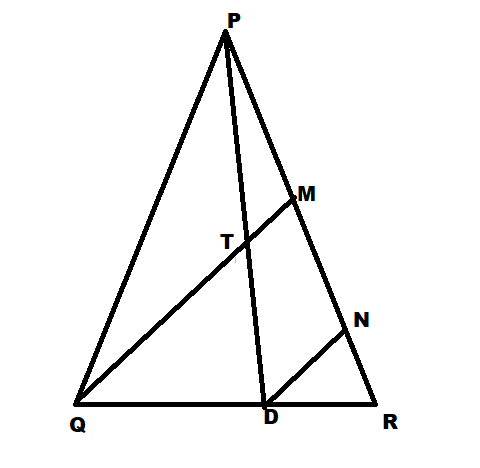
In the given figure, segment PD is a median of triangle PQR point T is the midpoint of segment
PD. Produced QT intersect PR at M. Show that PM/PR=1/3 [Hint: draw DN||QM]
Answer
 Verified
546k+ views
Hint: Here we are to prove a condition with the given data for the triangle, for such question we have to search for the best suited approach it may any formulae or standard proven property for the triangle, then by using that we just have to but the values given in the question and reach to our final desired value which needs to be proved.
Complete step by step solution:
The given question needs to prove the given condition, on solving we get:
PD is the median of QR,
So, D is the midpoint of QR,
DN is drawn parallel to QM.
By converse of midpoint theorem, N is the midpoint of MR,
Similarly, T is the midpoint of PD
Also DN|| QM
So, by converse of midpoint of PN,
Now we obtain that, N is the midpoint of MR and T is the midpoint of PD.
On framing it to the mathematical expression we get,
\[
\Rightarrow PM = MN = NR \\
\Rightarrow \dfrac{{PM}}{{PR}} = \dfrac{{PM}}{{PM + PM + PM}} = \dfrac{{PM}}{{3PM}} = \dfrac{1}{3} \\
\Rightarrow \dfrac{{PM}}{{PR}} = \dfrac{1}{3} \\
\]
Hence now we get the desired condition asked in the question and we got the same result which finally proves the final condition asked for.
Note: Here for this question we have used the midpoint theorem of triangle which states that for any triangle the bisector extended from one vertex to front side of the triangle will divide the line into two equal parts.
Complete step by step solution:
The given question needs to prove the given condition, on solving we get:
PD is the median of QR,
So, D is the midpoint of QR,
DN is drawn parallel to QM.
By converse of midpoint theorem, N is the midpoint of MR,
Similarly, T is the midpoint of PD
Also DN|| QM
So, by converse of midpoint of PN,
Now we obtain that, N is the midpoint of MR and T is the midpoint of PD.
On framing it to the mathematical expression we get,
\[
\Rightarrow PM = MN = NR \\
\Rightarrow \dfrac{{PM}}{{PR}} = \dfrac{{PM}}{{PM + PM + PM}} = \dfrac{{PM}}{{3PM}} = \dfrac{1}{3} \\
\Rightarrow \dfrac{{PM}}{{PR}} = \dfrac{1}{3} \\
\]
Hence now we get the desired condition asked in the question and we got the same result which finally proves the final condition asked for.
Note: Here for this question we have used the midpoint theorem of triangle which states that for any triangle the bisector extended from one vertex to front side of the triangle will divide the line into two equal parts.
Recently Updated Pages
Master Class 10 Computer Science: Engaging Questions & Answers for Success

Master Class 10 General Knowledge: Engaging Questions & Answers for Success
Master Class 10 English: Engaging Questions & Answers for Success
Master Class 10 Social Science: Engaging Questions & Answers for Success
Master Class 10 Maths: Engaging Questions & Answers for Success
Master Class 10 Science: Engaging Questions & Answers for Success
Trending doubts
What is the median of the first 10 natural numbers class 10 maths CBSE
Which women's tennis player has 24 Grand Slam singles titles?
Who is the Brand Ambassador of Incredible India?
Why is there a time difference of about 5 hours between class 10 social science CBSE
Write a letter to the principal requesting him to grant class 10 english CBSE
A moving boat is observed from the top of a 150 m high class 10 maths CBSE