




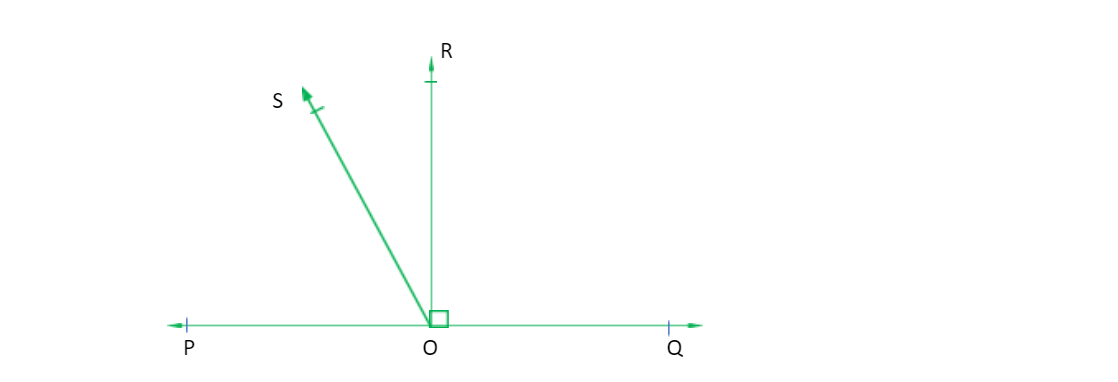
In the given figure, POQ is a line. Ray OR is perpendicular to line PQ. OS is another ray lying between rays OP and OR. Prove that
$\angle ROS = \dfrac{1}{2}\left( {\angle QOS - \angle POS} \right)$
Answer
 Verified
617.1k+ views
Hint: We will first prove that $\angle ROP$is 90° and then we can expand $\angle ROP$in terms of the angles ROS and POS. and upon simplifying the obtained equation, we will prove that $\angle ROS = \dfrac{1}{2}\left( {\angle QOS - \angle POS} \right)$
Complete step by step answer:
We are given that POQ is a line and a ray OR is perpendicular to it. OS is some other ray which is also located between rays OP and OR.
We need to prove that $\angle ROS = \dfrac{1}{2}\left( {\angle QOS - \angle POS} \right)$
Let us first see the figure:
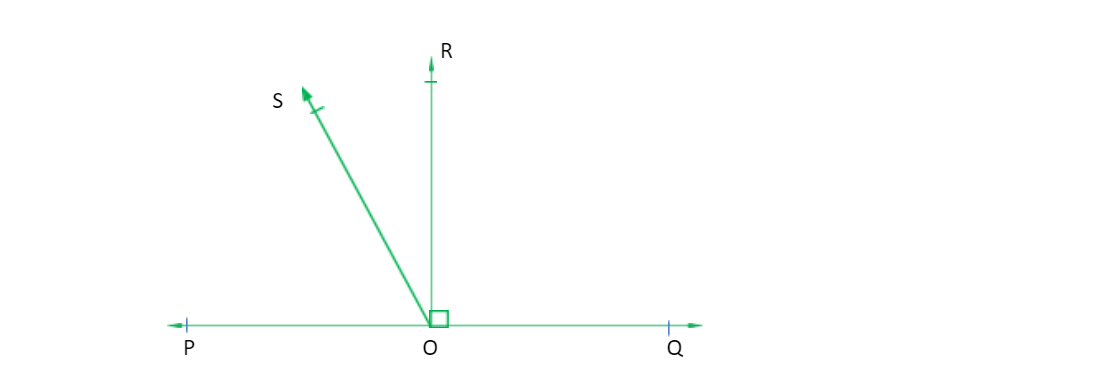
Here, as we can see that OR is perpendicular to PQ. So, if $\angle $ROQ = 90°, then$\angle $ROP must be 90 °.
Therefore, we can say that $\angle $ROP = $\angle $ROQ
Now, from the figure, we can see that $\angle $ROP = $\angle $ROS +$\angle $POS
$ \Rightarrow $$\angle $POS + $\angle $ROS = $\angle $ROQ
Also, $\angle $ROQ = $\angle $QOS - $\angle $ROS
$ \Rightarrow $$\angle $POS + $\angle $ROS = $\angle $QOS - $\angle $ROS
Rearranging the terms, we get
$ \Rightarrow $$\angle $ROS + $\angle $ROS = $\angle $QOS -$\angle $POS
$ \Rightarrow $2($\angle $ROS) = $\angle $QOS -$\angle $POS
$ \Rightarrow $$\angle $ROS = $\dfrac{1}{2}$($\angle $QOS -$\angle $POS)
Hence, we have proved the required relation that $\angle $ROS = $\dfrac{1}{2}$($\angle $QOS -$\angle $POS)
Note: In such questions, you may get confused while proving the relation between two angles like in this question, we deduced a relation between $\angle $ROP and $\angle $ROQ as OR was a perpendicular ray on PQ. You may go wrong while simplifying the $\angle $ROP in terms of $\angle $POS and $\angle $ROS in this question.
Complete step by step answer:
We are given that POQ is a line and a ray OR is perpendicular to it. OS is some other ray which is also located between rays OP and OR.
We need to prove that $\angle ROS = \dfrac{1}{2}\left( {\angle QOS - \angle POS} \right)$
Let us first see the figure:
Here, as we can see that OR is perpendicular to PQ. So, if $\angle $ROQ = 90°, then$\angle $ROP must be 90 °.
Therefore, we can say that $\angle $ROP = $\angle $ROQ
Now, from the figure, we can see that $\angle $ROP = $\angle $ROS +$\angle $POS
$ \Rightarrow $$\angle $POS + $\angle $ROS = $\angle $ROQ
Also, $\angle $ROQ = $\angle $QOS - $\angle $ROS
$ \Rightarrow $$\angle $POS + $\angle $ROS = $\angle $QOS - $\angle $ROS
Rearranging the terms, we get
$ \Rightarrow $$\angle $ROS + $\angle $ROS = $\angle $QOS -$\angle $POS
$ \Rightarrow $2($\angle $ROS) = $\angle $QOS -$\angle $POS
$ \Rightarrow $$\angle $ROS = $\dfrac{1}{2}$($\angle $QOS -$\angle $POS)
Hence, we have proved the required relation that $\angle $ROS = $\dfrac{1}{2}$($\angle $QOS -$\angle $POS)
Note: In such questions, you may get confused while proving the relation between two angles like in this question, we deduced a relation between $\angle $ROP and $\angle $ROQ as OR was a perpendicular ray on PQ. You may go wrong while simplifying the $\angle $ROP in terms of $\angle $POS and $\angle $ROS in this question.
Recently Updated Pages
Master Class 10 English: Engaging Questions & Answers for Success

Master Class 10 Social Science: Engaging Questions & Answers for Success
Master Class 10 Computer Science: Engaging Questions & Answers for Success
Class 10 Question and Answer - Your Ultimate Solutions Guide
Master Class 10 General Knowledge: Engaging Questions & Answers for Success
Master Class 10 Maths: Engaging Questions & Answers for Success
Trending doubts
What is the full form of NDA a National Democratic class 10 social science CBSE
Bharatiya Janata Party was founded in the year A 1979 class 10 social science CBSE
What is meant by the term constituency A Place where class 10 social science CBSE
The highest temperature in Karnataka is recorded in class 10 social science CBSE
Fill the blanks with proper collective nouns 1 A of class 10 english CBSE
What is the "grid" in Formula 1 racing?