




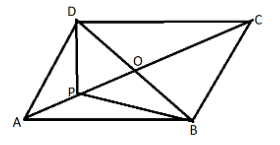
In the given figure, P is any point on the point on the diagonal AC of the parallelogram ABCD. Show that $ar\left( {\Delta ADP} \right) = ar\left( {\Delta ABP} \right)$
Answer
 Verified
581.1k+ views
Hint:
It is given in the question that P is any point on the point on the diagonal AC of the parallelogram ABCD.
So, we will show that $ar\left( {\Delta ADP} \right) = ar\left( {\Delta ABP} \right)$
we know that the diagonals of a parallelogram bisect each other.
Complete step by step solution:
It is given in the question that P is any point on the point on the diagonal AC of the parallelogram ABCD.
So, we have to show that $ar\left( {\Delta ADP} \right) = ar\left( {\Delta ABP} \right)$
Let, the diagonal AC and DB intersect at O.
Since, we know that the diagonals of a parallelogram bisect each other
So, O is the midpoint of both AC and DB.
We know that the median of a triangle bisects each other.
In $\Delta DBP,$
PO is median of $\Delta DBP$
$\therefore ar\left( {\Delta DPO} \right) = ar\left( {\Delta POB} \right)$ (I)
Now, In $\Delta ADB,$
AO is median of $\Delta ADB$
$\therefore ar\left( {\Delta ADO} \right) = ar\left( {\Delta AOB} \right)$ (II)
Now, subtract equation (II) from equation (I)
$\therefore ar\left( {\Delta ADO} \right) - ar\left( {\Delta DPO} \right)$ $ = $ $ar\left( {\Delta AOB} \right) - ar\left( {\Delta POB} \right)$
$\therefore ar\left( {\Delta ADP} \right) = ar\left( {\Delta ABP} \right)$
Hence proved
Note:
Parallelogram: A parallelogram is a simple quadrilateral with two pairs of parallel sides. The opposite sides of a parallelogram are of equal length and the opposite angles of a parallelogram are of equal measures. The 3-dimensional counterpart of a parallelogram is a parallelepiped.
It is given in the question that P is any point on the point on the diagonal AC of the parallelogram ABCD.
So, we will show that $ar\left( {\Delta ADP} \right) = ar\left( {\Delta ABP} \right)$
we know that the diagonals of a parallelogram bisect each other.
Complete step by step solution:
It is given in the question that P is any point on the point on the diagonal AC of the parallelogram ABCD.
So, we have to show that $ar\left( {\Delta ADP} \right) = ar\left( {\Delta ABP} \right)$
Let, the diagonal AC and DB intersect at O.
Since, we know that the diagonals of a parallelogram bisect each other
So, O is the midpoint of both AC and DB.
We know that the median of a triangle bisects each other.
In $\Delta DBP,$
PO is median of $\Delta DBP$
$\therefore ar\left( {\Delta DPO} \right) = ar\left( {\Delta POB} \right)$ (I)
Now, In $\Delta ADB,$
AO is median of $\Delta ADB$
$\therefore ar\left( {\Delta ADO} \right) = ar\left( {\Delta AOB} \right)$ (II)
Now, subtract equation (II) from equation (I)
$\therefore ar\left( {\Delta ADO} \right) - ar\left( {\Delta DPO} \right)$ $ = $ $ar\left( {\Delta AOB} \right) - ar\left( {\Delta POB} \right)$
$\therefore ar\left( {\Delta ADP} \right) = ar\left( {\Delta ABP} \right)$
Hence proved
Note:
Parallelogram: A parallelogram is a simple quadrilateral with two pairs of parallel sides. The opposite sides of a parallelogram are of equal length and the opposite angles of a parallelogram are of equal measures. The 3-dimensional counterpart of a parallelogram is a parallelepiped.
Recently Updated Pages
Master Class 10 Computer Science: Engaging Questions & Answers for Success

Master Class 10 General Knowledge: Engaging Questions & Answers for Success
Master Class 10 English: Engaging Questions & Answers for Success
Master Class 10 Social Science: Engaging Questions & Answers for Success
Master Class 10 Maths: Engaging Questions & Answers for Success
Master Class 10 Science: Engaging Questions & Answers for Success
Trending doubts
What is the median of the first 10 natural numbers class 10 maths CBSE
Which women's tennis player has 24 Grand Slam singles titles?
Who is the Brand Ambassador of Incredible India?
Why is there a time difference of about 5 hours between class 10 social science CBSE
Write a letter to the principal requesting him to grant class 10 english CBSE
A moving boat is observed from the top of a 150 m high class 10 maths CBSE