



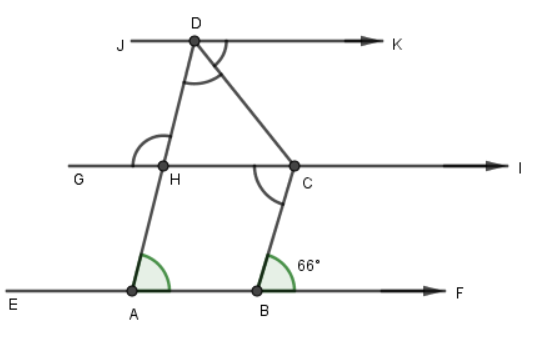
In the given figure (not drawn to scale), AD is parallel to BC. JDK, GHCI, EABF are straight and parallel lines. Find: 1) $\angle GHD - \angle HDC$ 2) $\angle BCI + \angle HAB$
A. 58°, 150°
B. 48°, 150°
C. 58°, 180°
D. 48°, 180°
Answer
 Verified
585.6k+ views
Hint: Here, from the given figure, we know that AD||BC and JK||GI||EF. $\angle CBF$ = ${60^ \circ }$, \[\angle HAB\] is corresponding angle of $\angle CBF$, hence equal to 60°. Similarly, equate all unknown angles with $\angle CBF$ as an alternate angle, corresponding angles, etc. We will also use the concept of the straight line that a straight line always forms $180^\circ $. By using these concepts, we will solve this question.
Complete step by step answer:
Given, line GI is parallel to the DH is transversal.
JK || GI and DH are transversal.
$\Rightarrow \angle GHD = \angle HDK$(Alternate angles)
$ \Rightarrow \angle GHD = \angle HDC + {48^ \circ }$($\angle HDK = \angle HDC + {48^ \circ }$)
$ \Rightarrow \angle GHD - \angle HDC = {48^ \circ }$
Thus, $\angle GHD - \angle HDC = {48^ \circ }$
Also given,
GI || EF and BC are transversal.
$\Rightarrow \angle BCI + \angle CBF = {180^ \circ }$ (Co-interior angles)
$ \Rightarrow \angle BCI + {66^ \circ } = {180^ \circ }$
$ \Rightarrow \angle BCI = {180^ \circ } - {66^ \circ } = {114^ \circ }$
As HA || CB and AB are transversal
$\Rightarrow \angle CBF = \angle HAB$(Corresponding angles)
$\Rightarrow \angle HAB = {66^ \circ }$
Now,
$Rightarrow \angle BCI + \angle HAB = {114^ \circ } + {66^ \circ } = {180^ \circ }$
Thus, $\angle BCI + \angle HAB = {180^ \circ }$
$\therefore$ (1) $\angle GHD - \angle HDC=48^\circ$ and (2) $\angle BCI + \angle HAB= 180^\circ$. Hence, option (D) is correct.
Note:
In these types of questions, from the figure, find the values of all corresponding angles, alternate angles with the help of given angle, and find whatever asked in the question.
For these types of questions, we need to keep some concepts in mind.
- Lines are parallel if they are always the same distance apart (called "equidistant"), and will never meet. Both the lines are said to be parallel.
- When parallel lines get crossed by another line is called a transversal.
- When two lines are parallel and a transversal pass through both the parallel lines then the alternate interior angle is always equal.
- When two lines are parallel and a transversal pass through both the parallel lines then the alternate exterior angle is always equal.
- When two lines are parallel and a transversal pass through both the parallel lines then the Corresponding angles are always equal.
- When two lines are parallel and a transversal pass through both the parallel lines then the sum of Co-interior angles is ${180^ \circ }$.
Complete step by step answer:
Given, line GI is parallel to the DH is transversal.
JK || GI and DH are transversal.
$\Rightarrow \angle GHD = \angle HDK$(Alternate angles)
$ \Rightarrow \angle GHD = \angle HDC + {48^ \circ }$($\angle HDK = \angle HDC + {48^ \circ }$)
$ \Rightarrow \angle GHD - \angle HDC = {48^ \circ }$
Thus, $\angle GHD - \angle HDC = {48^ \circ }$
Also given,
GI || EF and BC are transversal.
$\Rightarrow \angle BCI + \angle CBF = {180^ \circ }$ (Co-interior angles)
$ \Rightarrow \angle BCI + {66^ \circ } = {180^ \circ }$
$ \Rightarrow \angle BCI = {180^ \circ } - {66^ \circ } = {114^ \circ }$
As HA || CB and AB are transversal
$\Rightarrow \angle CBF = \angle HAB$(Corresponding angles)
$\Rightarrow \angle HAB = {66^ \circ }$
Now,
$Rightarrow \angle BCI + \angle HAB = {114^ \circ } + {66^ \circ } = {180^ \circ }$
Thus, $\angle BCI + \angle HAB = {180^ \circ }$
$\therefore$ (1) $\angle GHD - \angle HDC=48^\circ$ and (2) $\angle BCI + \angle HAB= 180^\circ$. Hence, option (D) is correct.
Note:
In these types of questions, from the figure, find the values of all corresponding angles, alternate angles with the help of given angle, and find whatever asked in the question.
For these types of questions, we need to keep some concepts in mind.
- Lines are parallel if they are always the same distance apart (called "equidistant"), and will never meet. Both the lines are said to be parallel.
- When parallel lines get crossed by another line is called a transversal.
- When two lines are parallel and a transversal pass through both the parallel lines then the alternate interior angle is always equal.
- When two lines are parallel and a transversal pass through both the parallel lines then the alternate exterior angle is always equal.
- When two lines are parallel and a transversal pass through both the parallel lines then the Corresponding angles are always equal.
- When two lines are parallel and a transversal pass through both the parallel lines then the sum of Co-interior angles is ${180^ \circ }$.
Recently Updated Pages
Master Class 9 General Knowledge: Engaging Questions & Answers for Success

Master Class 9 Social Science: Engaging Questions & Answers for Success
Master Class 9 English: Engaging Questions & Answers for Success
Master Class 9 Maths: Engaging Questions & Answers for Success
Master Class 9 Science: Engaging Questions & Answers for Success
Class 9 Question and Answer - Your Ultimate Solutions Guide
Trending doubts
Difference Between Plant Cell and Animal Cell
Fill the blanks with the suitable prepositions 1 The class 9 english CBSE
Who is eligible for RTE class 9 social science CBSE
Which places in India experience sunrise first and class 9 social science CBSE
What is pollution? How many types of pollution? Define it
Name 10 Living and Non living things class 9 biology CBSE