




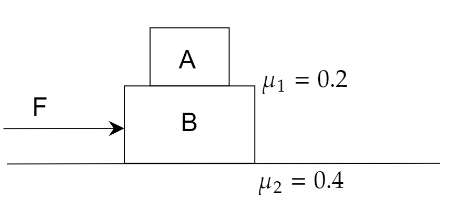
In the given figure, ${m_A} = 2{\text{ }}kg$ and ${m_B} = 4{\text{ }}kg$. For what minimum value of $F, A$ starts slipping over $B$.
A. $24{\text{ }}N$
B. $36{\text{ }}N$
C. $12{\text{ }}N$
D. $20{\text{ }}N$
Answer
 Verified
534k+ views
Hint: First of all, we have to find the frictional force between the block $B$ and the ground surface. Then, we have to find the frictional force between block $A$ and block $B$.By comparing the equations with that of force, we will find the value of $F$.
Complete step by step answer:
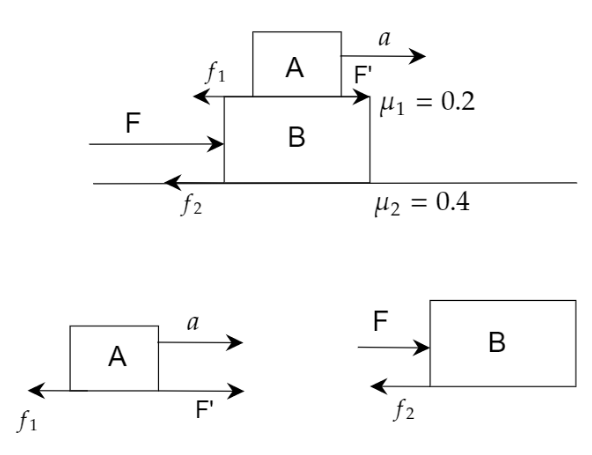
From the given diagram we will find the frictional forces,
The mass of block A, ${m_A} = 2{\text{ }}kg$
The mass of block B, ${m_B} = 4{\text{ }}kg$
${f_1} = {\mu _1}{m_A}g$
where ${f_1}$ is the frictional force that acts upon block A and block B, ${\mu _1} = $ coefficient of friction and $g = $ acceleration due to gravity.
Substituting all the values we get,
${f_1} = 0.2 \times 2 \times 10 = 4$
The frictional force between block A and B is $4{\text{ }}N$.As, the block just starts slipping then,
F’$ = {f_1} = 4{\text{ }}N$
According to Newton’s Law we know,
F’$ = {m_A} \times a$
where $a$ is the acceleration of the block.
Substituting the values we get,
$4 = 2 \times a$
$ \Rightarrow a = 2$
Now, the frictional force between the block B and the ground,
${f_2} = {\mu _2} \times ({m_B} + {m_A}) \times g = 0.4 \times 6 \times 10 = 24$
Thus, the frictional force between block B and ground is ${\text{24 }}N$.
Again, using Newton’s Law for the whole system we get,
F$ - {f_1} - {f_2} = {m_B} \times a$
Substituting all the values in the given question, we get,
F$ - 4 - 24 = 4 \times 2$
$ \therefore $F$ = 36$
The minimum value of F so that the block $A$ just starts slipping is $36{\text{ }}N$.
So, the correct option is B.
Note: It must be noted that when a block starts to slip the frictional force always opposes the movement of the block. In order to oppose the movement of the block, the frictional force must be of the same magnitude as the force which causes motion but opposite in direction.
Complete step by step answer:
From the given diagram we will find the frictional forces,
The mass of block A, ${m_A} = 2{\text{ }}kg$
The mass of block B, ${m_B} = 4{\text{ }}kg$
${f_1} = {\mu _1}{m_A}g$
where ${f_1}$ is the frictional force that acts upon block A and block B, ${\mu _1} = $ coefficient of friction and $g = $ acceleration due to gravity.
Substituting all the values we get,
${f_1} = 0.2 \times 2 \times 10 = 4$
The frictional force between block A and B is $4{\text{ }}N$.As, the block just starts slipping then,
F’$ = {f_1} = 4{\text{ }}N$
According to Newton’s Law we know,
F’$ = {m_A} \times a$
where $a$ is the acceleration of the block.
Substituting the values we get,
$4 = 2 \times a$
$ \Rightarrow a = 2$
Now, the frictional force between the block B and the ground,
${f_2} = {\mu _2} \times ({m_B} + {m_A}) \times g = 0.4 \times 6 \times 10 = 24$
Thus, the frictional force between block B and ground is ${\text{24 }}N$.
Again, using Newton’s Law for the whole system we get,
F$ - {f_1} - {f_2} = {m_B} \times a$
Substituting all the values in the given question, we get,
F$ - 4 - 24 = 4 \times 2$
$ \therefore $F$ = 36$
The minimum value of F so that the block $A$ just starts slipping is $36{\text{ }}N$.
So, the correct option is B.
Note: It must be noted that when a block starts to slip the frictional force always opposes the movement of the block. In order to oppose the movement of the block, the frictional force must be of the same magnitude as the force which causes motion but opposite in direction.
Recently Updated Pages
Master Class 11 English: Engaging Questions & Answers for Success

Master Class 11 Social Science: Engaging Questions & Answers for Success
Master Class 11 Maths: Engaging Questions & Answers for Success
Master Class 11 Biology: Engaging Questions & Answers for Success
Master Class 11 Physics: Engaging Questions & Answers for Success
Master Class 11 Chemistry: Engaging Questions & Answers for Success
Trending doubts
One Metric ton is equal to kg A 10000 B 1000 C 100 class 11 physics CBSE
Difference Between Prokaryotic Cells and Eukaryotic Cells
Find the value of the expression given below sin 30circ class 11 maths CBSE
Difference between physical and chemical change class 11 chemistry CBSE
Two of the body parts which do not appear in MRI are class 11 biology CBSE
Draw a diagram of a plant cell and label at least eight class 11 biology CBSE