




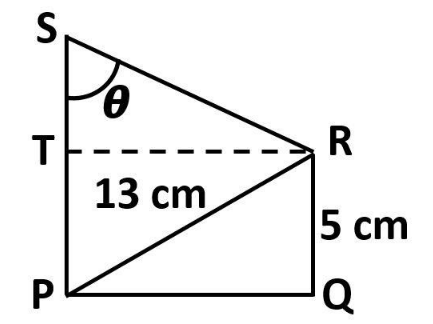
In the given figure, if $ PS = 14cm $ , then the value of $ \tan \theta $ is equal to:
(A) $ \dfrac{4}{3} $
(B) $ \dfrac{{14}}{3} $
(C) $ \dfrac{5}{3} $
(D) $ \dfrac{{13}}{3} $
Answer
 Verified
644.4k+ views
Hint: $ \tan \theta $ is the ratio of perpendicular to the base. Observe the figure carefully to find the values of the perpendicular or the opposite side. And the base or the adjacent side. Then find their ratio to solve the question.
Complete step-by-step answer:
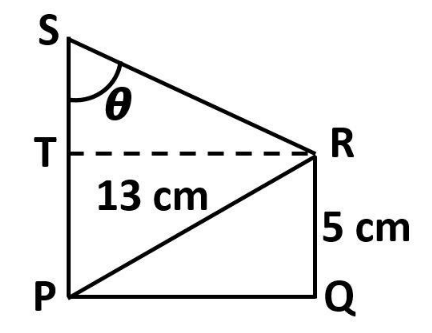
Observe the diagram
It is given in the question that,
$ PS = 14cm $
From the diagram, we can observe that,
$ PT = QR = 5cm $
And $ PS = PT + TS $
$ \Rightarrow 14 = 5 + TS $
Rearranging it we can write
$ TS = 9cm $
Now, in $ \Delta SRT $
We know that the trigonometric ratio of tan is the ratio of perpendicular to the base.
$ \Rightarrow \tan \theta = \dfrac{{TR}}{{ST}} $ . . . (1)
In $ \Delta PQR $ , from the diagram, and by Pythagoras theorem, we can observe that,
$ P{R^2} = R{Q^2} + P{Q^2} $
By substituting the given values, we get
$ \Rightarrow {13^2} = {5^2} + P{Q^2} $
Rearranging it we can write
$ P{Q^2} = 169 - 25 = 144 $
$ \Rightarrow P{Q^2} = {12^2} $
$ PQ = 12cm $
Now, from the diagram, we can observe that,
$ PQ = TR = 12cm $
By substituting these values in equation (1), we can write
\[\tan \theta = \dfrac{{12}}{9}\]
$ \Rightarrow \tan \theta = \dfrac{4}{3} $
Therefore, from the above explanation, the correct answer is, option (A) $ \dfrac{4}{3} $
So, the correct answer is “Option A”.
Note: In this question, the most important part was observing the diagram carefully and understanding which side is equal, where will Pythagoras theorem be required etc. The solution was easy, difficult and an important part was how to reach the solution.
Complete step-by-step answer:
Observe the diagram
It is given in the question that,
$ PS = 14cm $
From the diagram, we can observe that,
$ PT = QR = 5cm $
And $ PS = PT + TS $
$ \Rightarrow 14 = 5 + TS $
Rearranging it we can write
$ TS = 9cm $
Now, in $ \Delta SRT $
We know that the trigonometric ratio of tan is the ratio of perpendicular to the base.
$ \Rightarrow \tan \theta = \dfrac{{TR}}{{ST}} $ . . . (1)
In $ \Delta PQR $ , from the diagram, and by Pythagoras theorem, we can observe that,
$ P{R^2} = R{Q^2} + P{Q^2} $
By substituting the given values, we get
$ \Rightarrow {13^2} = {5^2} + P{Q^2} $
Rearranging it we can write
$ P{Q^2} = 169 - 25 = 144 $
$ \Rightarrow P{Q^2} = {12^2} $
$ PQ = 12cm $
Now, from the diagram, we can observe that,
$ PQ = TR = 12cm $
By substituting these values in equation (1), we can write
\[\tan \theta = \dfrac{{12}}{9}\]
$ \Rightarrow \tan \theta = \dfrac{4}{3} $
Therefore, from the above explanation, the correct answer is, option (A) $ \dfrac{4}{3} $
So, the correct answer is “Option A”.
Note: In this question, the most important part was observing the diagram carefully and understanding which side is equal, where will Pythagoras theorem be required etc. The solution was easy, difficult and an important part was how to reach the solution.
Recently Updated Pages
Which will be the least stable resonating structure class 11 chemistry CBSE

How many 5 digit telephone numbers can be construc-class-11-maths-CBSE
How do you find the angle of the resultant vector class 11 physics CBSE
Draw labelled diagram of the following i Gram seed class 11 biology CBSE
1 Quintal is equal to a 110 kg b 10 kg c 100kg d 1000 class 11 physics CBSE
What is the need and importance of classification class 11 biology CBSE
Trending doubts
Find the value of the expression given below sin 30circ class 11 maths CBSE
One Metric ton is equal to kg A 10000 B 1000 C 100 class 11 physics CBSE
10 examples of friction in our daily life
Draw a diagram of a plant cell and label at least eight class 11 biology CBSE
Difference between physical and chemical change class 11 chemistry CBSE
Proton was discovered by A Thomson B Rutherford C Chadwick class 11 chemistry CBSE