




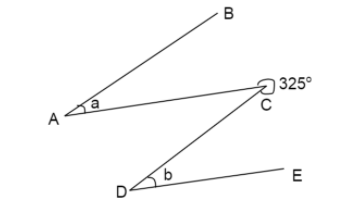
In the given figure, if $AB\parallel CD$ and $AC\parallel DE$, then find $\angle a + \angle b$.
A) ${70^ \circ }$
B) ${120^ \circ }$
C) $100^\circ $
D) $115^\circ $
Answer
 Verified
600k+ views
Hint: Here since we have two sets of parallel lines, we can find the relation between the forming angles. When a transversal cuts two parallel angles the alternate angle formed will be equal. We can use this concept here. Also we know the angle around a point is $360^\circ $.
Formula used:
If we have two parallel lines and a transversal cuts these lines, the alternate interior angles formed will be equal in measurement.
Angle around a point is always ${360^ \circ }$.
Complete step-by-step answer:
Given that $AB\parallel CD$ and $AC\parallel DE$.
We have to find $\angle a + \angle b$.
Here since $AB\parallel CD$ and $AC$ is a line that intersects them, the pair of angles $a$ and $\angle ACD$ are alternate interiors.
If we have two parallel lines and a transversal cuts these lines, the alternate interior angles formed will be equal in measurement.
This gives $\angle ACD = a$
Also since $AC\parallel DE$ and $CD$ is a line intersecting them, the pair of angles $b$ and $\angle ACD$ are alternate interior.
If we have two parallel lines and a transversal cuts these lines, the alternate interior angles formed will be equal in measurement.
This gives $\angle ACD = b$
We know that angle around a point is always ${360^ \circ }$.
So, $\angle ACD = 360^\circ - 325^\circ = 35^\circ $
Therefore, we have, $a = 35^\circ ,b = 35^\circ $
We are asked to find $a + b$.
Substituting we get,
$a + b = 35^\circ + 35^\circ = 70^\circ $
$\therefore $ The answer is option A.
Note: We can do this question in another way too. Since $AB\parallel CD$ and $AC\parallel DE$, angles $a$ and $b$ are formed in between these lines gives $a = b$. So instead of finding both we only need to find one angle.
Formula used:
If we have two parallel lines and a transversal cuts these lines, the alternate interior angles formed will be equal in measurement.
Angle around a point is always ${360^ \circ }$.
Complete step-by-step answer:
Given that $AB\parallel CD$ and $AC\parallel DE$.
We have to find $\angle a + \angle b$.
Here since $AB\parallel CD$ and $AC$ is a line that intersects them, the pair of angles $a$ and $\angle ACD$ are alternate interiors.
If we have two parallel lines and a transversal cuts these lines, the alternate interior angles formed will be equal in measurement.
This gives $\angle ACD = a$
Also since $AC\parallel DE$ and $CD$ is a line intersecting them, the pair of angles $b$ and $\angle ACD$ are alternate interior.
If we have two parallel lines and a transversal cuts these lines, the alternate interior angles formed will be equal in measurement.
This gives $\angle ACD = b$
We know that angle around a point is always ${360^ \circ }$.
So, $\angle ACD = 360^\circ - 325^\circ = 35^\circ $
Therefore, we have, $a = 35^\circ ,b = 35^\circ $
We are asked to find $a + b$.
Substituting we get,
$a + b = 35^\circ + 35^\circ = 70^\circ $
$\therefore $ The answer is option A.
Note: We can do this question in another way too. Since $AB\parallel CD$ and $AC\parallel DE$, angles $a$ and $b$ are formed in between these lines gives $a = b$. So instead of finding both we only need to find one angle.

Recently Updated Pages
Three beakers labelled as A B and C each containing 25 mL of water were taken A small amount of NaOH anhydrous CuSO4 and NaCl were added to the beakers A B and C respectively It was observed that there was an increase in the temperature of the solutions contained in beakers A and B whereas in case of beaker C the temperature of the solution falls Which one of the following statements isarecorrect i In beakers A and B exothermic process has occurred ii In beakers A and B endothermic process has occurred iii In beaker C exothermic process has occurred iv In beaker C endothermic process has occurred

Master Class 8 Social Science: Engaging Questions & Answers for Success
Master Class 8 Science: Engaging Questions & Answers for Success
Master Class 8 Maths: Engaging Questions & Answers for Success
Class 8 Question and Answer - Your Ultimate Solutions Guide
Master Class 9 Social Science: Engaging Questions & Answers for Success
Three beakers labelled as A B and C each containing 25 mL of water were taken A small amount of NaOH anhydrous CuSO4 and NaCl were added to the beakers A B and C respectively It was observed that there was an increase in the temperature of the solutions contained in beakers A and B whereas in case of beaker C the temperature of the solution falls Which one of the following statements isarecorrect i In beakers A and B exothermic process has occurred ii In beakers A and B endothermic process has occurred iii In beaker C exothermic process has occurred iv In beaker C endothermic process has occurred
Master Class 8 Social Science: Engaging Questions & Answers for Success
Master Class 8 Science: Engaging Questions & Answers for Success
Trending doubts
What is BLO What is the full form of BLO class 8 social science CBSE
Give me the opposite gender of Duck class 8 english CBSE
What are the 12 elements of nature class 8 chemistry CBSE
Name the states through which the Tropic of Cancer class 8 social science CBSE
Citizens of India can vote at the age of A 18 years class 8 social science CBSE
Advantages and disadvantages of science