




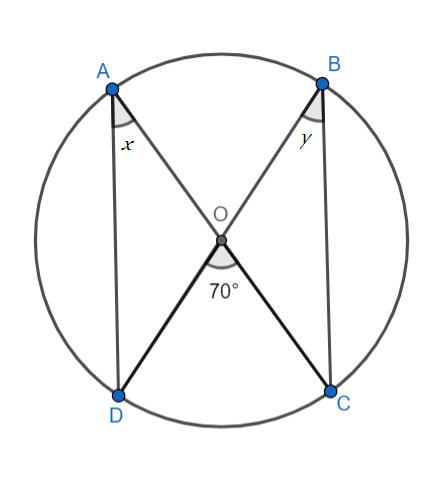
In the given figure, find the value of $x$ and $y$ where O is the centre of the circle.
Answer
 Verified
655.2k+ views
Hint: In this question, we will use the central angle theorem on a given angle, that is ${{70}^{\circ }}$, to find the values of the angles $x$ and $y$.
Complete step-by-step answer:
In the given question we have a circle with centre $O$. Here four points $A,B,C$ and $D$ are marked on the circumference of the circle and are joined with the lines $AD,AC,BD,BC$.
Also given that, $\angle DOC={{70}^{\circ }}$
Now, in two-dimensional geometry, we have a central angle theorem. According to this theorem,
The central angle subtended by two points on a circumference of a circle is twice the inscribed angle subtended by these two points.
Now, In a given question, Point $D$ and $C$, which are points on the circle, subtended an angle $DOC$ on the centre of the circle.
Also, $\angle $$DAC$ is the angle formed by point $D$ and $C$ on the point $A$, which is on the circumference of the circle. Hence, $\angle DAC$ is inscribed angle subtended by point $D$ and $C$.
Therefore, by central angle theorem, $\angle DOC$ must be twice of the $\angle DAC$. That is,
$\angle DOC=2\angle DAC$
Dividing two from both sides of the equation, we get,
$\angle DAC=\dfrac{\angle DOC}{2}$
Putting value of $\angle DOC$ here, we get,
$\angle DAC=\dfrac{{{70}^{\circ }}}{2}={{35}^{\circ }}$
Similarly, $\angle DBC$ is the angle formed by point $D$ and $C$ on the point $B$, which is on the circumference of the circle. Hence, $\angle DBC$ is inscribed angle subtended by point $D$ and $C$.
Therefore, by central angle theorem, $\angle DOC$ must be twice of the $\angle DBC$. That is,
$\angle DOC=2\angle DBC$
Dividing two from both sides of the equation, we get,
$\angle DBC=\dfrac{\angle DOC}{2}$
Putting value of $\angle DOC$ here, we get,
$\angle DBC=\dfrac{{{70}^{\circ }}}{2}={{35}^{\circ }}$
Hence, the value of $x$ and $y$ are ${{35}^{\circ }}$.
Note: Alternative way to do this question is that you can use angle sum property as $\Delta ABC$ and $\Delta BOC$ are isosceles triangles.From the figure $\angle BOD$=${{180}^{\circ }}$ as it is linear pair So,then $\angle DOC$+$\angle COB$=${{180}^{\circ }}$ which gives $\angle COB$=${{110}^{\circ }}$ by angle sum property for $\Delta COB$ we get required answer.
Complete step-by-step answer:
In the given question we have a circle with centre $O$. Here four points $A,B,C$ and $D$ are marked on the circumference of the circle and are joined with the lines $AD,AC,BD,BC$.
Also given that, $\angle DOC={{70}^{\circ }}$
Now, in two-dimensional geometry, we have a central angle theorem. According to this theorem,
The central angle subtended by two points on a circumference of a circle is twice the inscribed angle subtended by these two points.
Now, In a given question, Point $D$ and $C$, which are points on the circle, subtended an angle $DOC$ on the centre of the circle.
Also, $\angle $$DAC$ is the angle formed by point $D$ and $C$ on the point $A$, which is on the circumference of the circle. Hence, $\angle DAC$ is inscribed angle subtended by point $D$ and $C$.
Therefore, by central angle theorem, $\angle DOC$ must be twice of the $\angle DAC$. That is,
$\angle DOC=2\angle DAC$
Dividing two from both sides of the equation, we get,
$\angle DAC=\dfrac{\angle DOC}{2}$
Putting value of $\angle DOC$ here, we get,
$\angle DAC=\dfrac{{{70}^{\circ }}}{2}={{35}^{\circ }}$
Similarly, $\angle DBC$ is the angle formed by point $D$ and $C$ on the point $B$, which is on the circumference of the circle. Hence, $\angle DBC$ is inscribed angle subtended by point $D$ and $C$.
Therefore, by central angle theorem, $\angle DOC$ must be twice of the $\angle DBC$. That is,
$\angle DOC=2\angle DBC$
Dividing two from both sides of the equation, we get,
$\angle DBC=\dfrac{\angle DOC}{2}$
Putting value of $\angle DOC$ here, we get,
$\angle DBC=\dfrac{{{70}^{\circ }}}{2}={{35}^{\circ }}$
Hence, the value of $x$ and $y$ are ${{35}^{\circ }}$.
Note: Alternative way to do this question is that you can use angle sum property as $\Delta ABC$ and $\Delta BOC$ are isosceles triangles.From the figure $\angle BOD$=${{180}^{\circ }}$ as it is linear pair So,then $\angle DOC$+$\angle COB$=${{180}^{\circ }}$ which gives $\angle COB$=${{110}^{\circ }}$ by angle sum property for $\Delta COB$ we get required answer.
Recently Updated Pages
Master Class 11 English: Engaging Questions & Answers for Success

Master Class 11 Social Science: Engaging Questions & Answers for Success
Master Class 11 Maths: Engaging Questions & Answers for Success
Master Class 11 Biology: Engaging Questions & Answers for Success
Master Class 11 Physics: Engaging Questions & Answers for Success
Master Class 11 Chemistry: Engaging Questions & Answers for Success
Trending doubts
One Metric ton is equal to kg A 10000 B 1000 C 100 class 11 physics CBSE
Difference Between Prokaryotic Cells and Eukaryotic Cells
Find the value of the expression given below sin 30circ class 11 maths CBSE
Difference between physical and chemical change class 11 chemistry CBSE
Two of the body parts which do not appear in MRI are class 11 biology CBSE
Draw a diagram of a plant cell and label at least eight class 11 biology CBSE