




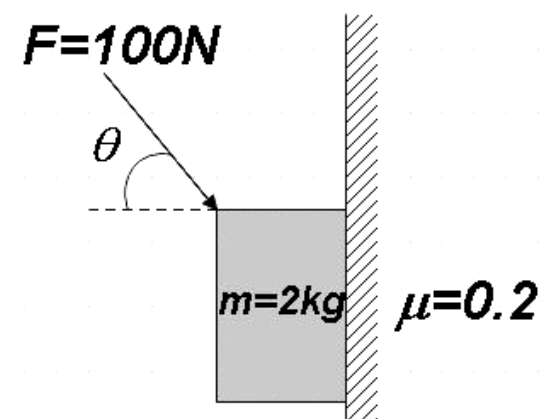
In the given figure find the acceleration of mass m=2kg when $\theta =63{}^\circ $
A. $0m{{s}^{-2}}$
B. $47m{{s}^{-2}}$
C. $50m{{s}^{-2}}$
D. $32m{{s}^{-2}}$
Answer
 Verified
574.2k+ views
Hint: As a first step make a free body diagram. By balancing the forces in the horizontal directions you will get the normal force. Now balance the forces in the vertical direction and then apply Newton’s second law to find the resultant acceleration. Also, note that the angle given in the question is that angle made by the applied force with the horizontal but what we need is that made with the vertical.
Formula used:
Frictional force,
${{F}_{f}}=\mu N$
Complete step-by-step solution
In the figure, we are given a mass of 2kg that is pushed down on a surface having a coefficient of friction 0.2 with a force of 100N at an angle $\theta =63{}^\circ $ with the horizontal.
We know that the body is accelerating downwards with an acceleration of a. Firstly let us mark all the forces acting on the body.
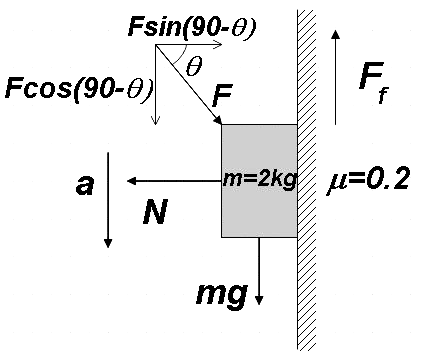
The angle given in the question is that made with the horizontal but what we require is the angle made with the vertical. So if $\theta $ is the angle made by the force exerted with horizontal then $90-\theta $ is the angle made with vertical. The force is further resolved into its components.
Apart from that, other forces acting on the body are the weight of the body downwards, normal force, and frictional force$\left( {{F}_{f}} \right)$ upwards.
The weight of the body is given by,
$W=mg$ ………………………. (1)
Normal force balances the sine component of the force applied,
$N=F\sin \left( 90-\theta \right)$
We know that the frictional force is given by,
${{F}_{f}}=\mu N$
Where $\mu $ is the coefficient of friction and N is the normal force.
${{F}_{f}}=0.2\times F\sin \left( 90-\theta \right)$
$\Rightarrow {{F}_{f}}=0.2\times 100\times \sin \left( 27{}^\circ \right)$
$\therefore {{F}_{f}}=9.1N$ …………………………………….. (2)
We know that the net acceleration on the body is along the vertical direction. So let us balance all the vertical forces.
${{F}_{net}}=F\cos \left( 90-\theta \right)+mg-{{F}_{{{f}_{{}}}}}$
But from Newton’s second law we have,
${{F}_{net}}=ma$
$\Rightarrow ma=F\cos \left( 90-\theta \right)+mg-{{F}_{f}}$
$\Rightarrow a=\dfrac{100\cos \left( 27{}^\circ \right)+\left( 2\times 10 \right)-9.1}{2}$
$\Rightarrow a=\dfrac{89.1+20-9.1}{2}$
$\therefore a=50m{{s}^{-2}}$
Therefore, we find the net acceleration of the mass to be $50m{{s}^{-2}}$. Hence, option C is the correct answer.
Note: Free body diagram is the most important part in solving these types of questions. You should make sure that you mark all the forces acting on the body correctly. Also, you may have noted that we have taken the direction of frictional force upwards. This is because the frictional force opposes the relative motion of mass and the surface and hence will be directed opposite to the motion of the body.
Formula used:
Frictional force,
${{F}_{f}}=\mu N$
Complete step-by-step solution
In the figure, we are given a mass of 2kg that is pushed down on a surface having a coefficient of friction 0.2 with a force of 100N at an angle $\theta =63{}^\circ $ with the horizontal.
We know that the body is accelerating downwards with an acceleration of a. Firstly let us mark all the forces acting on the body.
The angle given in the question is that made with the horizontal but what we require is the angle made with the vertical. So if $\theta $ is the angle made by the force exerted with horizontal then $90-\theta $ is the angle made with vertical. The force is further resolved into its components.
Apart from that, other forces acting on the body are the weight of the body downwards, normal force, and frictional force$\left( {{F}_{f}} \right)$ upwards.
The weight of the body is given by,
$W=mg$ ………………………. (1)
Normal force balances the sine component of the force applied,
$N=F\sin \left( 90-\theta \right)$
We know that the frictional force is given by,
${{F}_{f}}=\mu N$
Where $\mu $ is the coefficient of friction and N is the normal force.
${{F}_{f}}=0.2\times F\sin \left( 90-\theta \right)$
$\Rightarrow {{F}_{f}}=0.2\times 100\times \sin \left( 27{}^\circ \right)$
$\therefore {{F}_{f}}=9.1N$ …………………………………….. (2)
We know that the net acceleration on the body is along the vertical direction. So let us balance all the vertical forces.
${{F}_{net}}=F\cos \left( 90-\theta \right)+mg-{{F}_{{{f}_{{}}}}}$
But from Newton’s second law we have,
${{F}_{net}}=ma$
$\Rightarrow ma=F\cos \left( 90-\theta \right)+mg-{{F}_{f}}$
$\Rightarrow a=\dfrac{100\cos \left( 27{}^\circ \right)+\left( 2\times 10 \right)-9.1}{2}$
$\Rightarrow a=\dfrac{89.1+20-9.1}{2}$
$\therefore a=50m{{s}^{-2}}$
Therefore, we find the net acceleration of the mass to be $50m{{s}^{-2}}$. Hence, option C is the correct answer.
Note: Free body diagram is the most important part in solving these types of questions. You should make sure that you mark all the forces acting on the body correctly. Also, you may have noted that we have taken the direction of frictional force upwards. This is because the frictional force opposes the relative motion of mass and the surface and hence will be directed opposite to the motion of the body.
Recently Updated Pages
Master Class 11 Computer Science: Engaging Questions & Answers for Success

Master Class 11 Business Studies: Engaging Questions & Answers for Success
Master Class 11 Economics: Engaging Questions & Answers for Success
Master Class 11 English: Engaging Questions & Answers for Success
Master Class 11 Maths: Engaging Questions & Answers for Success
Master Class 11 Biology: Engaging Questions & Answers for Success
Trending doubts
One Metric ton is equal to kg A 10000 B 1000 C 100 class 11 physics CBSE
There are 720 permutations of the digits 1 2 3 4 5 class 11 maths CBSE
Discuss the various forms of bacteria class 11 biology CBSE
Draw a diagram of a plant cell and label at least eight class 11 biology CBSE
State the laws of reflection of light
Explain zero factorial class 11 maths CBSE