




In the given figure, chord AB is the diameter of the circle. What is the measure of the $\angle BDC$ ?
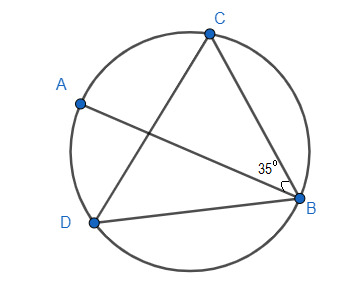
Answer
 Verified
611.7k+ views
Hint: For solving the question, you need to use the property that the angles subtended by the same segment of the circle are equal, and the angle subtended by a diameter of the circle at the circumference is equal to $90{}^\circ $.
Complete step-by-step solution -
Let’s start by drawing a diagram with all the required constructions for our better visualisation.
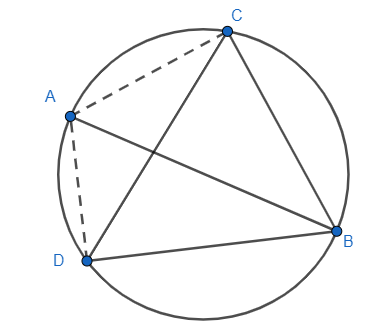
Now we know that the angles subtended by the same segment of the circle are equal and $\angle ABC\text{ and }\angle \text{ADC}$ are angles subtended by the same segment AC.
$\therefore \angle ABC=\angle ADC$
It is given in the question that $\angle ABC=15{}^\circ $ . If we combine this with above result, we get
$\angle ABC=\angle ADC=15{}^\circ $
Now from the figure, we can see that $\angle ADB$ can be written as the sum of $\angle ADC\text{ and }\angle BDC$ . We also found that $\angle ADC=15{}^\circ $ . So, we can say:
$\angle BDC+\angle ADC=\angle ADB$
$\Rightarrow \angle BDC+15{}^\circ =\angle ADB$
Now, as it is given that AB is the diameter of the circle and we know angle subtended by a diameter of the circle at the circumference is equal to $90{}^\circ $ . So, we can say that $\angle ADB=90{}^\circ $ .
$\therefore \angle BDC+15{}^\circ =90{}^\circ $
$\Rightarrow \angle BDC=75{}^\circ $
Therefore, the measure of the $\angle BDC$ is equal to $75{}^\circ $ .
Note: It is prescribed to learn all the basic theorems related to circles as they are regularly used in the questions related to circles and cyclic quadrilaterals, as we did in the above question.
Complete step-by-step solution -
Let’s start by drawing a diagram with all the required constructions for our better visualisation.
Now we know that the angles subtended by the same segment of the circle are equal and $\angle ABC\text{ and }\angle \text{ADC}$ are angles subtended by the same segment AC.
$\therefore \angle ABC=\angle ADC$
It is given in the question that $\angle ABC=15{}^\circ $ . If we combine this with above result, we get
$\angle ABC=\angle ADC=15{}^\circ $
Now from the figure, we can see that $\angle ADB$ can be written as the sum of $\angle ADC\text{ and }\angle BDC$ . We also found that $\angle ADC=15{}^\circ $ . So, we can say:
$\angle BDC+\angle ADC=\angle ADB$
$\Rightarrow \angle BDC+15{}^\circ =\angle ADB$
Now, as it is given that AB is the diameter of the circle and we know angle subtended by a diameter of the circle at the circumference is equal to $90{}^\circ $ . So, we can say that $\angle ADB=90{}^\circ $ .
$\therefore \angle BDC+15{}^\circ =90{}^\circ $
$\Rightarrow \angle BDC=75{}^\circ $
Therefore, the measure of the $\angle BDC$ is equal to $75{}^\circ $ .
Note: It is prescribed to learn all the basic theorems related to circles as they are regularly used in the questions related to circles and cyclic quadrilaterals, as we did in the above question.
Recently Updated Pages
Master Class 10 Computer Science: Engaging Questions & Answers for Success

Master Class 10 General Knowledge: Engaging Questions & Answers for Success
Master Class 10 English: Engaging Questions & Answers for Success
Master Class 10 Social Science: Engaging Questions & Answers for Success
Master Class 10 Maths: Engaging Questions & Answers for Success
Master Class 10 Science: Engaging Questions & Answers for Success
Trending doubts
What is the median of the first 10 natural numbers class 10 maths CBSE
The draft of the Preamble of the Indian Constitution class 10 social science CBSE
Which women's tennis player has 24 Grand Slam singles titles?
Who gave "Inqilab Zindabad" slogan?
Why is there a time difference of about 5 hours between class 10 social science CBSE
Who is the Brand Ambassador of Incredible India?