




In the given figure CB: QR and CA: QR and CA||PR. If \[AQ = 12cm\] , \[AR = 20cm\] and \[PB = CQ = 15cm\] , find PC and BR.
Answer
 Verified
579.3k+ views
Hint:
Here, we have given the triangle PQR in which A, B and C is the point of the side QR, PR and PQ. Also, we have given lines AB and BC. We have to find the length of the PC and BR by using Basic proportionality Theorem.
Complete step by step solution:
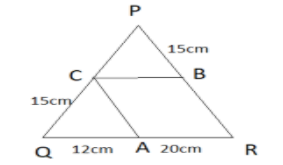
In $\Delta PQR$, \[CA||PR\]
Here by applying basic proportionality Theorem,
$ \Rightarrow \dfrac{{PC}}{{CQ}} = \dfrac{{RA}}{{AQ}} \to (1)$
Now, put the given values in the above equation
$
\Rightarrow \dfrac{{PC}}{{15}} = \dfrac{{20}}{{12}} \\
\Rightarrow PC = \dfrac{{15 \times 20}}{{12}} \\
\Rightarrow PC = 25cm \\
$
Now, for the length of BR
In $\Delta PQR$ , $CB||QR$
Using basic proportionality theorem,
$
\Rightarrow \dfrac{{PC}}{{CQ}} = \dfrac{{PB}}{{BR}} \\
\Rightarrow \dfrac{{25}}{{15}} = \dfrac{{15}}{{BR}} \\
\Rightarrow BR = \dfrac{{15 \times 15}}{{25}} \\
\Rightarrow BR = 9cm \\
$
$ \Rightarrow BR = 9cm$ and \[ \Rightarrow PC = 25cm\]
Note:
Basic proportionality theorem states that the line drawn parallel to the one side of the triangle and intersecting the other two sides in distinct points then the other two sides are divided in the same ratio. Basic probability theorem states the sides are in the same ratio not the same length.
Here, we have given the triangle PQR in which A, B and C is the point of the side QR, PR and PQ. Also, we have given lines AB and BC. We have to find the length of the PC and BR by using Basic proportionality Theorem.
Complete step by step solution:
In $\Delta PQR$, \[CA||PR\]
Here by applying basic proportionality Theorem,
$ \Rightarrow \dfrac{{PC}}{{CQ}} = \dfrac{{RA}}{{AQ}} \to (1)$
Now, put the given values in the above equation
$
\Rightarrow \dfrac{{PC}}{{15}} = \dfrac{{20}}{{12}} \\
\Rightarrow PC = \dfrac{{15 \times 20}}{{12}} \\
\Rightarrow PC = 25cm \\
$
Now, for the length of BR
In $\Delta PQR$ , $CB||QR$
Using basic proportionality theorem,
$
\Rightarrow \dfrac{{PC}}{{CQ}} = \dfrac{{PB}}{{BR}} \\
\Rightarrow \dfrac{{25}}{{15}} = \dfrac{{15}}{{BR}} \\
\Rightarrow BR = \dfrac{{15 \times 15}}{{25}} \\
\Rightarrow BR = 9cm \\
$
$ \Rightarrow BR = 9cm$ and \[ \Rightarrow PC = 25cm\]
Note:
Basic proportionality theorem states that the line drawn parallel to the one side of the triangle and intersecting the other two sides in distinct points then the other two sides are divided in the same ratio. Basic probability theorem states the sides are in the same ratio not the same length.
Recently Updated Pages
Master Class 10 Computer Science: Engaging Questions & Answers for Success

Master Class 10 General Knowledge: Engaging Questions & Answers for Success
Master Class 10 English: Engaging Questions & Answers for Success
Master Class 10 Social Science: Engaging Questions & Answers for Success
Master Class 10 Maths: Engaging Questions & Answers for Success
Master Class 10 Science: Engaging Questions & Answers for Success
Trending doubts
What is the median of the first 10 natural numbers class 10 maths CBSE
Which women's tennis player has 24 Grand Slam singles titles?
Who is the Brand Ambassador of Incredible India?
Why is there a time difference of about 5 hours between class 10 social science CBSE
Write a letter to the principal requesting him to grant class 10 english CBSE
A moving boat is observed from the top of a 150 m high class 10 maths CBSE