




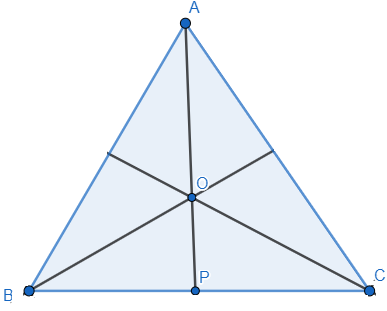
In the given figure BO and CO are respectively the bisectors of $\angle B$ and $\angle C$ of $\Delta ABC$. AO produced meets BC at P.
Show that
(i) $\dfrac{AB}{BP}=\dfrac{AO}{OP}$
(ii) $\dfrac{AC}{CP}=\dfrac{AO}{OP}$
(iii) $\dfrac{AB}{AC}=\dfrac{BP}{PC}$
(iv) AP is the bisector of $\angle BAC$
Answer
 Verified
609.9k+ views
Hint: We use the angle bisector formula to get the first two solutions using the relation only. We use those two proved relations to find the third proof. After getting the third proved, we use that with the help of the inverse of the angle bisector theorem to get to the fourth prove.
Complete step by step answer:
We are going to use the angle bisector theorem of triangles.
The angle bisector theorem is concerned with the relative lengths of the two segments that a triangle's side is divided into by a line that bisects the opposite angle. It equates their relative lengths to the relative lengths of the other two sides of the triangle.
In the figure, BO and CO are respectively the bisectors of $\angle B$ and $\angle C$ of $\Delta ABC$.
So, $\angle ABO=\angle CBO=\dfrac{1}{2}\angle ABC$, $\angle ACO=\angle BCO=\dfrac{1}{2}\angle ACB$.
In $\Delta ABP$, BO acts as the bisector.
So, $\dfrac{AB}{BP}=\dfrac{AO}{OP}$ … (1) [$\because \angle ABO=\angle CBO$]
Now we take $\Delta ABP$ where CO acts as a bisector.
It gives $\dfrac{AC}{CP}=\dfrac{AO}{OP}$ …(2) [$\because \angle ACO=\angle BCO$]
From equation (1) and (2) we get $\dfrac{AB}{BP}=\dfrac{AO}{OP}=\dfrac{AC}{CP}$ which gives us $\dfrac{AB}{BP}=\dfrac{AC}{CP}$.
We cross-change to get $\dfrac{AB}{AC}=\dfrac{BP}{PC}$.
The inverse of the angle-bisector theorem is also true.
Now in case of $\Delta ABC$ we got $\dfrac{AB}{AC}=\dfrac{BP}{PC}$. So, $\angle BAP=\angle CAP$.
It gives us AP is the angle bisector of $\angle BAC$.
Note: In the theorem, we need to remember that the relationship is with the relative lengths of the other two sides of the triangle. We can’t confuse it with the theorem of a similar triangle or the congruent triangle.
Complete step by step answer:
We are going to use the angle bisector theorem of triangles.
The angle bisector theorem is concerned with the relative lengths of the two segments that a triangle's side is divided into by a line that bisects the opposite angle. It equates their relative lengths to the relative lengths of the other two sides of the triangle.
In the figure, BO and CO are respectively the bisectors of $\angle B$ and $\angle C$ of $\Delta ABC$.
So, $\angle ABO=\angle CBO=\dfrac{1}{2}\angle ABC$, $\angle ACO=\angle BCO=\dfrac{1}{2}\angle ACB$.
In $\Delta ABP$, BO acts as the bisector.
So, $\dfrac{AB}{BP}=\dfrac{AO}{OP}$ … (1) [$\because \angle ABO=\angle CBO$]
Now we take $\Delta ABP$ where CO acts as a bisector.
It gives $\dfrac{AC}{CP}=\dfrac{AO}{OP}$ …(2) [$\because \angle ACO=\angle BCO$]
From equation (1) and (2) we get $\dfrac{AB}{BP}=\dfrac{AO}{OP}=\dfrac{AC}{CP}$ which gives us $\dfrac{AB}{BP}=\dfrac{AC}{CP}$.
We cross-change to get $\dfrac{AB}{AC}=\dfrac{BP}{PC}$.
The inverse of the angle-bisector theorem is also true.
Now in case of $\Delta ABC$ we got $\dfrac{AB}{AC}=\dfrac{BP}{PC}$. So, $\angle BAP=\angle CAP$.
It gives us AP is the angle bisector of $\angle BAC$.
Note: In the theorem, we need to remember that the relationship is with the relative lengths of the other two sides of the triangle. We can’t confuse it with the theorem of a similar triangle or the congruent triangle.
Recently Updated Pages
Master Class 12 Business Studies: Engaging Questions & Answers for Success

Master Class 12 Biology: Engaging Questions & Answers for Success
Master Class 12 Chemistry: Engaging Questions & Answers for Success
Class 12 Question and Answer - Your Ultimate Solutions Guide
Master Class 11 Social Science: Engaging Questions & Answers for Success
Master Class 11 English: Engaging Questions & Answers for Success
Trending doubts
Explain the Treaty of Vienna of 1815 class 10 social science CBSE
Who Won 36 Oscar Awards? Record Holder Revealed
What is the median of the first 10 natural numbers class 10 maths CBSE
Why is it 530 pm in india when it is 1200 afternoon class 10 social science CBSE
What is the full form of POSCO class 10 social science CBSE
The highest temperature in Karnataka is recorded in class 10 social science CBSE