



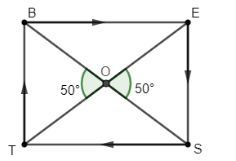
In the given figure, BEST is a rectangle in which diagonals BS and TE intersect at O. If $\angle EOS=50{}^\circ $, then $\angle OBT$
(a) $56{}^\circ $
(b) $45{}^\circ $
(c) $65{}^\circ $
(d) None of these
Answer
 Verified
622.8k+ views
Hint: First, as we know that diagonals of rectangles are bisecting means diagonals are divided into equal length so, $BO=OS=EO=OT$ will be equal. Then, the sum of angles of the triangle $180{}^\circ $ using this angle OBT can be found.
Complete step-by-step answer:
In the question, we are given a rectangle whose diagonals bisect each other. Also, $\angle EOS=50{}^\circ $ and $\angle BOT=50{}^\circ $ is given. So, the diagram is as shown below.
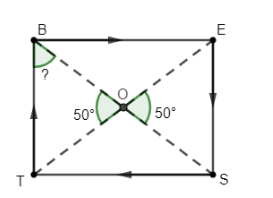
Here, we will use the theorem which stated that “diagonals of a rectangle are equal”. This means that the length of ET and BS are equal. So, O is the intersection point which intersects both the diagonals.
So, Diagonals are bisecting here which means dividing into two parts which will be equal. Therefore, $BO=OS=EO=OT$ are equal in length.
(Dotted line shown means it is having same length)
Now, we have to find $\angle OBT$ , So we know that summation of angles of triangle is equal to $180{}^\circ $ . So, we get
$180{}^\circ =\angle BOT+\angle OTB+\angle OBT$ …………………..(1)
Now, as we know OT and OB are equal in length it means $\Delta BOT$ is an isosceles triangle and also the opposite angle of side OT and OB are equal. Thus, we get
$\Rightarrow \angle OTB=\angle OBT$
So, substituting the above value in equation (1) we get,
$180{}^\circ =\angle BOT+\angle OBT+\angle OBT=\angle BOT+2\angle OBT$
We know that $\angle BOT=50{}^\circ $ is given, so we get
\[180{}^\circ =50{}^\circ +2\angle OBT\]
\[180{}^\circ -50{}^\circ =2\angle OBT\]
\[\dfrac{130{}^\circ }{2}=65{}^\circ =\angle OBT\]
Thus, \[\angle OBT=65{}^\circ \] .
Option (c) is the correct answer.
Note: Be careful in this type of problem because students generally consider that all the angles of rectangle are \[90{}^\circ \] i.e. right angle so, as diagonals are bisecting means angles also bisect in two part which means \[\dfrac{90{}^\circ }{2}=45{}^\circ \] . Thus, \[\angle OBT=45{}^\circ \] which is a completely wrong answer. So, don’t make this mistake. Also, if students apply this method then they must verify by adding 3 angles of triangle whether their sum is \[180{}^\circ \]or not. So, this way also mistakes can be avoided by verification.
Complete step-by-step answer:
In the question, we are given a rectangle whose diagonals bisect each other. Also, $\angle EOS=50{}^\circ $ and $\angle BOT=50{}^\circ $ is given. So, the diagram is as shown below.
Here, we will use the theorem which stated that “diagonals of a rectangle are equal”. This means that the length of ET and BS are equal. So, O is the intersection point which intersects both the diagonals.
So, Diagonals are bisecting here which means dividing into two parts which will be equal. Therefore, $BO=OS=EO=OT$ are equal in length.
(Dotted line shown means it is having same length)
Now, we have to find $\angle OBT$ , So we know that summation of angles of triangle is equal to $180{}^\circ $ . So, we get
$180{}^\circ =\angle BOT+\angle OTB+\angle OBT$ …………………..(1)
Now, as we know OT and OB are equal in length it means $\Delta BOT$ is an isosceles triangle and also the opposite angle of side OT and OB are equal. Thus, we get
$\Rightarrow \angle OTB=\angle OBT$
So, substituting the above value in equation (1) we get,
$180{}^\circ =\angle BOT+\angle OBT+\angle OBT=\angle BOT+2\angle OBT$
We know that $\angle BOT=50{}^\circ $ is given, so we get
\[180{}^\circ =50{}^\circ +2\angle OBT\]
\[180{}^\circ -50{}^\circ =2\angle OBT\]
\[\dfrac{130{}^\circ }{2}=65{}^\circ =\angle OBT\]
Thus, \[\angle OBT=65{}^\circ \] .
Option (c) is the correct answer.
Note: Be careful in this type of problem because students generally consider that all the angles of rectangle are \[90{}^\circ \] i.e. right angle so, as diagonals are bisecting means angles also bisect in two part which means \[\dfrac{90{}^\circ }{2}=45{}^\circ \] . Thus, \[\angle OBT=45{}^\circ \] which is a completely wrong answer. So, don’t make this mistake. Also, if students apply this method then they must verify by adding 3 angles of triangle whether their sum is \[180{}^\circ \]or not. So, this way also mistakes can be avoided by verification.
Recently Updated Pages
Three beakers labelled as A B and C each containing 25 mL of water were taken A small amount of NaOH anhydrous CuSO4 and NaCl were added to the beakers A B and C respectively It was observed that there was an increase in the temperature of the solutions contained in beakers A and B whereas in case of beaker C the temperature of the solution falls Which one of the following statements isarecorrect i In beakers A and B exothermic process has occurred ii In beakers A and B endothermic process has occurred iii In beaker C exothermic process has occurred iv In beaker C endothermic process has occurred

Master Class 9 Social Science: Engaging Questions & Answers for Success
Master Class 9 Science: Engaging Questions & Answers for Success
Master Class 9 Maths: Engaging Questions & Answers for Success
Master Class 9 General Knowledge: Engaging Questions & Answers for Success
Class 9 Question and Answer - Your Ultimate Solutions Guide
Three beakers labelled as A B and C each containing 25 mL of water were taken A small amount of NaOH anhydrous CuSO4 and NaCl were added to the beakers A B and C respectively It was observed that there was an increase in the temperature of the solutions contained in beakers A and B whereas in case of beaker C the temperature of the solution falls Which one of the following statements isarecorrect i In beakers A and B exothermic process has occurred ii In beakers A and B endothermic process has occurred iii In beaker C exothermic process has occurred iv In beaker C endothermic process has occurred
Master Class 9 Social Science: Engaging Questions & Answers for Success
Master Class 9 Science: Engaging Questions & Answers for Success
Trending doubts
Find the sum of series 1 + 2 + 3 + 4 + 5 + + 100 class 9 maths CBSE
What is the Full Form of ISI and RAW
Which are the Top 10 Largest States of India?
Name 10 Living and Non living things class 9 biology CBSE
What is the Full Form of ICSE / ISC ?
What is the color of ferrous sulphate crystals? How does this color change after heating? Name the products formed on strongly heating ferrous sulphate crystals. What type of chemical reaction occurs in this type of change.