



In the given figure, $AP\parallel BQ\parallel CR$. Prove that area(ACQ) is equal to area(PBR).
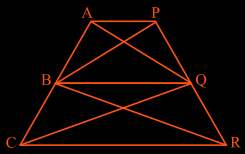
Answer
 Verified
663k+ views
Hint:
Two figures are said to be on the same base and between same parallels, if they have a common base (side) and the vertices, (or the vertex) opposite to the common base of each figure lie on a line parallel to the base.
The following theorem can be useful in dealing with these types of questions.
Theorem 1: Two triangles on the same base (or equal bases) and between the same parallel lines are equal in area.
Complete step by step solution:
Step 1: Draw the given figure
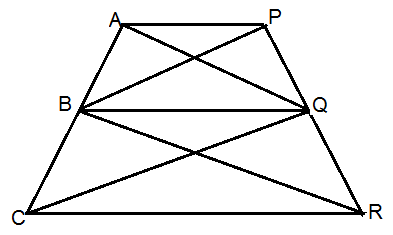
Step 2
Given that $AP\parallel BQ$ …… (1)
Consider $\vartriangle ABQ$and $\vartriangle PQB$ , having the same base BQ and are between the parallels AP and BQ
$ \Rightarrow ar(\vartriangle ABQ) = ar(\vartriangle PQB)$ (according to Theorem 1) …… (2)
Step 3
Given that $BQ\parallel CR$ …… (3)
Consider $\vartriangle CBQ$and $\vartriangle RQB$ , having the same base BQ and are between the parallels BQ and CR
$ \Rightarrow ar(\vartriangle CBQ) = ar(\vartriangle RQB)$ (according to theorem 1) …… (4)
Step 4: Adding (2) and (4)
$
\Rightarrow ar(\vartriangle ABQ) + ar(\vartriangle CBQ) = ar(\vartriangle PQB) + ar(\vartriangle RQB) \\
\Rightarrow {\text{ }}ar(\vartriangle AQC) = ar(\vartriangle PBR) \\
$
Hence proved. The required result area(ACQ) is equal to area(PBR) has been proved.
Note:
The converse (or reverse) of the above mention theorem is also true, i.e.
Theorem 2: Two triangles having the same base (or equal bases) and given that their areas are equal; then they lie between the same parallel lines.
Theorem 1 and 2 are also true for the parallelograms.
We should not get confused with complex figures, try to break it in smaller areas.
For the application of theorem, look for parallel lines and triangles or parallelograms between them.
Two figures are said to be on the same base and between same parallels, if they have a common base (side) and the vertices, (or the vertex) opposite to the common base of each figure lie on a line parallel to the base.
The following theorem can be useful in dealing with these types of questions.
Theorem 1: Two triangles on the same base (or equal bases) and between the same parallel lines are equal in area.
Complete step by step solution:
Step 1: Draw the given figure
Step 2
Given that $AP\parallel BQ$ …… (1)
Consider $\vartriangle ABQ$and $\vartriangle PQB$ , having the same base BQ and are between the parallels AP and BQ
$ \Rightarrow ar(\vartriangle ABQ) = ar(\vartriangle PQB)$ (according to Theorem 1) …… (2)
Step 3
Given that $BQ\parallel CR$ …… (3)
Consider $\vartriangle CBQ$and $\vartriangle RQB$ , having the same base BQ and are between the parallels BQ and CR
$ \Rightarrow ar(\vartriangle CBQ) = ar(\vartriangle RQB)$ (according to theorem 1) …… (4)
Step 4: Adding (2) and (4)
$
\Rightarrow ar(\vartriangle ABQ) + ar(\vartriangle CBQ) = ar(\vartriangle PQB) + ar(\vartriangle RQB) \\
\Rightarrow {\text{ }}ar(\vartriangle AQC) = ar(\vartriangle PBR) \\
$
Hence proved. The required result area(ACQ) is equal to area(PBR) has been proved.
Note:
The converse (or reverse) of the above mention theorem is also true, i.e.
Theorem 2: Two triangles having the same base (or equal bases) and given that their areas are equal; then they lie between the same parallel lines.
Theorem 1 and 2 are also true for the parallelograms.
We should not get confused with complex figures, try to break it in smaller areas.
For the application of theorem, look for parallel lines and triangles or parallelograms between them.
Recently Updated Pages
What are the two major island groups in India class 9 social science CBSE

What is Jhum cultivation class 9 biology CBSE
Write an Article on Save Earth Save Life
Silk is obtained from of the silk moth APupa BLarva class 9 chemistry CBSE
Write chemical formulas of the following compounds class 9 chemistry CBSE
The Indo Gangetic Plains of India are fertile due to class 9 social science CBSE
Trending doubts
Fill the blanks with the suitable prepositions 1 The class 9 english CBSE
Difference Between Plant Cell and Animal Cell
Name 10 Living and Non living things class 9 biology CBSE
What is the full form of pH?
On an outline map of India show its neighbouring c class 9 social science CBSE
What is pollution? How many types of pollution? Define it