




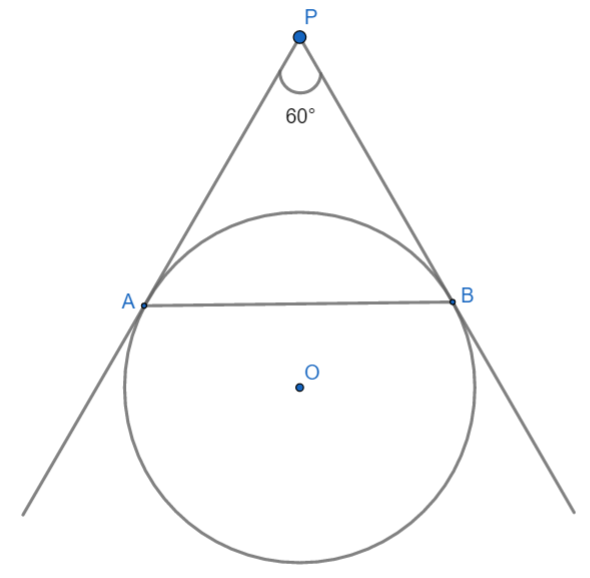
In the given figure, AP and BP are tangents to a circle with center O, such that AP = 5cm and $\angle APB={{60}^{\circ }}$. Find the length of the chord AB.
Answer
 Verified
603k+ views
Hint: Here, we are given a diagram in which AP and BP are two tangents with AP = 5cm and $\angle APB={{60}^{\circ }}$. We need to find the length of the chord AB. For this, we will use following properties:
(i) The length of the tangents drawn from an external point to a circle are always equal.
(ii) Isosceles triangle property: the angles corresponding to equal sides of the triangle are also equal.
(iii) If all the angles of a triangle are equal (${{60}^{\circ }}$ each) the triangle is an equilateral triangle.
Complete step by step answer:
Let us redraw the diagram. Here AP = 5cm, $\angle APB={{60}^{\circ }}$ and we need to find the length of the chord AB.
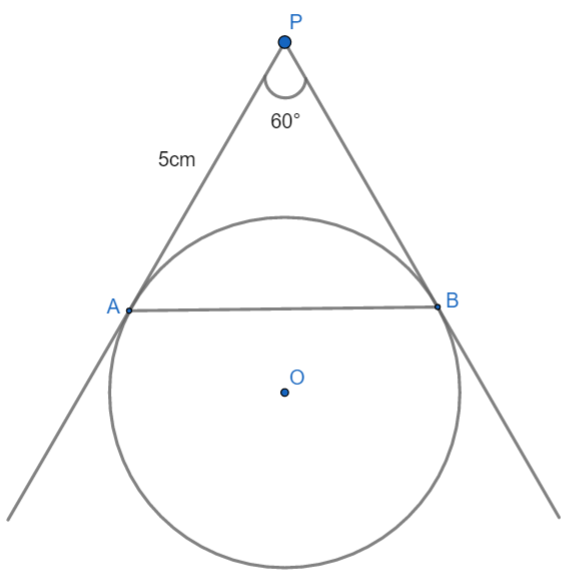
As we can see, AP and BP are tangents to the given circle from the same external point P. So we can use the property that, length of the tangents drawn from an external point to a circle are equal. Hence for this figure we get PA = PB.
Now we can see that APB forms a triangle with equal sides PA and PB.
We know that, in an isosceles triangle, angles corresponding to equal sides are also equal. Therefore, $\angle PAB=\angle PBA$.
We are given $\angle APB={{60}^{\circ }}$.
Using angle sum property of the triangle $\angle APB+\angle PAB+\angle PBA={{180}^{\circ }}$.
Let us suppose that, $\angle PAB=\angle PBA=x$ so we get ${{60}^{\circ }}+x+x={{180}^{\circ }}\Rightarrow {{60}^{\circ }}+2x={{180}^{\circ }}\Rightarrow 2x={{120}^{\circ }}$.
Dividing by 2 both sides we get: $x={{60}^{\circ }}$.
Since x was supposed to be equal to $\angle PAB=\angle PBA={{60}^{\circ }}$.
Since all the angles of the triangle are equal to ${{60}^{\circ }}$. Therefore, the triangle is an equilateral triangle.
$\Delta APB$ is an equilateral triangle. So, AP = PB = AB.
We are given AP as 5cm.
Therefore, AP = PB = AB = 5cm.
Hence, AB = 5cm which is the required length of the chord.
Note: Students should keep in mind all the properties before doing these sums. We can only draw two tangents from an external point to a circle and these tangents are always of equal length. An equilateral triangle always has angles of ${{60}^{\circ }}$ each.
(i) The length of the tangents drawn from an external point to a circle are always equal.
(ii) Isosceles triangle property: the angles corresponding to equal sides of the triangle are also equal.
(iii) If all the angles of a triangle are equal (${{60}^{\circ }}$ each) the triangle is an equilateral triangle.
Complete step by step answer:
Let us redraw the diagram. Here AP = 5cm, $\angle APB={{60}^{\circ }}$ and we need to find the length of the chord AB.
As we can see, AP and BP are tangents to the given circle from the same external point P. So we can use the property that, length of the tangents drawn from an external point to a circle are equal. Hence for this figure we get PA = PB.
Now we can see that APB forms a triangle with equal sides PA and PB.
We know that, in an isosceles triangle, angles corresponding to equal sides are also equal. Therefore, $\angle PAB=\angle PBA$.
We are given $\angle APB={{60}^{\circ }}$.
Using angle sum property of the triangle $\angle APB+\angle PAB+\angle PBA={{180}^{\circ }}$.
Let us suppose that, $\angle PAB=\angle PBA=x$ so we get ${{60}^{\circ }}+x+x={{180}^{\circ }}\Rightarrow {{60}^{\circ }}+2x={{180}^{\circ }}\Rightarrow 2x={{120}^{\circ }}$.
Dividing by 2 both sides we get: $x={{60}^{\circ }}$.
Since x was supposed to be equal to $\angle PAB=\angle PBA={{60}^{\circ }}$.
Since all the angles of the triangle are equal to ${{60}^{\circ }}$. Therefore, the triangle is an equilateral triangle.
$\Delta APB$ is an equilateral triangle. So, AP = PB = AB.
We are given AP as 5cm.
Therefore, AP = PB = AB = 5cm.
Hence, AB = 5cm which is the required length of the chord.
Note: Students should keep in mind all the properties before doing these sums. We can only draw two tangents from an external point to a circle and these tangents are always of equal length. An equilateral triangle always has angles of ${{60}^{\circ }}$ each.
Recently Updated Pages
Master Class 12 Economics: Engaging Questions & Answers for Success

Master Class 12 English: Engaging Questions & Answers for Success
Master Class 12 Social Science: Engaging Questions & Answers for Success
Master Class 12 Maths: Engaging Questions & Answers for Success
Master Class 12 Physics: Engaging Questions & Answers for Success
Master Class 10 English: Engaging Questions & Answers for Success
Trending doubts
Explain the Treaty of Vienna of 1815 class 10 social science CBSE
Who Won 36 Oscar Awards? Record Holder Revealed
Why is it 530 pm in india when it is 1200 afternoon class 10 social science CBSE
What is the full form of POSCO class 10 social science CBSE
Define Potential, Developed, Stock and Reserved resources
The speaker of the Lok Sabha is elected by the APresident class 10 social science CBSE