



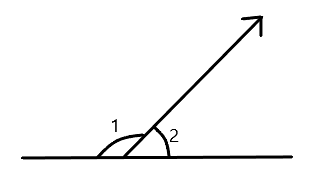
In the given figure $\angle 1$ and $\angle 2$ are supplementary angles. If $\angle 1$ is decreased, what changes should take place in $\angle 2$ so that both the angles still remain supplementary?
Answer
 Verified
564.6k+ views
Hint: In the above question we have been given two supplementary angles. We know that if two angles are supplementary then the sum of both angles is
$180^\circ $ . So we will use this property to solve this question. We will assume that let $\angle 1$ be decreased by $x$ .
Complete step-by-step solution:
We have been given that figure $\angle 1$ and $\angle 2$ are supplementary angles.
So it can be written as
$\angle 1 + \angle 2 = 180^\circ $
We can calculate $\angle 1$ as,
$\angle 1 = 180^\circ - \angle 2$
Now let us assume that $\angle 1$ is decreased by $x$ .
It can be written as
$\left( {\angle 1 - x} \right)$
Now since both the angles are supplementary, so if there is a change in $\angle 1$ , then the other angle will also change.
So let us say that $\angle 2$ changes to $\angle 3$ .
So we have new angles i.e.
$\left( {\angle 1 - x} \right)$ and $\angle 3$ area also supplementary angles.
So we can write them as
$\left( {\angle 1 - x} \right) + \angle 3 = 180^\circ $
We can substitute the value $\angle 1 = 180^\circ - \angle 2$ in the equation, so we have
$180^\circ - \angle 2 - x + \angle 3 = 180^\circ $
By arranging the terms in the right hand side, we have
$\angle 3 = 180^\circ - 180^\circ + \angle 2 + x$
It gives us value
$\angle 3 = \angle 2 + x$
So we can see that the other angle i.e. $\angle 2$ is increased by $x$
Hence in order to make both the angles supplementary if $\angle 1$ is decreased by any value , then $\angle 2$ is to be increased by the same value.
Note: We should know the properties of supplementary angles to solve this type of question. We should note that if one angle is $90^\circ $ , then the other angle has to be equal to $90^\circ $ . Another property is that if one angle is acute angle then the other angle has to be an obtuse angle to fulfil the criteria of supplementary angle.
$180^\circ $ . So we will use this property to solve this question. We will assume that let $\angle 1$ be decreased by $x$ .
Complete step-by-step solution:
We have been given that figure $\angle 1$ and $\angle 2$ are supplementary angles.
So it can be written as
$\angle 1 + \angle 2 = 180^\circ $
We can calculate $\angle 1$ as,
$\angle 1 = 180^\circ - \angle 2$
Now let us assume that $\angle 1$ is decreased by $x$ .
It can be written as
$\left( {\angle 1 - x} \right)$
Now since both the angles are supplementary, so if there is a change in $\angle 1$ , then the other angle will also change.
So let us say that $\angle 2$ changes to $\angle 3$ .
So we have new angles i.e.
$\left( {\angle 1 - x} \right)$ and $\angle 3$ area also supplementary angles.
So we can write them as
$\left( {\angle 1 - x} \right) + \angle 3 = 180^\circ $
We can substitute the value $\angle 1 = 180^\circ - \angle 2$ in the equation, so we have
$180^\circ - \angle 2 - x + \angle 3 = 180^\circ $
By arranging the terms in the right hand side, we have
$\angle 3 = 180^\circ - 180^\circ + \angle 2 + x$
It gives us value
$\angle 3 = \angle 2 + x$
So we can see that the other angle i.e. $\angle 2$ is increased by $x$
Hence in order to make both the angles supplementary if $\angle 1$ is decreased by any value , then $\angle 2$ is to be increased by the same value.
Note: We should know the properties of supplementary angles to solve this type of question. We should note that if one angle is $90^\circ $ , then the other angle has to be equal to $90^\circ $ . Another property is that if one angle is acute angle then the other angle has to be an obtuse angle to fulfil the criteria of supplementary angle.
Recently Updated Pages
What are the two major island groups in India class 9 social science CBSE

What is Jhum cultivation class 9 biology CBSE
Write an Article on Save Earth Save Life
Silk is obtained from of the silk moth APupa BLarva class 9 chemistry CBSE
Write chemical formulas of the following compounds class 9 chemistry CBSE
The Indo Gangetic Plains of India are fertile due to class 9 social science CBSE
Trending doubts
Fill the blanks with the suitable prepositions 1 The class 9 english CBSE
Difference Between Plant Cell and Animal Cell
Name 10 Living and Non living things class 9 biology CBSE
What is the full form of pH?
On an outline map of India show its neighbouring c class 9 social science CBSE
What is pollution? How many types of pollution? Define it