




In the given figure, $AB\parallel CD$. Find the value of x.
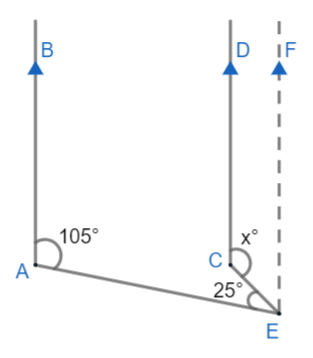
Answer
 Verified
607.2k+ views
Hint: At first, draw a line AG at point A parallel to CE. Then, use the fact that $AG\parallel CE$ and alternate angles are equal to find angle GAE. Then, find the angle BAG. After that, finally use the fact that $AB\parallel CD\text{ and }AG\parallel CE$ to tell that angle GAB is equal to angle ECD to get the answer.
Complete step by step answer:
In the question, we are given a figure,
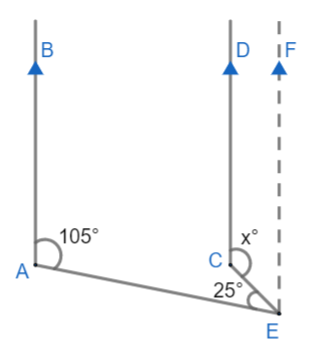
Where $AB\parallel CD$ is given. Now, to proceed we will like to do certain construction such as drawing a line from A such that it is parallel to CE so we can re-draw the figure as,
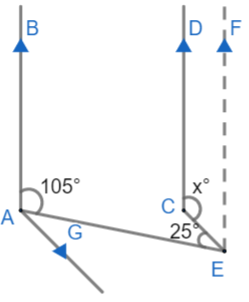
Hereby construction AG is parallel to CE.
Now, as we know that AG is parallel to CE and AE is transversal then, we can use the property of parallel lines which says alternative angles are equal.
Here, angle AEC and angle GAE are alternative angles then they are equal.
Here, angle AEC is ${{25}^{\circ }}$ So angle GAE is ${{25}^{\circ }}$
Now, we know that angle BAE is ${{105}^{\circ }}$ and GAE is ${{25}^{\circ }}$ so angle BAG will be sum of both angle GAE and BAE which is $\left( {{105}^{\circ }}+{{25}^{\circ }} \right)\Rightarrow {{130}^{\circ }}$
Now, the measure of angle BAG is ${{130}^{\circ }}$. As we know $BA\parallel DC, AG\parallel CE$ so we can say that angle BAG is equal to DCE using the property of corresponding angles.
So, as we know that corresponding angles are equal in parallel lines then we can write,
\[\begin{align}
& \angle DCE=\angle BAG \\
& \Rightarrow x={{130}^{\circ }} \\
\end{align}\]
Thus, value of x is ${{130}^{\circ }}$
Note:
Students can do the same question by using another method. They can do construction C such that CG is parallel to AE and then using properties of corresponding angles and alternate angles to get the desired result.
Complete step by step answer:
In the question, we are given a figure,
Where $AB\parallel CD$ is given. Now, to proceed we will like to do certain construction such as drawing a line from A such that it is parallel to CE so we can re-draw the figure as,
Hereby construction AG is parallel to CE.
Now, as we know that AG is parallel to CE and AE is transversal then, we can use the property of parallel lines which says alternative angles are equal.
Here, angle AEC and angle GAE are alternative angles then they are equal.
Here, angle AEC is ${{25}^{\circ }}$ So angle GAE is ${{25}^{\circ }}$
Now, we know that angle BAE is ${{105}^{\circ }}$ and GAE is ${{25}^{\circ }}$ so angle BAG will be sum of both angle GAE and BAE which is $\left( {{105}^{\circ }}+{{25}^{\circ }} \right)\Rightarrow {{130}^{\circ }}$
Now, the measure of angle BAG is ${{130}^{\circ }}$. As we know $BA\parallel DC, AG\parallel CE$ so we can say that angle BAG is equal to DCE using the property of corresponding angles.
So, as we know that corresponding angles are equal in parallel lines then we can write,
\[\begin{align}
& \angle DCE=\angle BAG \\
& \Rightarrow x={{130}^{\circ }} \\
\end{align}\]
Thus, value of x is ${{130}^{\circ }}$
Note:
Students can do the same question by using another method. They can do construction C such that CG is parallel to AE and then using properties of corresponding angles and alternate angles to get the desired result.
Recently Updated Pages
Three beakers labelled as A B and C each containing 25 mL of water were taken A small amount of NaOH anhydrous CuSO4 and NaCl were added to the beakers A B and C respectively It was observed that there was an increase in the temperature of the solutions contained in beakers A and B whereas in case of beaker C the temperature of the solution falls Which one of the following statements isarecorrect i In beakers A and B exothermic process has occurred ii In beakers A and B endothermic process has occurred iii In beaker C exothermic process has occurred iv In beaker C endothermic process has occurred

Master Class 10 Social Science: Engaging Questions & Answers for Success
Master Class 10 Science: Engaging Questions & Answers for Success
Master Class 10 Maths: Engaging Questions & Answers for Success
Master Class 10 General Knowledge: Engaging Questions & Answers for Success
Master Class 10 Computer Science: Engaging Questions & Answers for Success
Three beakers labelled as A B and C each containing 25 mL of water were taken A small amount of NaOH anhydrous CuSO4 and NaCl were added to the beakers A B and C respectively It was observed that there was an increase in the temperature of the solutions contained in beakers A and B whereas in case of beaker C the temperature of the solution falls Which one of the following statements isarecorrect i In beakers A and B exothermic process has occurred ii In beakers A and B endothermic process has occurred iii In beaker C exothermic process has occurred iv In beaker C endothermic process has occurred
Master Class 10 Social Science: Engaging Questions & Answers for Success
Master Class 10 Science: Engaging Questions & Answers for Success
Trending doubts
Explain the Treaty of Vienna of 1815 class 10 social science CBSE
Who Won 36 Oscar Awards? Record Holder Revealed
What is the name of Japan Parliament?
What is the median of the first 10 natural numbers class 10 maths CBSE
Why is it 530 pm in india when it is 1200 afternoon class 10 social science CBSE
Why is there a time difference of about 5 hours between class 10 social science CBSE