




In the given figure, ABCD is a square, M is the midpoint of AB and $PQ\bot CM$ . Which of the following statements is not true?
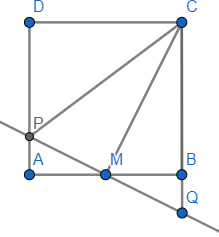
(a) AM=MB
(b) CP=CQ
(c) CP=CB
(d) PM=MQ
Answer
 Verified
638.4k+ views
Hint: Check the congruency of the triangle PAM and the triangle QBM followed by checking the congruency of the triangle CPM and triangle CQM.
Complete step-by-step answer:
It is given that M is the midpoint of AB, so we can say that AM=MB which is equal to half of the length of AB. Therefore, option (a) is true.
Now in $\Delta PAM\text{ and }\Delta \text{QBM}$ , we have:
AM=BM
$\angle QBM=\angle PAM=90{}^\circ $
And $\angle QMB\text{ and }\angle PMA$ are vertically opposite angles, so they are equal.
So, by ASA criteria, we can say that $\Delta PAM\cong \Delta \text{QBM}$ .
Therefore, by using the corresponding part of congruent triangles (CPCT), we can say that PM=MQ , so option (d) is also true.
Now in $\Delta CPM\text{ and }\Delta C\text{QM}$ , we have:
PM=QM
\[\angle CMQ=\angle CMP=90{}^\circ \]
And CM is common to both the triangles.
So, by SAS criteria, we can say that $\Delta CPM\cong \Delta C\text{QM}$ .
Therefore, by using the corresponding part of congruent triangles (CPCT), we can say that CP=CQ , so option (b) is also true.
Hence, we can conclude that the answer to the above question is option (c).
Note: It is prescribed to learn all the basic theorems related to congruence and similarity of triangles as they are used quite often. Also, learn the properties of parallelograms, including squares, as they might also be needed for solving such problems as we used in the above question.
Complete step-by-step answer:
It is given that M is the midpoint of AB, so we can say that AM=MB which is equal to half of the length of AB. Therefore, option (a) is true.
Now in $\Delta PAM\text{ and }\Delta \text{QBM}$ , we have:
AM=BM
$\angle QBM=\angle PAM=90{}^\circ $
And $\angle QMB\text{ and }\angle PMA$ are vertically opposite angles, so they are equal.
So, by ASA criteria, we can say that $\Delta PAM\cong \Delta \text{QBM}$ .
Therefore, by using the corresponding part of congruent triangles (CPCT), we can say that PM=MQ , so option (d) is also true.
Now in $\Delta CPM\text{ and }\Delta C\text{QM}$ , we have:
PM=QM
\[\angle CMQ=\angle CMP=90{}^\circ \]
And CM is common to both the triangles.
So, by SAS criteria, we can say that $\Delta CPM\cong \Delta C\text{QM}$ .
Therefore, by using the corresponding part of congruent triangles (CPCT), we can say that CP=CQ , so option (b) is also true.
Hence, we can conclude that the answer to the above question is option (c).
Note: It is prescribed to learn all the basic theorems related to congruence and similarity of triangles as they are used quite often. Also, learn the properties of parallelograms, including squares, as they might also be needed for solving such problems as we used in the above question.
Recently Updated Pages
Master Class 12 Business Studies: Engaging Questions & Answers for Success

Master Class 12 Biology: Engaging Questions & Answers for Success
Master Class 12 Chemistry: Engaging Questions & Answers for Success
Class 12 Question and Answer - Your Ultimate Solutions Guide
Master Class 11 Social Science: Engaging Questions & Answers for Success
Master Class 11 English: Engaging Questions & Answers for Success
Trending doubts
What is BLO What is the full form of BLO class 8 social science CBSE
Citizens of India can vote at the age of A 18 years class 8 social science CBSE
Right to vote is a AFundamental Right BFundamental class 8 social science CBSE
Give me the opposite gender of Duck class 8 english CBSE
What are the 12 elements of nature class 8 chemistry CBSE
Full form of STD, ISD and PCO