



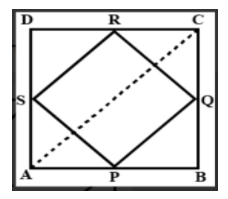
In the given figure $ABCD$ is a quadrilateral in which $P$, $Q$, $R$ and $S$ are mid-points the sides $AB$, $BC$, $CD$ and $DA$. $AC$ is a diagonal. Show that:
$SR\;\parallel AC$ and $SR = \dfrac{1}{2}AC$
Answer
 Verified
640.2k+ views
Hint: In the solution we will use the Midpoint theorem. The theorem says that When line segments attach the mid-points of any two sides of a triangle, then that line segments are parallel to the other side.
Complete Step-by-step Solution
Given:
$ABCD$ is a quadrilateral in which $P$, $Q$, $R$ and $S$ are the mid-points of the sides $AB$, $BC$, $CD$ and $DA$ respectively.
The following is the schematic diagram of the quadrilateral $ABCD$.
To prove that
$SR\;\parallel AC$ and $SR = \dfrac{1}{2}AC$
In the triangle $\Delta DAC$, the point $S$ is the midpoint of $DA$ whereas $R$ is the midpoint of $DC$.
According to the mid-point theorem, SR will be parallel to the diagonal of the quadrilateral that is AC.
$SR\parallel AC$
Therefore, it is proved that $SR\parallel AC$.
Since, we know that from the mid-point theorem that the line connecting the mid-points of two sides of the triangle will be parallel to the other side and also half of it. Then with the help of mid-point theorem, we get the required relation,
$SR = \dfrac{1}{2}AC$
Note: In this problem, make sure to use the mid-point theorem instead of other theorems when any question is asking about a quadrilateral with midpoints. The solution is totally based on the mid-point theorem. Mid-point is the point on the line segment which is exactly at the middle and it is equidistant from the end point of the line segment.
Complete Step-by-step Solution
Given:
$ABCD$ is a quadrilateral in which $P$, $Q$, $R$ and $S$ are the mid-points of the sides $AB$, $BC$, $CD$ and $DA$ respectively.
The following is the schematic diagram of the quadrilateral $ABCD$.
To prove that
$SR\;\parallel AC$ and $SR = \dfrac{1}{2}AC$
In the triangle $\Delta DAC$, the point $S$ is the midpoint of $DA$ whereas $R$ is the midpoint of $DC$.
According to the mid-point theorem, SR will be parallel to the diagonal of the quadrilateral that is AC.
$SR\parallel AC$
Therefore, it is proved that $SR\parallel AC$.
Since, we know that from the mid-point theorem that the line connecting the mid-points of two sides of the triangle will be parallel to the other side and also half of it. Then with the help of mid-point theorem, we get the required relation,
$SR = \dfrac{1}{2}AC$
Note: In this problem, make sure to use the mid-point theorem instead of other theorems when any question is asking about a quadrilateral with midpoints. The solution is totally based on the mid-point theorem. Mid-point is the point on the line segment which is exactly at the middle and it is equidistant from the end point of the line segment.
Recently Updated Pages
Basicity of sulphurous acid and sulphuric acid are

Master Class 12 Economics: Engaging Questions & Answers for Success
Master Class 12 Biology: Engaging Questions & Answers for Success
Master Class 11 English: Engaging Questions & Answers for Success
Master Class 11 Physics: Engaging Questions & Answers for Success
Master Class 11 Computer Science: Engaging Questions & Answers for Success
Trending doubts
Difference Between Plant Cell and Animal Cell
Fill the blanks with the suitable prepositions 1 The class 9 english CBSE
What is pollution? How many types of pollution? Define it
What is the full form of pH?
What is the Full Form of ICSE, CBSE and SSC
Name 10 Living and Non living things class 9 biology CBSE