




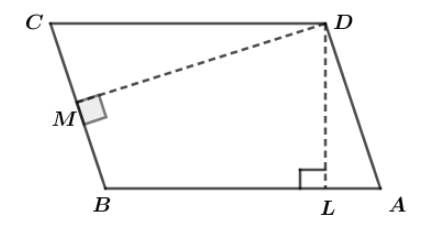
In the given figure, ABCD is a parallelogram. DL AB and DM BC. If AB = 18 cm and BC = 12 cm and DM = 10 cm. Find DL.
A. $6\dfrac{1}{2}$cm
B. 6 cm
C. $6\dfrac{1}{3}$cm
D. none
Answer
 Verified
647.1k+ views
Hint: Here, first calculate the area of quadrilateral ABCD, using base BC and height DM. Then calculate the area of quadrilateral ABCD, using base AB and height DL and equate the two areas, as both areas are of quadrilateral ABCD. And Value of DL could be easily obtained by doing simple calculations.
Complete step-by-step answer:
Given, AB = 18 cm and BC = 12 cm and DM = 10 cm.
Area of parallelogram, ABCD = $BC \times DM$
Since, in quadrilateral ABCD, Base is BC and Height is DM.
[Area of parallelogram: Area of parallelogram can be calculated by using formula, Area = Base × Height]
Here, BC = 12 cm and DM = 10 cm
Putting the values in formula, we get
Area of ABCD = 12 cm × 10 cm
Area of ABCD = 120 cm2
Also, Area of parallelogram, ABCD = $AB \times DL$
Since, in quadrilateral ABCD, Base is AB and Height is DL.
Here, AB = 18 cm and Area of ABCD = 120 cm2
Putting the values in formula, we get
120 cm2 = 18 cm × DL
⇒ DL = $\dfrac{{120}}{{18}} = \dfrac{{20}}{3} = 6\dfrac{2}{3}$ cm
Therefore, the length of DL is $6\dfrac{2}{3}$cm.
Hence, the correct option is (D).
Note: In these types of questions, obtain an area of the same quadrilateral using different bases and their respective perpendiculars (or heights). Always draw a figure of these types of questions first if the figure is not given. Do not calculate the exact value of the area if not asked in question, directly put the known values and perform the mathematical operation.
Complete step-by-step answer:
Given, AB = 18 cm and BC = 12 cm and DM = 10 cm.
Area of parallelogram, ABCD = $BC \times DM$
Since, in quadrilateral ABCD, Base is BC and Height is DM.
[Area of parallelogram: Area of parallelogram can be calculated by using formula, Area = Base × Height]
Here, BC = 12 cm and DM = 10 cm
Putting the values in formula, we get
Area of ABCD = 12 cm × 10 cm
Area of ABCD = 120 cm2
Also, Area of parallelogram, ABCD = $AB \times DL$
Since, in quadrilateral ABCD, Base is AB and Height is DL.
Here, AB = 18 cm and Area of ABCD = 120 cm2
Putting the values in formula, we get
120 cm2 = 18 cm × DL
⇒ DL = $\dfrac{{120}}{{18}} = \dfrac{{20}}{3} = 6\dfrac{2}{3}$ cm
Therefore, the length of DL is $6\dfrac{2}{3}$cm.
Hence, the correct option is (D).
Note: In these types of questions, obtain an area of the same quadrilateral using different bases and their respective perpendiculars (or heights). Always draw a figure of these types of questions first if the figure is not given. Do not calculate the exact value of the area if not asked in question, directly put the known values and perform the mathematical operation.
Recently Updated Pages
Basicity of sulphurous acid and sulphuric acid are

Master Class 10 Computer Science: Engaging Questions & Answers for Success
Master Class 10 Social Science: Engaging Questions & Answers for Success
Master Class 10 Science: Engaging Questions & Answers for Success
Class 10 Question and Answer - Your Ultimate Solutions Guide
Master Class 10 Maths: Engaging Questions & Answers for Success
Trending doubts
What is the Total Duration of Football Match?
Explain the Treaty of Vienna of 1815 class 10 social science CBSE
In football, which nation is called "La Roja"?
Why is there a time difference of about 5 hours between class 10 social science CBSE
10 examples of evaporation in daily life with explanations
What is the full form of POSCO class 10 social science CBSE