




In the given figure, ABCD is a parallelogram, and X and Y are points such that DX = BY. Prove that
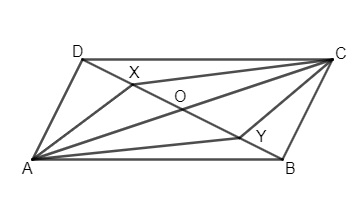
(a) AXCY is a parallelogram
(b) AX = XY, AY = CX
(c) $\Delta AYB\cong \Delta CXD$
(d) $\Delta AXD\cong \Delta CYB$
Answer
 Verified
629.1k+ views
Hint: Draw a suitable diagram with the help of the given information to visualize the problem in a right way. Use the property: “if diagonals of any quadrilateral is bisecting each other, then it will be a parallelogram. Opposite sides of a parallelogram are equal and parallel to each other, use these properties to solve the problem.
Complete step-by-step answer:
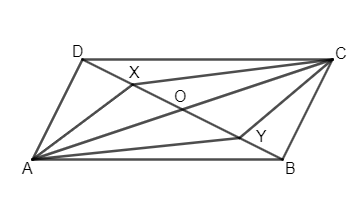
Here, we are given a parallelogram ABCD, such that points X and Y are lying on BD in a way that DX = BY. So, we know
$DX=BY.........\left( i \right)$
As we know the property of parallelogram suggests that opposite sides and opposite angles are equal to each other and the diagonals of the parallelogram bisect each other. So, we get
$\begin{align}
& OD=OB.......\left( ii \right) \\
& OC=OA........\left( iii \right) \\
\end{align}$
Now from equation (iii) we have
OD = OB
Subtract BY from both sides of the above equation, we get
OD – BY = OB – BY
Now, we can replace BY of L.H.S. sides of the above equation by DX from the equation (i). So, we get
OD – DX = OB – BY
Now, we can observe the length OD – DX will be equal to OX and OB – BY will be equal to OY. So, we get
OX = OY ………………(iv)
Now, in quadrilateral AXCY, we get
OX = OY and OA = OC …………..(v)
As XY and AC are the diagonals of the quadrilateral AXCY and they are getting bisected at point O from the equation.
So, as we know any quadrilateral will be a parallelogram, if its diagonals are getting bisected. So, we get that AXCY will represent a parallelogram because their diagonals are getting bisected.
Hence part(a) of the question is proved.
Now, as AXCY is representing a parallelogram, it will follow all the properties of the parallelogram. Hence as we know parallelogram has equal opposite sides. It means we can write equations from parallelogram AXCY as
AX = CY, AY = CX
Hence part (b) is proved.
In $\Delta AYB$ and $\Delta CXD$, we have
AB = CD (ABCD is a parallelogram)
AY = CX (AXCY is a parallelogram)
DX = BY (Given)
Hence, by SSS criteria of congruence of triangles, $\Delta AYB$ will be congruent to $\Delta CXD$ i..e. $\Delta AYB\cong \Delta CXD$ .
So, part (c) of the question is proved
Similarly, in $\Delta AXD$ and $\Delta CYB$ , we have
AD = BC (ABCD is a parallelogram)
AX = CY (AXCY is a parallelogram)
DX = BY (Given)
Hence, by SSS criteria triangles AXD and CYB are congruent to each other i.e. $\Delta AXD\cong \Delta CYB$
So, part(d) of the question is proved.
Note: Draw a suitable diagram with the given information for the perfect visualization of the problem.
One needs to be clear with the properties of a parallelogram. One may not be able to solve these kinds of questions without knowing properties of the given shape as we can not do any mathematical calculations with these kinds of problems (proving). So, be clear with the concepts and theorems for these types of questions in future.
Complete step-by-step answer:
Here, we are given a parallelogram ABCD, such that points X and Y are lying on BD in a way that DX = BY. So, we know
$DX=BY.........\left( i \right)$
As we know the property of parallelogram suggests that opposite sides and opposite angles are equal to each other and the diagonals of the parallelogram bisect each other. So, we get
$\begin{align}
& OD=OB.......\left( ii \right) \\
& OC=OA........\left( iii \right) \\
\end{align}$
Now from equation (iii) we have
OD = OB
Subtract BY from both sides of the above equation, we get
OD – BY = OB – BY
Now, we can replace BY of L.H.S. sides of the above equation by DX from the equation (i). So, we get
OD – DX = OB – BY
Now, we can observe the length OD – DX will be equal to OX and OB – BY will be equal to OY. So, we get
OX = OY ………………(iv)
Now, in quadrilateral AXCY, we get
OX = OY and OA = OC …………..(v)
As XY and AC are the diagonals of the quadrilateral AXCY and they are getting bisected at point O from the equation.
So, as we know any quadrilateral will be a parallelogram, if its diagonals are getting bisected. So, we get that AXCY will represent a parallelogram because their diagonals are getting bisected.
Hence part(a) of the question is proved.
Now, as AXCY is representing a parallelogram, it will follow all the properties of the parallelogram. Hence as we know parallelogram has equal opposite sides. It means we can write equations from parallelogram AXCY as
AX = CY, AY = CX
Hence part (b) is proved.
In $\Delta AYB$ and $\Delta CXD$, we have
AB = CD (ABCD is a parallelogram)
AY = CX (AXCY is a parallelogram)
DX = BY (Given)
Hence, by SSS criteria of congruence of triangles, $\Delta AYB$ will be congruent to $\Delta CXD$ i..e. $\Delta AYB\cong \Delta CXD$ .
So, part (c) of the question is proved
Similarly, in $\Delta AXD$ and $\Delta CYB$ , we have
AD = BC (ABCD is a parallelogram)
AX = CY (AXCY is a parallelogram)
DX = BY (Given)
Hence, by SSS criteria triangles AXD and CYB are congruent to each other i.e. $\Delta AXD\cong \Delta CYB$
So, part(d) of the question is proved.
Note: Draw a suitable diagram with the given information for the perfect visualization of the problem.
One needs to be clear with the properties of a parallelogram. One may not be able to solve these kinds of questions without knowing properties of the given shape as we can not do any mathematical calculations with these kinds of problems (proving). So, be clear with the concepts and theorems for these types of questions in future.
Recently Updated Pages
Master Class 10 Social Science: Engaging Questions & Answers for Success

Master Class 10 Science: Engaging Questions & Answers for Success
Master Class 10 Maths: Engaging Questions & Answers for Success
Master Class 10 General Knowledge: Engaging Questions & Answers for Success
Master Class 10 Computer Science: Engaging Questions & Answers for Success
Class 10 Question and Answer - Your Ultimate Solutions Guide
Trending doubts
What is the full form of PNG A Petrol Natural Gas B class 10 chemistry CBSE
Explain the Treaty of Vienna of 1815 class 10 social science CBSE
In cricket, how many legal balls are there in a standard over?
Why is there a time difference of about 5 hours between class 10 social science CBSE
Who Won 36 Oscar Awards? Record Holder Revealed
What is the median of the first 10 natural numbers class 10 maths CBSE