




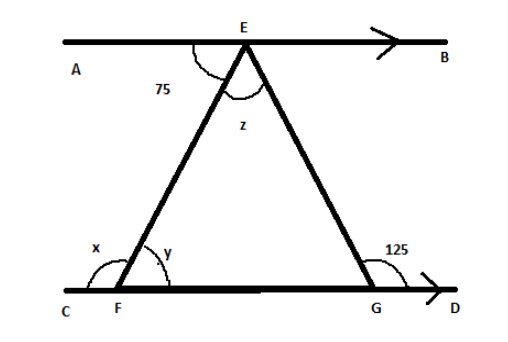
In the given figure, AB$||$CD. Find in degree the value of $x - y + z$ (Input the value without degree).
Answer
 Verified
594.9k+ views
Hint: Here in this question properties of parallel lines and interior angle property of a triangle will get used. By this we can find the values of x, y and z
Properties of parallel lines: Here AB is parallel to CD and EF and EG are intersecting lines. . In this question the following properties will get used.
1) Alternate angles are equal \[(\angle AEF \& {y^ \circ })\]
2) Interior sum of angles on the same side of transverse line (${75^ \circ }$+${x^ \circ }$=${180^ \circ }$)
3) Property of triangle: Sum of interior angles of triangle is ${180^ \circ }$ (triangle EFG)
Complete step by step solution:
In the given figure AB||CD , EF is an intersecting line so here we will first apply interior angle property also known as complementary angles.
${75^ \circ } + {x^ \circ } = {180^ \circ }$ (Complementary angles)
${x^ \circ } = {105^ \circ }$
Now for finding y˚ apply alternate angle property therefore angle $\angle AEF = {y^ \circ }$
${y^ \circ } = {75^ \circ } = \angle EFG$
Now to find the value of z˚ we have to use the angle sum property of a triangle.
Here $\angle FEG + \angle EFG + \angle EGF = {180^ \circ }$ ................equation 1.
Now, $\angle EGD + \angle EGF = {180^ \circ }$ (Sum of angles on a straight line is${180^ \circ }$)
${125^ \circ } + \angle EGF = {180^ \circ }$
$\angle EGF = {55^ \circ }$
Now putting values of$\angle EFG$, $\angle EGF$ in equation 1, we will get $\angle FEG$
$\angle FEG + {75^ \circ } + {55^ \circ } = {180^ \circ }$
$\angle FEG = {50^ \circ }$ (Which is ${z^ \circ }$), therefore ${z^ \circ } = {50^ \circ }$
${x^ \circ } - {y^ \circ } + {z^ \circ } = {105^ \circ } - {75^ \circ } + {50^ \circ }\\$
${x^ \circ } - {y^ \circ } + {z^ \circ } = {80^ \circ }$
Note:
1. We have applied properties of parallel line on intersecting line EF but we can also apply these same properties on intersecting line EG.
2. Angle properties can be confusing sometimes so students should not be confused between alternate angles and corresponding angles.
3. Don’t forget to mark degrees on the angles.
Properties of parallel lines: Here AB is parallel to CD and EF and EG are intersecting lines. . In this question the following properties will get used.
1) Alternate angles are equal \[(\angle AEF \& {y^ \circ })\]
2) Interior sum of angles on the same side of transverse line (${75^ \circ }$+${x^ \circ }$=${180^ \circ }$)
3) Property of triangle: Sum of interior angles of triangle is ${180^ \circ }$ (triangle EFG)
Complete step by step solution:
In the given figure AB||CD , EF is an intersecting line so here we will first apply interior angle property also known as complementary angles.
${75^ \circ } + {x^ \circ } = {180^ \circ }$ (Complementary angles)
${x^ \circ } = {105^ \circ }$
Now for finding y˚ apply alternate angle property therefore angle $\angle AEF = {y^ \circ }$
${y^ \circ } = {75^ \circ } = \angle EFG$
Now to find the value of z˚ we have to use the angle sum property of a triangle.
Here $\angle FEG + \angle EFG + \angle EGF = {180^ \circ }$ ................equation 1.
Now, $\angle EGD + \angle EGF = {180^ \circ }$ (Sum of angles on a straight line is${180^ \circ }$)
${125^ \circ } + \angle EGF = {180^ \circ }$
$\angle EGF = {55^ \circ }$
Now putting values of$\angle EFG$, $\angle EGF$ in equation 1, we will get $\angle FEG$
$\angle FEG + {75^ \circ } + {55^ \circ } = {180^ \circ }$
$\angle FEG = {50^ \circ }$ (Which is ${z^ \circ }$), therefore ${z^ \circ } = {50^ \circ }$
${x^ \circ } - {y^ \circ } + {z^ \circ } = {105^ \circ } - {75^ \circ } + {50^ \circ }\\$
${x^ \circ } - {y^ \circ } + {z^ \circ } = {80^ \circ }$
Note:
1. We have applied properties of parallel line on intersecting line EF but we can also apply these same properties on intersecting line EG.
2. Angle properties can be confusing sometimes so students should not be confused between alternate angles and corresponding angles.
3. Don’t forget to mark degrees on the angles.
Recently Updated Pages
Master Class 11 Computer Science: Engaging Questions & Answers for Success

Master Class 11 Business Studies: Engaging Questions & Answers for Success
Master Class 11 Economics: Engaging Questions & Answers for Success
Master Class 11 English: Engaging Questions & Answers for Success
Master Class 11 Maths: Engaging Questions & Answers for Success
Master Class 11 Biology: Engaging Questions & Answers for Success
Trending doubts
One Metric ton is equal to kg A 10000 B 1000 C 100 class 11 physics CBSE
There are 720 permutations of the digits 1 2 3 4 5 class 11 maths CBSE
Discuss the various forms of bacteria class 11 biology CBSE
Draw a diagram of a plant cell and label at least eight class 11 biology CBSE
State the laws of reflection of light
Explain zero factorial class 11 maths CBSE