




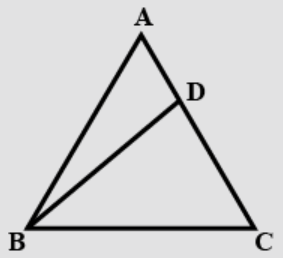
In the given figure ABC is a triangle in which AB = AC and D is a point on AC such that \[B{{C}^{2}}=AC\times CD\]. Prove that BD = BC.
Answer
 Verified
642.3k+ views
Hint: Consider the figure and prove that \[\Delta ABC\] is similar to \[\Delta BDC\], using the given concepts in question. As the triangles are similar, their corresponding angles will also be similar. So in \[\Delta BDC\], as angles are similar, the lengths will also be equal.
Complete step-by-step answer:
We are given a triangle ABC.
We are told that the length of AB and AC are the same, such that, AB = AC.
D is a point on the side AC, such that, \[B{{C}^{2}}=AC\times CD\].
\[\Rightarrow BC\times BC=AC\times CD.\]
We can arrange the above relation,
\[\dfrac{BC}{CD}=\dfrac{AC}{BC}\]
From this we can say that the lengths of the sides are proportional.
Hence we can say that the ratio of two sides is the same as the ratio between another 2 sides.
\[\therefore \]\[\Delta ABC\] is similar to \[\Delta BDC\].
As the 2 triangles are similar, then their corresponding angles will also be similar.
So \[\angle BAC\] is equal to the corresponding angle \[\angle DBC.\]
\[\Rightarrow \angle BAC=\angle DBC.\]
Similarly, \[\angle ABC\] is equal to the corresponding angle \[\angle BDC.\]
\[\angle ABC=\angle BDC\]
So as per the relations, we can say that \[\angle ABC=\angle BDC\].
In \[\Delta ABC\], we were given that AB = AC.
\[\angle ABC=\angle ACB=\angle DCB\].
In \[\Delta BDC\], \[\angle BDC=\angle BCD\].
Thus as the angles are similar, the length of the side BD is equal to BC.
\[\therefore BD=BC.\]
Hence we proved that \[BD=BC.\]
Note: We can also solve this by using the ratio of corresponding sides. Let us consider \[\Delta ABC\] and \[\Delta BDC\]. We proved that the triangles are similar. So the ratio of corresponding sides may be written as,
\[\dfrac{BC}{CD}=\dfrac{AC}{BC}=\dfrac{AB}{BD}\].
From this let us consider \[\dfrac{AC}{BC}=\dfrac{AB}{BD}\].
We have been given that AC = AB.
\[\dfrac{AB}{BC}=\dfrac{AB}{BD}\], cancel out the like terms and cross multiply.
\[\dfrac{1}{BC}=\dfrac{1}{BD}\Rightarrow BC=BD.\]
Complete step-by-step answer:
We are given a triangle ABC.
We are told that the length of AB and AC are the same, such that, AB = AC.
D is a point on the side AC, such that, \[B{{C}^{2}}=AC\times CD\].
\[\Rightarrow BC\times BC=AC\times CD.\]
We can arrange the above relation,
\[\dfrac{BC}{CD}=\dfrac{AC}{BC}\]
From this we can say that the lengths of the sides are proportional.
Hence we can say that the ratio of two sides is the same as the ratio between another 2 sides.
\[\therefore \]\[\Delta ABC\] is similar to \[\Delta BDC\].
As the 2 triangles are similar, then their corresponding angles will also be similar.
So \[\angle BAC\] is equal to the corresponding angle \[\angle DBC.\]
\[\Rightarrow \angle BAC=\angle DBC.\]
Similarly, \[\angle ABC\] is equal to the corresponding angle \[\angle BDC.\]
\[\angle ABC=\angle BDC\]
So as per the relations, we can say that \[\angle ABC=\angle BDC\].
In \[\Delta ABC\], we were given that AB = AC.
\[\angle ABC=\angle ACB=\angle DCB\].
In \[\Delta BDC\], \[\angle BDC=\angle BCD\].
Thus as the angles are similar, the length of the side BD is equal to BC.
\[\therefore BD=BC.\]
Hence we proved that \[BD=BC.\]
Note: We can also solve this by using the ratio of corresponding sides. Let us consider \[\Delta ABC\] and \[\Delta BDC\]. We proved that the triangles are similar. So the ratio of corresponding sides may be written as,
\[\dfrac{BC}{CD}=\dfrac{AC}{BC}=\dfrac{AB}{BD}\].
From this let us consider \[\dfrac{AC}{BC}=\dfrac{AB}{BD}\].
We have been given that AC = AB.
\[\dfrac{AB}{BC}=\dfrac{AB}{BD}\], cancel out the like terms and cross multiply.
\[\dfrac{1}{BC}=\dfrac{1}{BD}\Rightarrow BC=BD.\]
Recently Updated Pages
Master Class 12 Business Studies: Engaging Questions & Answers for Success

Master Class 12 Biology: Engaging Questions & Answers for Success
Master Class 12 Chemistry: Engaging Questions & Answers for Success
Class 12 Question and Answer - Your Ultimate Solutions Guide
Master Class 11 Social Science: Engaging Questions & Answers for Success
Master Class 11 English: Engaging Questions & Answers for Success
Trending doubts
Explain the Treaty of Vienna of 1815 class 10 social science CBSE
Which Indian city is known as the "City of Victory"?
Which instrument is used to measure the Blood Pressure?
Who Won 36 Oscar Awards? Record Holder Revealed
What is the median of the first 10 natural numbers class 10 maths CBSE
Why is it 530 pm in india when it is 1200 afternoon class 10 social science CBSE