




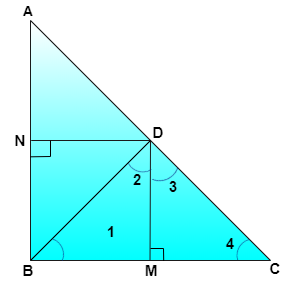
In the given figure, ABC is a right triangle right angled at B and D is the foot of the perpendicular drawn from B on AC. If DM \[ \bot \] BC and DN \[ \bot \] AB, prove that
(i).$D{M^2} = DN \times MC$
(ii).$D{N^2} = DM \times AN$
Answer
 Verified
664.8k+ views
Hint: In this question use the given information to show quadrilateral BMDN is a rectangle and also remember to use Angle-Angle property to show triangles are congruent, use this information to approach towards the solution of the question.
Complete step by step answer:
According to the given information we have a right angle triangle ABC right angle at B and BD is perpendicular to AC where D is the foot of the perpendicular on AC
It is given that DM \[ \bot \] BC also we know that in right angle triangle ABC AB \[ \bot \] BC
Therefore AB is parallel to each other DM
Since we know that when two sides of a quadrilateral are parallel to each other than the other two sides of quadrilateral are equal to each other
Hence we can say that quadrilateral BMDN is a rectangle
Therefore BM = ND
(i).$D{M^2} = DN \times MC$
In triangle BMD by the angle sum property
$\angle 1 + \angle 2 + \angle BMD = {180^ \circ }$
Since we know that DM is perpendicular to BC
Therefore $\angle BMD = {90^ \circ }$
Substituting the value in above equation we get
$\angle 1 + \angle 2 + {90^ \circ } = {180^ \circ }$
$ \Rightarrow $$\angle 1 + \angle 2 = {180^ \circ } - {90^ \circ }$
$ \Rightarrow $$\angle 1 + \angle 2 = {90^ \circ }$ Taking this as equation 1
For triangle DMC by the angle sum property
$\angle 3 + \angle 4 + \angle DMC = {180^ \circ }$
Since we know that DM is perpendicular to BC
Therefore $\angle DMC = {90^ \circ }$
Substituting the value in the above equation we get
$\angle 3 + \angle 4 + {90^ \circ } = {180^ \circ }$
$ \Rightarrow $$\angle 3 + \angle 4 = {180^ \circ } - {90^ \circ }$
$ \Rightarrow $$\angle 3 + \angle 4 = {90^ \circ }$ Taking this as equation 2
Since we know that BD is perpendicular to AC therefore
$\angle 2 + \angle 3 = {90^ \circ }$ Taking this as equation 3
Now comparing the equation 1 and 3 we get
$\angle 1 + \angle 2 = \angle 2 + \angle 3$
Therefore $\angle 1 = \angle 3$
Now comparing equation 2 and equation 3 we get
$\angle 3 + \angle 2 = \angle 3 + \angle 4$
Therefore $\angle 2 = \angle 4$
Since for triangle BMD and triangle DMC
We know that $\angle 1 = \angle 3$ and $\angle 2 = \angle 4$
Therefore by the Angle-Angle property
Triangle BMD and triangle DMC are congruent i.e. $\Delta BMD \sim \Delta DMC$
Since the triangle BMD and triangle DMC are equal to each other therefore
\[\dfrac{{BM}}{{DM}} = \dfrac{{DM}}{{MC}}\]
Since we know that BM = DN by the property of rectangle BMDN
Therefore \[\dfrac{{DN}}{{DM}} = \dfrac{{DM}}{{MC}}\]
$ \Rightarrow $\[D{M^2} = DN \times MC\]
Hence proved
(ii).$D{N^2} = DM \times AN$
In triangle DNB by the angle sum property
$\angle NBD + \angle NDB + \angle BND = {180^ \circ }$
Since we know that DN is perpendicular to AB
Therefore $\angle BND = {90^ \circ }$
Substituting the value in above equation we get
$\angle NBD + \angle NDB + {90^ \circ } = {180^ \circ }$
$ \Rightarrow $$\angle NBD + \angle NDB = {180^ \circ } - {90^ \circ }$
$ \Rightarrow $$\angle NBD + \angle NDB = {90^ \circ }$ Taking this as equation 1
For triangle AND by the angle sum property
$\angle NDA + \angle NAD + \angle DNA = {180^ \circ }$
Since we know that DN is perpendicular to AB
Therefore $\angle DNA = {90^ \circ }$
Substituting the value in the above equation we get
$\angle NDA + \angle NAD + {90^ \circ } = {180^ \circ }$
$ \Rightarrow $$\angle NDA + \angle NAD = {180^ \circ } - {90^ \circ }$
$ \Rightarrow $$\angle NDA + \angle NAD = {90^ \circ }$ Taking this as equation 2
Since we know that BD is perpendicular to AC therefore
$\angle NDA + \angle NDB = {90^ \circ }$ Taking this as equation 3
Now comparing the equation 1 and 3 we get
$\angle NBD + \angle NDB = \angle NDA + \angle NDB$
Therefore $\angle NBD = \angle NDA$
Now comparing equation 2 and equation $\angle 2 = \angle 4$3 we get
$\angle NDA + \angle NAD = \angle NDA + \angle NDB$
Therefore $\angle NAD = \angle NDB$
Since for triangle AND and triangle BND
We know that $\angle NAD = \angle NDB$ and $\angle NBD = \angle NDA$
Therefore by the Angle-Angle property
Triangle AND and triangle BND are congruent i.e. $\Delta AND \sim \Delta BND$
Since the triangle AND and triangle BND are equal to each other therefore
\[\dfrac{{AN}}{{DN}} = \dfrac{{DN}}{{BN}}\]
Since we know that BN = DM by the property of rectangle BMDN
Therefore \[\dfrac{{AN}}{{DN}} = \dfrac{{DN}}{{DM}}\]
$ \Rightarrow $\[D{N^2} = DM \times AN\]
Hence proved
Note: In the above solution we used the congruence of triangles which can be explained as the term which is generally used to identify the shape and its image, the triangle which are said to be congruent have same dimensions and shapes there are some conditions for congruence of triangles such as Side-Side-Side, Side-Angle-Side, Angle-Side-Angle, etc. as shown in these conditions triangles should have their three sides and all three angles equal to angles and sides of other triangle.
Complete step by step answer:
According to the given information we have a right angle triangle ABC right angle at B and BD is perpendicular to AC where D is the foot of the perpendicular on AC
It is given that DM \[ \bot \] BC also we know that in right angle triangle ABC AB \[ \bot \] BC
Therefore AB is parallel to each other DM
Since we know that when two sides of a quadrilateral are parallel to each other than the other two sides of quadrilateral are equal to each other
Hence we can say that quadrilateral BMDN is a rectangle
Therefore BM = ND
(i).$D{M^2} = DN \times MC$
In triangle BMD by the angle sum property
$\angle 1 + \angle 2 + \angle BMD = {180^ \circ }$
Since we know that DM is perpendicular to BC
Therefore $\angle BMD = {90^ \circ }$
Substituting the value in above equation we get
$\angle 1 + \angle 2 + {90^ \circ } = {180^ \circ }$
$ \Rightarrow $$\angle 1 + \angle 2 = {180^ \circ } - {90^ \circ }$
$ \Rightarrow $$\angle 1 + \angle 2 = {90^ \circ }$ Taking this as equation 1
For triangle DMC by the angle sum property
$\angle 3 + \angle 4 + \angle DMC = {180^ \circ }$
Since we know that DM is perpendicular to BC
Therefore $\angle DMC = {90^ \circ }$
Substituting the value in the above equation we get
$\angle 3 + \angle 4 + {90^ \circ } = {180^ \circ }$
$ \Rightarrow $$\angle 3 + \angle 4 = {180^ \circ } - {90^ \circ }$
$ \Rightarrow $$\angle 3 + \angle 4 = {90^ \circ }$ Taking this as equation 2
Since we know that BD is perpendicular to AC therefore
$\angle 2 + \angle 3 = {90^ \circ }$ Taking this as equation 3
Now comparing the equation 1 and 3 we get
$\angle 1 + \angle 2 = \angle 2 + \angle 3$
Therefore $\angle 1 = \angle 3$
Now comparing equation 2 and equation 3 we get
$\angle 3 + \angle 2 = \angle 3 + \angle 4$
Therefore $\angle 2 = \angle 4$
Since for triangle BMD and triangle DMC
We know that $\angle 1 = \angle 3$ and $\angle 2 = \angle 4$
Therefore by the Angle-Angle property
Triangle BMD and triangle DMC are congruent i.e. $\Delta BMD \sim \Delta DMC$
Since the triangle BMD and triangle DMC are equal to each other therefore
\[\dfrac{{BM}}{{DM}} = \dfrac{{DM}}{{MC}}\]
Since we know that BM = DN by the property of rectangle BMDN
Therefore \[\dfrac{{DN}}{{DM}} = \dfrac{{DM}}{{MC}}\]
$ \Rightarrow $\[D{M^2} = DN \times MC\]
Hence proved
(ii).$D{N^2} = DM \times AN$
In triangle DNB by the angle sum property
$\angle NBD + \angle NDB + \angle BND = {180^ \circ }$
Since we know that DN is perpendicular to AB
Therefore $\angle BND = {90^ \circ }$
Substituting the value in above equation we get
$\angle NBD + \angle NDB + {90^ \circ } = {180^ \circ }$
$ \Rightarrow $$\angle NBD + \angle NDB = {180^ \circ } - {90^ \circ }$
$ \Rightarrow $$\angle NBD + \angle NDB = {90^ \circ }$ Taking this as equation 1
For triangle AND by the angle sum property
$\angle NDA + \angle NAD + \angle DNA = {180^ \circ }$
Since we know that DN is perpendicular to AB
Therefore $\angle DNA = {90^ \circ }$
Substituting the value in the above equation we get
$\angle NDA + \angle NAD + {90^ \circ } = {180^ \circ }$
$ \Rightarrow $$\angle NDA + \angle NAD = {180^ \circ } - {90^ \circ }$
$ \Rightarrow $$\angle NDA + \angle NAD = {90^ \circ }$ Taking this as equation 2
Since we know that BD is perpendicular to AC therefore
$\angle NDA + \angle NDB = {90^ \circ }$ Taking this as equation 3
Now comparing the equation 1 and 3 we get
$\angle NBD + \angle NDB = \angle NDA + \angle NDB$
Therefore $\angle NBD = \angle NDA$
Now comparing equation 2 and equation $\angle 2 = \angle 4$3 we get
$\angle NDA + \angle NAD = \angle NDA + \angle NDB$
Therefore $\angle NAD = \angle NDB$
Since for triangle AND and triangle BND
We know that $\angle NAD = \angle NDB$ and $\angle NBD = \angle NDA$
Therefore by the Angle-Angle property
Triangle AND and triangle BND are congruent i.e. $\Delta AND \sim \Delta BND$
Since the triangle AND and triangle BND are equal to each other therefore
\[\dfrac{{AN}}{{DN}} = \dfrac{{DN}}{{BN}}\]
Since we know that BN = DM by the property of rectangle BMDN
Therefore \[\dfrac{{AN}}{{DN}} = \dfrac{{DN}}{{DM}}\]
$ \Rightarrow $\[D{N^2} = DM \times AN\]
Hence proved
Note: In the above solution we used the congruence of triangles which can be explained as the term which is generally used to identify the shape and its image, the triangle which are said to be congruent have same dimensions and shapes there are some conditions for congruence of triangles such as Side-Side-Side, Side-Angle-Side, Angle-Side-Angle, etc. as shown in these conditions triangles should have their three sides and all three angles equal to angles and sides of other triangle.
Recently Updated Pages
Write any three differences between metals and nonmetals class 10 social science CBSE

Amit standing on a horizontal plane finds a bird flying class 10 maths CBSE
Two circles of radii 5 cm and 3 cm intersect at two class 10 maths CBSE
Solve the following i John and Jivanti together have class 10 maths CBSE
What is the relation between orthocenter circumcentre class 10 maths CBSE
Two plane mirrors are inclined at 70circ A ray incident class 10 physics CBSE
Trending doubts
Explain the Treaty of Vienna of 1815 class 10 social science CBSE
1 GB equals how many MB?
10 examples of evaporation in daily life with explanations
What is the full form of POSCO class 10 social science CBSE
Which is the hottest planet in the Solar system A Earth class 10 social science CBSE
Name any four life processes in living things class 10 biology CBSE