



In the given figure, ABC is a quadrant of a circle of radius $ 14cm $ and a semicircle is drawn with BC as diameter. Find the area of the shaded region.
Answer
 Verified
548.7k+ views
Hint: In the question, we are given a figure in which a portion of the figure is shaded with blue color. We are required to find the area of the shaded region with the help of analytical skills. We have to employ the formulae of area of circle and semicircle in order to find the area of the shaded region. We can also use the inclusion exclusion principle in order to find the area of the required portion.
Complete step by step solution:
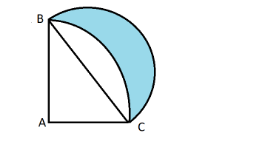
In the question, we are given that the radius of the quadrant is $ 14\;cm $ . So,
$ AB = AC = 14\;cm $ .
So, the area of triangle ABC
$ = \dfrac{{\left( {b \times h} \right)}}{2} = \dfrac{{\left( {14 \times 14} \right)}}{2} = 98\,c{m^2} $
Area of a quadrant of circle $ = \dfrac{{\pi {r^2}}}{4} = \dfrac{1}{4} \times \dfrac{{22}}{7} \times 14 \times 14 $
$ \Rightarrow 11 \times 14 $
$ \Rightarrow 154\,c{m^2} $
Using Pythagoras theorem, we know that $ {\left( {Hypotenuse} \right)^2} = {\left( {Altitude} \right)^2} + {\left( {Base} \right)^2} $ . Applying Pythagoras theorem in $ \Delta ABC $ , we get,
$ \Rightarrow {\left( {BC} \right)^2} = {\left( {AB} \right)^2} + {\left( {AC} \right)^2} $
$ \Rightarrow {\left( {BC} \right)^2} = {\left( {14} \right)^2} + {\left( {14} \right)^2} $
Calculating the squares and simplifying further, we get,
$ \Rightarrow {\left( {BC} \right)^2} = 196 + 196 $
$ \Rightarrow {\left( {BC} \right)^2} = 392 $
$ \Rightarrow BC = \sqrt {392} $
Simplifying the square root,
$ \Rightarrow BC = 14\sqrt 2 \,cm $
So, the length of hypotenuse of the right angled triangle is $ 14\sqrt 2 \,cm $ .
So, Diameter of the semicircle $ = 14\sqrt 2 \,cm $
So, the radius of the semicircle is $ 7\,cm $ .
Now, the area of semicircle $ = \dfrac{{\pi {r^2}}}{2} = \dfrac{1}{2} \times \dfrac{{22}}{7} \times 7 \times 7 $
$ \Rightarrow 11 \times 7 $
$ \Rightarrow 77\,c{m^2} $
Hence, area of shaded region $ = \,\left( {Area\,of\,Semicircle} \right)\, + \,\left( {Area\,of\,\Delta ABC} \right)\, - \,\left( {Area\,of\,quadrant} \right) $
$ \Rightarrow \,\left( {77\,c{m^2}} \right)\, + \,\left( {98\,c{m^2}} \right)\, - \,\left( {154\,c{m^2}} \right) $
$ \Rightarrow \,21\,c{m^2} $
So, the area of the shaded region is $ \,21\,c{m^2} $ .
So, the correct answer is “ $ \,21\,c{m^2} $ ”.
Note: Such problems that require us to find the area of figures relating circles, triangles and any other shape can be solved easily using analytical, logical and critical thinking along with the use of appropriate formulae for finding the area of the shapes in the figure given to us.
Complete step by step solution:
In the question, we are given that the radius of the quadrant is $ 14\;cm $ . So,
$ AB = AC = 14\;cm $ .
So, the area of triangle ABC
$ = \dfrac{{\left( {b \times h} \right)}}{2} = \dfrac{{\left( {14 \times 14} \right)}}{2} = 98\,c{m^2} $
Area of a quadrant of circle $ = \dfrac{{\pi {r^2}}}{4} = \dfrac{1}{4} \times \dfrac{{22}}{7} \times 14 \times 14 $
$ \Rightarrow 11 \times 14 $
$ \Rightarrow 154\,c{m^2} $
Using Pythagoras theorem, we know that $ {\left( {Hypotenuse} \right)^2} = {\left( {Altitude} \right)^2} + {\left( {Base} \right)^2} $ . Applying Pythagoras theorem in $ \Delta ABC $ , we get,
$ \Rightarrow {\left( {BC} \right)^2} = {\left( {AB} \right)^2} + {\left( {AC} \right)^2} $
$ \Rightarrow {\left( {BC} \right)^2} = {\left( {14} \right)^2} + {\left( {14} \right)^2} $
Calculating the squares and simplifying further, we get,
$ \Rightarrow {\left( {BC} \right)^2} = 196 + 196 $
$ \Rightarrow {\left( {BC} \right)^2} = 392 $
$ \Rightarrow BC = \sqrt {392} $
Simplifying the square root,
$ \Rightarrow BC = 14\sqrt 2 \,cm $
So, the length of hypotenuse of the right angled triangle is $ 14\sqrt 2 \,cm $ .
So, Diameter of the semicircle $ = 14\sqrt 2 \,cm $
So, the radius of the semicircle is $ 7\,cm $ .
Now, the area of semicircle $ = \dfrac{{\pi {r^2}}}{2} = \dfrac{1}{2} \times \dfrac{{22}}{7} \times 7 \times 7 $
$ \Rightarrow 11 \times 7 $
$ \Rightarrow 77\,c{m^2} $
Hence, area of shaded region $ = \,\left( {Area\,of\,Semicircle} \right)\, + \,\left( {Area\,of\,\Delta ABC} \right)\, - \,\left( {Area\,of\,quadrant} \right) $
$ \Rightarrow \,\left( {77\,c{m^2}} \right)\, + \,\left( {98\,c{m^2}} \right)\, - \,\left( {154\,c{m^2}} \right) $
$ \Rightarrow \,21\,c{m^2} $
So, the area of the shaded region is $ \,21\,c{m^2} $ .
So, the correct answer is “ $ \,21\,c{m^2} $ ”.
Note: Such problems that require us to find the area of figures relating circles, triangles and any other shape can be solved easily using analytical, logical and critical thinking along with the use of appropriate formulae for finding the area of the shapes in the figure given to us.

Recently Updated Pages
Master Class 8 Social Science: Engaging Questions & Answers for Success

Master Class 8 English: Engaging Questions & Answers for Success
Class 8 Question and Answer - Your Ultimate Solutions Guide
Master Class 8 Maths: Engaging Questions & Answers for Success
Master Class 8 Science: Engaging Questions & Answers for Success
Master Class 7 English: Engaging Questions & Answers for Success
Trending doubts
What is BLO What is the full form of BLO class 8 social science CBSE
Citizens of India can vote at the age of A 18 years class 8 social science CBSE
Full form of STD, ISD and PCO
Advantages and disadvantages of science
Right to vote is a AFundamental Right BFundamental class 8 social science CBSE
What are the 12 elements of nature class 8 chemistry CBSE