



In the given figure AB and CD are respectively the smallest and largest side of a quadrilateral ABCD. Show that$\angle A > \angle C$ and $\angle B > \angle D$.
Answer
 Verified
614.1k+ views
Hint: Solve this problem by using the theorem of triangle that is opposite angle of longest side is always greater and angle opposite to the shortest side is always shorter.
Complete Step-by-step Solution
Given:
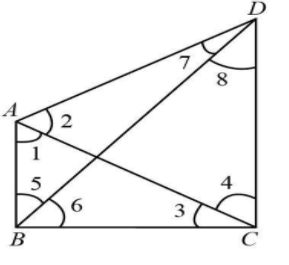
In quadrilateral ABCD, AB and CD are respectively the smallest and largest side of quadrilateral.
From the figure consider$\Delta ABC$, where AB is the shortest side of the triangle. So the angle opposite to the side will be shortest between all angles.
Angle opposite to the side AB is $\angle 3$ and angle opposite to the side BC is $\angle 1$.
$\begin{array}{l}
AB < BC\\
\angle 3 < \angle 1
\end{array}$……....(1)
In$\Delta ADC$, AD is the longest side of the triangle and rest sides are shorter than AD. So the angle opposite to the side will be largest between all angles.
Angle opposite to the side AD is $\angle 4$ and angle opposite to the side CD is $\angle 2$.
$\begin{array}{l}
CD > AD\\
\angle 2 > \angle 4
\end{array}$……..(2)
On adding both the equations (1) and (2), we get the values as,
$\begin{array}{l}
\angle 3 + \angle 4 < \angle 1 + \angle 2\\
\angle C < \angle A\,{\rm{or}}\,\angle A > \angle C
\end{array}$
Now, we are considering the triangles $\Delta ABD$ and $\Delta BCD$.
In triangle $\Delta ABD$, we have,
$\begin{array}{l}
AD > AB\\
\angle 5 > \angle 6
\end{array}$ ……(3)
In triangle $\Delta BCD$, we have,
$\begin{array}{l}
CD > BC\\
\angle 7 > \angle 8
\end{array}$ …...(4)
On adding the equations (3) and (4), we get the values as,
$\begin{array}{c}
\angle 5 + \angle 7 > \angle 6 + \angle 8\\
\angle B > \angle D
\end{array}$
Therefore, it is proved that $\angle B > \angle D$ and $\angle A > \angle C$.
Note: The important point to solve the problem is that while choosing the other side of triangle make sure the side chosen by you is opposite to that angle which have to be proved in question.
Complete Step-by-step Solution
Given:
In quadrilateral ABCD, AB and CD are respectively the smallest and largest side of quadrilateral.
From the figure consider$\Delta ABC$, where AB is the shortest side of the triangle. So the angle opposite to the side will be shortest between all angles.
Angle opposite to the side AB is $\angle 3$ and angle opposite to the side BC is $\angle 1$.
$\begin{array}{l}
AB < BC\\
\angle 3 < \angle 1
\end{array}$……....(1)
In$\Delta ADC$, AD is the longest side of the triangle and rest sides are shorter than AD. So the angle opposite to the side will be largest between all angles.
Angle opposite to the side AD is $\angle 4$ and angle opposite to the side CD is $\angle 2$.
$\begin{array}{l}
CD > AD\\
\angle 2 > \angle 4
\end{array}$……..(2)
On adding both the equations (1) and (2), we get the values as,
$\begin{array}{l}
\angle 3 + \angle 4 < \angle 1 + \angle 2\\
\angle C < \angle A\,{\rm{or}}\,\angle A > \angle C
\end{array}$
Now, we are considering the triangles $\Delta ABD$ and $\Delta BCD$.
In triangle $\Delta ABD$, we have,
$\begin{array}{l}
AD > AB\\
\angle 5 > \angle 6
\end{array}$ ……(3)
In triangle $\Delta BCD$, we have,
$\begin{array}{l}
CD > BC\\
\angle 7 > \angle 8
\end{array}$ …...(4)
On adding the equations (3) and (4), we get the values as,
$\begin{array}{c}
\angle 5 + \angle 7 > \angle 6 + \angle 8\\
\angle B > \angle D
\end{array}$
Therefore, it is proved that $\angle B > \angle D$ and $\angle A > \angle C$.
Note: The important point to solve the problem is that while choosing the other side of triangle make sure the side chosen by you is opposite to that angle which have to be proved in question.

Recently Updated Pages
Master Class 10 Computer Science: Engaging Questions & Answers for Success

Master Class 10 General Knowledge: Engaging Questions & Answers for Success
Master Class 10 English: Engaging Questions & Answers for Success
Master Class 10 Social Science: Engaging Questions & Answers for Success
Master Class 10 Maths: Engaging Questions & Answers for Success
Master Class 10 Science: Engaging Questions & Answers for Success
Trending doubts
Find the sum of series 1 + 2 + 3 + 4 + 5 + + 100 class 9 maths CBSE
Fill the blanks with the suitable prepositions 1 The class 9 english CBSE
Difference Between Plant Cell and Animal Cell
What is the Full Form of ICSE / ISC ?
What is pollution? How many types of pollution? Define it
Name 10 Living and Non living things class 9 biology CBSE