




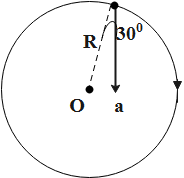
In the given figure \[a=15\dfrac{m}{{{s}^{2}}}\] represents the total acceleration of particle moving in the clockwise direction in a circle of radius R = 2.5 m at a given instant of time. If the square of the speed of the particle is \[\dfrac{75\sqrt{3}}{n}\dfrac{{{m}^{2}}}{{{s}^{2}}}\]. Then write the value of n.
Answer
 Verified
645.9k+ views
Hint: This is a direct question. Using the centripetal acceleration formula, we can solve this problem, as we can obtain the expression for the velocity, as the product of the radius of the circle and the total acceleration of the particle. As these values are given, so, substituting these values, we will find the value of n.
Formula used:
\[{{a}_{C}}=\dfrac{{{V}^{2}}}{R}\]
Complete step by step answer:
The formula that relates the centripetal acceleration, the velocity of the particle and the radius of the circle is given as follows.
\[{{a}_{C}}=\dfrac{{{V}^{2}}}{R}\]
From the data, we have the data as follows.
The total acceleration of the particle moving in the clockwise direction is, \[a=15\dfrac{m}{{{s}^{2}}}\]
The radius of the circle is, R = 2.5 m
The square of the speed of the particle is,\[{{v}^{2}}=\dfrac{75\sqrt{3}}{n}\dfrac{{{m}^{2}}}{{{s}^{2}}}\].
Consider the diagram while going through the calculation.
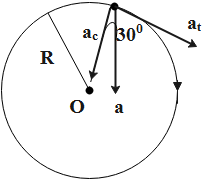
The above figure represents the centripetal acceleration and the tangential acceleration, the components of the acceleration of the particle.
The centripetal acceleration of the particle is given as follows.
\[{{a}_{C}}=a\cos 30{}^\circ \]
Substitute the given values in the above equation.
\[\dfrac{{{V}^{2}}}{R}=a\cos 30{}^\circ \]
\[\dfrac{{{V}^{2}}}{2.5}=15\cos 30{}^\circ \]
Continue the further calculation.
\[\begin{align}
& {{v}^{2}}=2.5\times 15\cos 30{}^\circ \\
& {{v}^{2}}=\dfrac{2.5\times 15\times \sqrt{3}}{2} \\
& \Rightarrow {{v}^{2}}=\dfrac{75\sqrt{3}}{4} \\
\end{align}\]
Compare this obtained value of the square of the speed of the particle with the given value of the square of the speed of the particle. So, we get,
\[\dfrac{75\sqrt{3}}{n}=\dfrac{75\sqrt{3}}{4}\]
Cancel out the common terms.
\[n=4\]
Therefore, the value of the n is 4.
Note:
The units of the parameters should be taken care of. The main point to remember while solving such problems is the components of the acceleration of the particle, that is, the centripetal acceleration and the tangential acceleration. The formula that relates the centripetal acceleration with the velocity of the particle should also be known. In this case, the value of n is asked. Even, they can directly ask for the value of the velocity of the particle.
Formula used:
\[{{a}_{C}}=\dfrac{{{V}^{2}}}{R}\]
Complete step by step answer:
The formula that relates the centripetal acceleration, the velocity of the particle and the radius of the circle is given as follows.
\[{{a}_{C}}=\dfrac{{{V}^{2}}}{R}\]
From the data, we have the data as follows.
The total acceleration of the particle moving in the clockwise direction is, \[a=15\dfrac{m}{{{s}^{2}}}\]
The radius of the circle is, R = 2.5 m
The square of the speed of the particle is,\[{{v}^{2}}=\dfrac{75\sqrt{3}}{n}\dfrac{{{m}^{2}}}{{{s}^{2}}}\].
Consider the diagram while going through the calculation.
The above figure represents the centripetal acceleration and the tangential acceleration, the components of the acceleration of the particle.
The centripetal acceleration of the particle is given as follows.
\[{{a}_{C}}=a\cos 30{}^\circ \]
Substitute the given values in the above equation.
\[\dfrac{{{V}^{2}}}{R}=a\cos 30{}^\circ \]
\[\dfrac{{{V}^{2}}}{2.5}=15\cos 30{}^\circ \]
Continue the further calculation.
\[\begin{align}
& {{v}^{2}}=2.5\times 15\cos 30{}^\circ \\
& {{v}^{2}}=\dfrac{2.5\times 15\times \sqrt{3}}{2} \\
& \Rightarrow {{v}^{2}}=\dfrac{75\sqrt{3}}{4} \\
\end{align}\]
Compare this obtained value of the square of the speed of the particle with the given value of the square of the speed of the particle. So, we get,
\[\dfrac{75\sqrt{3}}{n}=\dfrac{75\sqrt{3}}{4}\]
Cancel out the common terms.
\[n=4\]
Therefore, the value of the n is 4.
Note:
The units of the parameters should be taken care of. The main point to remember while solving such problems is the components of the acceleration of the particle, that is, the centripetal acceleration and the tangential acceleration. The formula that relates the centripetal acceleration with the velocity of the particle should also be known. In this case, the value of n is asked. Even, they can directly ask for the value of the velocity of the particle.
Recently Updated Pages
If x a + bt + ct2 where x is in meters and t is in class 11 physics CBSE

A car covers the first half distance between two places class 11 physics CBSE
The resultant of two vectors overrightarrow P and overrightarrow class 11 physics CBSE
Find the value of cos 135 class 11 maths CBSE
A mass M is held in place by an applied force F and class 11 physics CBSE
A solution of glucose in water is labelled as 10 dfracwv class 11 chemistry CBSE
Trending doubts
One Metric ton is equal to kg A 10000 B 1000 C 100 class 11 physics CBSE
Find the value of the expression given below sin 30circ class 11 maths CBSE
What do you mean by retardation What is its SI uni class 11 physics CBSE
Draw a diagram of nephron and explain its structur class 11 biology CBSE
10 examples of friction in our daily life
Difference between physical and chemical change class 11 chemistry CBSE