




In the given figure a diode D is connected to an external resistance $R = 100\Omega $and an emf of $3.5V$. If the barrier potential developed across the diode is $0.5V$, the current in the circuit will be
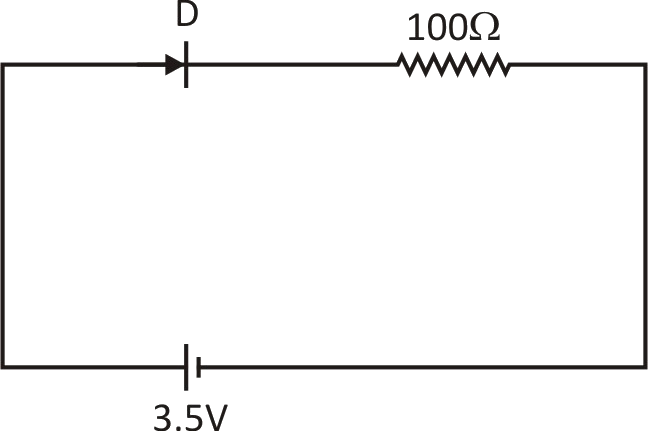
A. $35mA$
B. $30mA$
C. $40mA$
D. $20mA$
Answer
 Verified
569.7k+ views
Hint: potential across diode is given it means diode has some internal resistance use kirchhoff's voltage law or KVL to find the current in the circuit( Remember in forward biased diode do not oppose the current so it will acts as a plane wire but due to some internal resistance of the diode we may see some potential difference across it).
Complete step by step answer:
Let current in the circuit be $Ampere$ and
Internal resistance of the diode is $R\Omega $
Now total resistance of the circuit will be sum of external resistance and internal resistance of the diode
Therefore,${R_{total}} = (R + 100)$
Now we will use ohm's law across whole circuit and across diode
For diode
We have ${V_{diode}} = 0.5 = IR$
For whole circuit
We have ${V_{total}} = 3.5 = I(R + 100)$
$ \Rightarrow 3.5 = IR + I \times 100$
Putting value of IR from the potential equation of diode
We have ,
$
3.5 = 0.5 + I \times 100 \\
\Rightarrow I = \dfrac{{3.5 - 0.5}}{{100}} = \dfrac{2}{{100}} = 20 \times {10^{ - 3}} \\
$
Or $I = 20mA$
So, the correct answer is “Option D”.
Note:
Sometimes students are scared just looking at the diode because they understand the diode properly in most cases but even if you do not understand it properly if you look at the type of bias it becomes like a normal circuit if its its forward biased treat diode as a plane wire with some internal resistance and if its reverse biased treat it as a open wire.
Complete step by step answer:
Let current in the circuit be $Ampere$ and
Internal resistance of the diode is $R\Omega $
Now total resistance of the circuit will be sum of external resistance and internal resistance of the diode
Therefore,${R_{total}} = (R + 100)$
Now we will use ohm's law across whole circuit and across diode
For diode
We have ${V_{diode}} = 0.5 = IR$
For whole circuit
We have ${V_{total}} = 3.5 = I(R + 100)$
$ \Rightarrow 3.5 = IR + I \times 100$
Putting value of IR from the potential equation of diode
We have ,
$
3.5 = 0.5 + I \times 100 \\
\Rightarrow I = \dfrac{{3.5 - 0.5}}{{100}} = \dfrac{2}{{100}} = 20 \times {10^{ - 3}} \\
$
Or $I = 20mA$
So, the correct answer is “Option D”.
Note:
Sometimes students are scared just looking at the diode because they understand the diode properly in most cases but even if you do not understand it properly if you look at the type of bias it becomes like a normal circuit if its its forward biased treat diode as a plane wire with some internal resistance and if its reverse biased treat it as a open wire.
Recently Updated Pages
Master Class 12 Economics: Engaging Questions & Answers for Success

Master Class 12 Physics: Engaging Questions & Answers for Success
Master Class 12 English: Engaging Questions & Answers for Success
Master Class 12 Social Science: Engaging Questions & Answers for Success
Master Class 12 Maths: Engaging Questions & Answers for Success
Master Class 12 Business Studies: Engaging Questions & Answers for Success
Trending doubts
Which are the Top 10 Largest Countries of the World?
What are the major means of transport Explain each class 12 social science CBSE
Draw a labelled sketch of the human eye class 12 physics CBSE
Differentiate between insitu conservation and exsitu class 12 biology CBSE
Draw a neat and well labeled diagram of TS of ovary class 12 biology CBSE
Give 10 examples of unisexual and bisexual flowers