



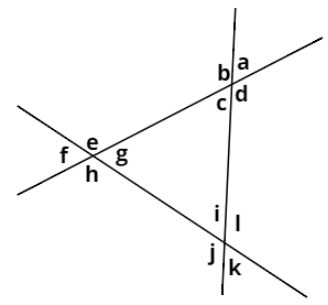
In the given figure ${\text{a, b, c, d,}}...$ are measures of respective angles as shown. If $g = {90^ \circ }$, what is ${\text{a + k}}$?
A. 135
B. 45
C. 90
D. 60
Answer
 Verified
612.6k+ views
Hint: Consider the triangle with angles ${\text{g, i and c}}$ in the figure. Use the property that the sum of angles in a triangle is ${180^ \circ }$. And then apply the property of opposite angles.
Complete step by step answer:
We know that the sum of angles in a triangle is ${180^ \circ }$. So from the figure, in triangle with angles ${\text{g, i and c}}$, we have:
$ \Rightarrow g + i + c = {180^ \circ }$
According to the question $g = {90^ \circ }$. Putting its value above, we’ll get:
$
\Rightarrow {90^ \circ } + i + c = {180^ \circ } \\
\Rightarrow i + c = {90^ \circ } .....(i) \\
$
Again from figure, angles $i$ and $k$ are opposite angles. Thus they will be equal in measure.
$ \Rightarrow i = k$
Same is the case with $a$ and $c$ also. So, we have:
$ \Rightarrow c = a$
Putting $i = k$ and $c = a$ in equation $(i)$, we’ll get:
$ \Rightarrow k + a = {90^ \circ }$
Hence the value of ${\text{a + k}}$ is ${90^ \circ }$.
Note: The sum of the angles in an n sided polygon is given by the formula:
$ \Rightarrow $ Sum of angles $ = \left( {n - 2} \right) \times {180^ \circ }$.
If it is a triangle then $n = 3$ and the sum of angles is ${180^ \circ }$.
Complete step by step answer:
We know that the sum of angles in a triangle is ${180^ \circ }$. So from the figure, in triangle with angles ${\text{g, i and c}}$, we have:
$ \Rightarrow g + i + c = {180^ \circ }$
According to the question $g = {90^ \circ }$. Putting its value above, we’ll get:
$
\Rightarrow {90^ \circ } + i + c = {180^ \circ } \\
\Rightarrow i + c = {90^ \circ } .....(i) \\
$
Again from figure, angles $i$ and $k$ are opposite angles. Thus they will be equal in measure.
$ \Rightarrow i = k$
Same is the case with $a$ and $c$ also. So, we have:
$ \Rightarrow c = a$
Putting $i = k$ and $c = a$ in equation $(i)$, we’ll get:
$ \Rightarrow k + a = {90^ \circ }$
Hence the value of ${\text{a + k}}$ is ${90^ \circ }$.
Note: The sum of the angles in an n sided polygon is given by the formula:
$ \Rightarrow $ Sum of angles $ = \left( {n - 2} \right) \times {180^ \circ }$.
If it is a triangle then $n = 3$ and the sum of angles is ${180^ \circ }$.

Recently Updated Pages
Master Class 12 Business Studies: Engaging Questions & Answers for Success

Master Class 12 Chemistry: Engaging Questions & Answers for Success
Master Class 12 Biology: Engaging Questions & Answers for Success
Class 12 Question and Answer - Your Ultimate Solutions Guide
Complete reduction of benzene diazonium chloride with class 12 chemistry CBSE
How can you identify optical isomers class 12 chemistry CBSE
Trending doubts
What is BLO What is the full form of BLO class 8 social science CBSE
Citizens of India can vote at the age of A 18 years class 8 social science CBSE
Full form of STD, ISD and PCO
Convert 40circ C to Fahrenheit A 104circ F B 107circ class 8 maths CBSE
Advantages and disadvantages of science
Right to vote is a AFundamental Right BFundamental class 8 social science CBSE